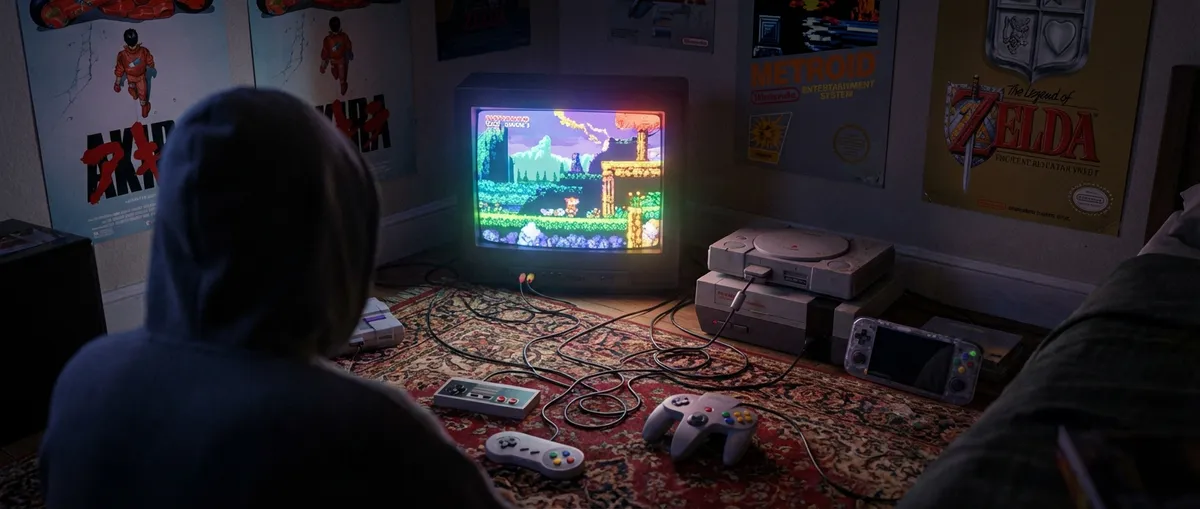
Everyone keeps talking about the next big release, but meanwhile millions of people are still logging into games that came out 5, 10, even 20 years ago. On paper, this makes no sense: better graphics, faster hardware, more online features… and yet we keep going back to the same digital comfort food.
What’s going on under the hood is way more interesting than nostalgia. There’s a whole stack of modern tech quietly keeping older games alive, sharper, smoother, and more fun than they ever were at launch. Let’s dig into a few reasons “old” games refuse to die—and why tech enthusiasts should absolutely be paying attention.
1. Community Mods Turn Finished Games Into Living Projects
Ask any PC gamer why they still play certain classics, and you’ll hear one word a lot: mods.
Modding used to mean digging through weird forums, manually unzipping files, and hoping your game didn’t explode on launch. Now it’s closer to an app ecosystem. Platforms like Steam Workshop and mod hubs make it basically one-click to add new maps, graphics packs, weapons, or entire game modes.
What’s interesting from a tech angle is how this extends a game’s architecture way beyond what the original devs planned. Players:
- Patch old bugs that studios never got around to fixing
- Build upscalers and shader mods for better visuals
- Add accessibility features the game never shipped with
- Create entirely new content loops (speedrun modes, roguelike variants, survival mechanics)
In some cases, the mod scene becomes so powerful it shapes the official version of the game. Developers now sometimes design with modding in mind, exposing tools or scripting hooks so the community can tinker without breaking everything. It’s like giving your game a built-in R&D lab powered by thousands of hobbyists.
The result: a game that technically launched years ago but evolves like a live service—without the battle pass drama.
2. AI Upscaling and Frame Tech Quietly Rewrite What “Old” Looks Like
If you’ve ever loaded up an older game on a modern monitor and winced at the blurry textures, there’s good news: the AI is on it.
Visual upgrade tech has gotten wild:
- AI upscalers can take old textures and sharpen them using machine learning, so walls and faces don’t look like smeared paint.
- Upscaling tools like DLSS, FSR, and XeSS render frames at a lower resolution, then reconstruct them at higher resolutions on the fly, making older titles run smoother while still looking crisp.
- Fan-made texture packs use neural networks to generate high-res art from old, low-res assets.
What’s cool here isn’t just “prettier graphics.” It’s that hardware and software advances are retroactively improving games that were never designed for them. A game built for 1080p and 60 fps can suddenly feel right at home on a 4K 144 Hz monitor with almost no dev effort—sometimes just a config tweak or a fan patch.
Games don’t age the way they used to. They just quietly level up alongside your GPU.
3. Input Tech Turned Clunky Controls Into Comfort Food
Pick up a controller from 2001 and it feels like a fossil compared to today’s gear. But the inverse is also true: play an older game with modern hardware and the whole experience changes.
Several under-the-radar upgrades help older titles feel right again:
- High-refresh monitors make older fast-paced games feel silky smooth, especially when they can now run at 120+ fps.
- Modern controllers (with better sticks, precise triggers, and haptics) make clunky movement and camera systems feel more forgiving.
- Input adapters let you use your favorite controller on almost anything—retro consoles, PCs, handhelds—so muscle memory stays intact.
- Low-latency tech (from gaming TVs and monitors to controller firmware) reduces that mushy “laggy” feeling we used to just accept.
There’s a comfort in revisiting older games, but there’s also a subtle layer of modern ergonomics making them easier on your hands, eyes, and nerves. The code’s from 2010; the feel is very 2026.
4. Cloud and Handhelds Let “Big” Games Go Anywhere
Once upon a time, there were “PC games” and “console games,” and that was that. Now? You can be on a train playing a 2015 open-world monster of a game on a handheld, or streaming a 2018 AAA title to a cheap laptop.
A few shifts made this possible:
- Cloud gaming streams the heavy lifting from big servers, so your underpowered device just displays the result.
- Portable PCs and handhelds (think Steam Deck–style devices) run older titles incredibly well because those games were built for lower system requirements.
- Cross-save and cloud sync let you start on one device and pick up exactly where you left off on another, without juggling manual save files.
The funny part: a lot of “new hardware” is actually perfect for old software. Games that struggled on mid-range rigs at launch suddenly feel tailored for portable devices and modest cloud setups. There’s a whole second life cycle happening where yesterday’s “hardware-pushing beast” is today’s perfect commute companion.
5. Preservation Tech Is Quietly Becoming a Big Deal
Behind all the shiny remasters and rereleases, there’s a more serious conversation: What happens when games disappear?
Unlike music or books, games depend on:
- Servers that can be shut down
- Operating systems that move on
- DRM systems that stop working
- Hardware that eventually dies
To keep games playable, a lot of under-the-radar tech and policy work is happening:
- Emulators recreate old consoles and systems in software so classic games can still run on modern machines.
- Compatibility layers (like Proton and Wine) let games built for one platform run on another without major rewrites.
- Game preservation efforts by libraries, museums, and nonprofits are pushing for safe archiving and legal protection for older titles.
For tech enthusiasts, this is a fascinating problem: how do you preserve something that’s half software, half ecosystem? The solutions—emulation, virtualization, smart legal carve-outs—end up helping everyone who wants their favorite game to still work in 10 years.
The irony is that some of the most “cutting-edge” moves in gaming right now aren’t about the next generation—they’re about making sure the last few generations don’t vanish.
Conclusion
The idea that games have an expiration date is starting to look outdated. Between AI-powered visuals, slick input tech, modding communities, cloud tricks, and serious preservation work, older games aren’t just “still around”—they’re actively evolving.
For gamers, that means your favorite title from years ago is probably better now than when you first played it. For tech fans, it’s a living case study in how software, hardware, and communities interact over time.
New releases will always grab headlines. But in the background, a quiet revolution is making sure the games we already love keep up with the tech we keep upgrading—and that might be the most exciting upgrade of all.
Sources
- [Steam Workshop](https://store.steampowered.com/workshop/) – Official hub for community-made content and mods on Steam
- [NVIDIA DLSS: Deep Learning Super Sampling](https://www.nvidia.com/en-us/geforce/technologies/dlss/) – Overview of AI-powered upscaling and how it boosts game performance and visuals
- [Microsoft: Xbox Cloud Gaming (Beta)](https://www.xbox.com/en-US/cloud-gaming) – Explains how cloud streaming lets games run on lower-powered devices
- [Internet Archive – Software Library: Console Living Room](https://archive.org/details/consolelivingroom) – Example of game preservation and emulation efforts for older systems
- [Library of Congress – Preserving Virtual Worlds Final Report](https://www.loc.gov/programs/national-digital-information-infrastructure-and-preservation-program/resources/preserving-virtual-worlds/) – Research on long-term preservation challenges for digital games and virtual worlds
Key Takeaway
The most important thing to remember from this article is that this information can change how you think about Gaming.