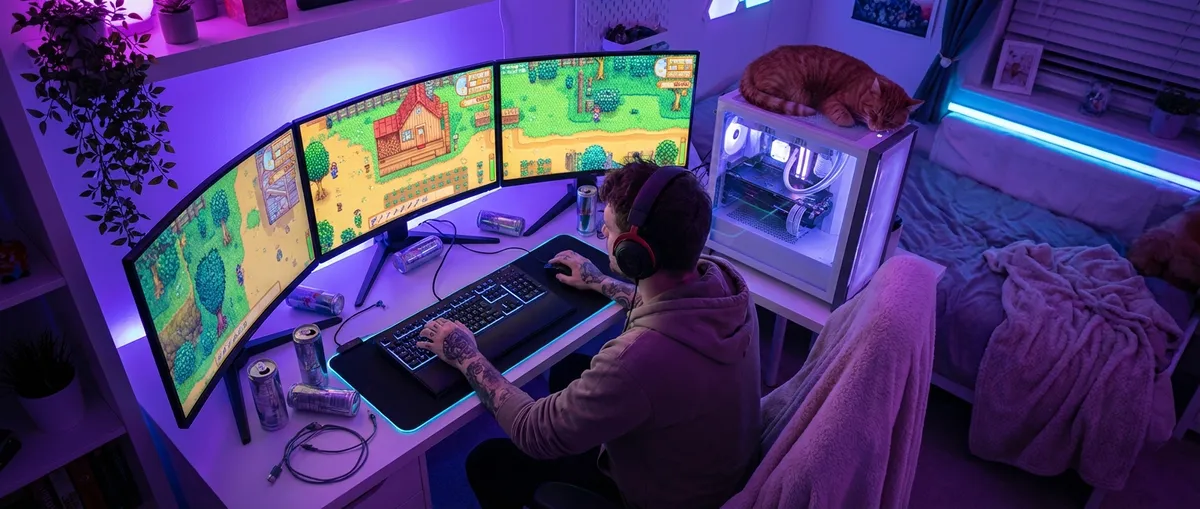
Cozy games look harmless. Soft colors, chill music, zero pressure. But under that blanket of vibes, there’s a surprising amount of smart tech, clever design, and hidden complexity that even hardcore gamers and tech enthusiasts can appreciate.
If you’ve ever dismissed games like Stardew Valley, Animal Crossing, or Disney Dreamlight Valley as “cute but shallow,” it might be time to zoom in. There’s more going on under the hood than you think.
Below are five angles on cozy gaming that hit that sweet spot between relaxing and nerdy.
1. Chill on the Surface, Min-Max Underneath
Cozy games are the only place where you can both sip tea and secretly optimize crop layouts like you’re running a logistics startup.
On the outside, it’s all: “Plant some turnips, talk to a cat, watch the sunset.” Underneath, there’s math everywhere: growth timers, weather cycles, resource spawn rates, crafting chains, and layout efficiency. If you’re the type who tweaks fan curves on your GPU, you’ll eventually find yourself spreadsheeting the perfect fishing route or optimal farm grid.
Developers know this. They design systems that can be played casually but also reward people who obsess over tiny details. It’s optional complexity: the game never demands optimization, but it quietly supports it. That balance keeps cozy games approachable for beginners while still scratching the systems-brain itch for power users.
2. Low-Stress, High-Loop: Why They’re So Replayable
Cozy games are basically feedback loop machines wrapped in wholesome packaging.
You do small things: water plants, feed animals, craft one more thing before bed. Each tiny action gives you immediate micro-rewards—visual changes, cute sounds, or social progress with NPCs. Then long-term loops kick in: new areas unlock, your house upgrades, festivals appear, relationships grow.
Because there’s no big “game over” or punishing fail state, your brain treats everything as a gentle nudge to keep going instead of a threat. The loop becomes: “I’m not grinding, I’m just tidying my virtual life.” You get the satisfaction of progress without the stress spikes of competitive games. For anyone who likes optimizing their real-world workflows, it’s like project management—but with more ducks and fewer emails.
3. Cozy Doesn’t Mean Simple: The Tech Making It Feel Alive
A lot of cozy games rely on quietly clever tech to feel… well, cozy.
Dynamic time-of-day lighting makes a town feel different at sunrise vs. midnight. Subtle weather systems change not just the look, but what activities make sense: rainy days push you into caves, sunny ones nudge you toward the beach. NPCs run on behavior schedules that simulate routines—going to work, heading to the bar, fishing on weekends—making the world feel less like a stage and more like a place.
Even on weaker hardware (Switch, Steam Deck, older laptops), these games use smart tricks: low-poly art, stylized shaders, and clever asset reuse. It’s tech minimalism with intention—more about mood than realism. For people who appreciate good engineering, it’s fun to spot how devs squeeze atmosphere out of limited resources while staying buttery smooth.
4. Hidden Social Engineering: Designing for Kindness
Cozy games aren’t just relaxing; they’re basically social experiments in making people behave nicer.
Instead of leaderboards and K/D ratios, they nudge you toward cooperation and care. You help villagers, decorate shared spaces, send gifts, trade items, or visit friends’ islands. There’s rarely a way to “dominate” someone else—most systems are built around collaboration, not competition.
Even small design choices matter: no global chat toxicity, no voice comms screaming, and very few zero-sum scenarios. When conflict does exist, it’s usually between you and time, not you and other humans. It’s social tech design flipped on its head—less “who’s the best” and more “how can we make this town less ugly together?”
For anyone burned out by sweaty ranked lobbies, this is a very intentional alternative reality.
5. The Perfect Testbed for New Hardware and Play Styles
Cozy games might look small, but they’re quietly great stress tests for new tech and toys.
Steam Deck, handheld PCs, cloud gaming, and phone controllers all love cozy titles. These games are ideal because they don’t need pinpoint reflexes or ultra-low latency. You can play them at 30–40 FPS on a handheld and still have a great time. That makes them perfect for testing battery life, screen quality, comfort, and input setups without getting destroyed by enemies while you experiment.
They’re also ideal for second-screen or “half-attention” gaming: play while watching YouTube, listening to podcasts, or chatting on Discord. From a tech perspective, they’re flexible, modular experiences that fit into your setup instead of dominating it. For enthusiasts always tweaking their environment, cozy games are like the friendly benchmark tool you actually want to keep running.
Conclusion
Cozy games aren’t just digital comfort food. They’re low-pressure sandboxes built on surprisingly smart systems, subtle tech, and kind social design.
If you’re a tech nerd who likes tinkering, optimizing, or experimenting with new gear, they give you plenty to chew on—without popping a vein over ranked matches or frame-perfect combos.
Next time you see pastel graphics and relaxed music, don’t write it off. Under that soft exterior, there’s a whole lot of brain candy waiting if you decide to dig in.
Sources
- [GDC Talk: The Making of Stardew Valley](https://www.gdcvault.com/play/1024690/Approaching-Indie-Game-Development-The) – Eric Barone’s breakdown of design choices and systems behind Stardew Valley
- [Nintendo – Animal Crossing: New Horizons Overview](https://www.nintendo.com/us/store/products/animal-crossing-new-horizons-switch/) – Official page outlining core mechanics and social features
- [Valve – Steam Deck Developer Documentation](https://partner.steamgames.com/doc/steamdeck) – Technical details on how games are optimized and tested for handheld play
- [Microsoft Game Dev – Designing Games for Accessibility](https://learn.microsoft.com/en-us/gaming/accessibility/) – Explores design principles often adopted by cozy games to reduce friction and stress
- [Stanford – The Psychology of Immersion in Video Games](https://web.stanford.edu/group/htgg/sts145papers/psiu.pdf) – Academic look at the psychological hooks and feedback loops that make games engaging
Key Takeaway
The most important thing to remember from this article is that this information can change how you think about Gaming.