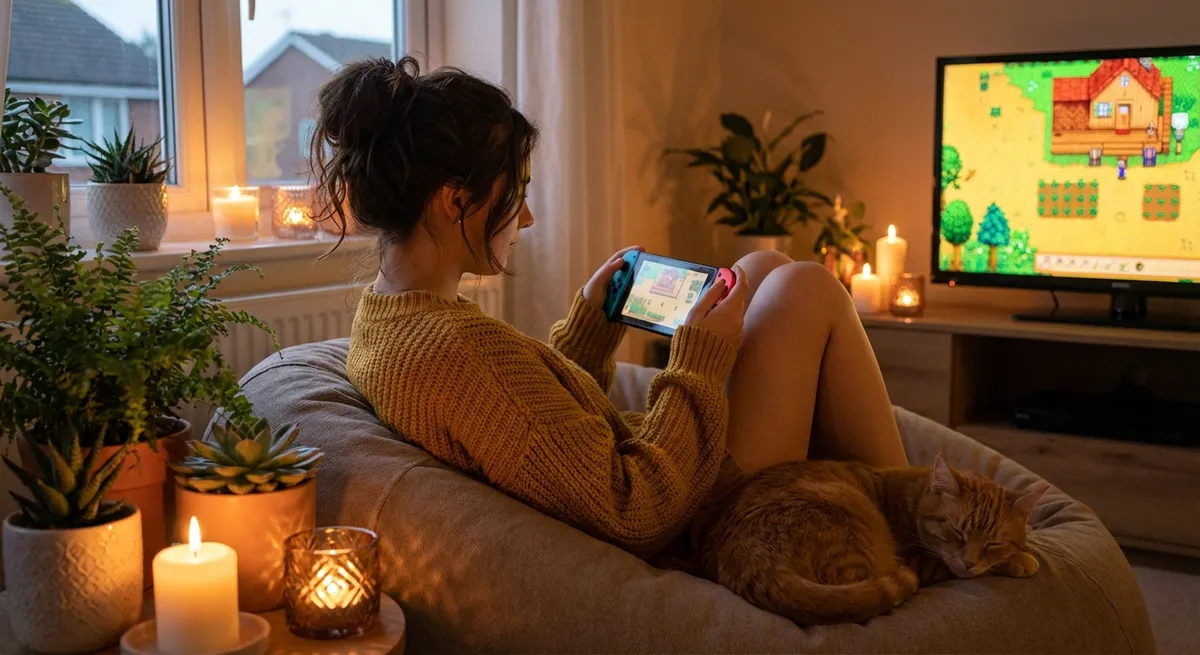
There’s a weird shift happening in gaming right now. Not in graphics, not in frame rates, not even in battle royale lobbies—but in vibes. More people are trading sweaty competitive matches for games about watering plants, running tiny cafés, or just…vibing on a virtual farm. And it’s not just a trend; there’s real tech, psychology, and design thinking behind it.
Let’s talk about why calm, low-stress “cozy games” are blowing up—and why tech nerds should absolutely be paying attention.
The Rise of “Low-Stress Mode” Gaming
You’ve probably noticed it: games with soft color palettes, gentle music, and zero pressure to “git gud” are everywhere.
Part of this is timing. During and after the pandemic, people started using games less like a competitive sport and more like a digital hangout or comfort blanket. Titles like Animal Crossing: New Horizons, Stardew Valley, and Disney Dreamlight Valley let you progress at your own pace, skip the stress, and still feel like you accomplished something.
Under the hood, these games are basically optimization sandboxes disguised as chill experiences. You’re still min-maxing layouts, routes, and resource flows—but without a leaderboard screaming in your face. It’s dopamine by gentle suggestion, not by pressure.
For tech folks, it’s interesting because it flips the traditional “challenge + reward” design into something closer to “comfort + routine + optional mastery,” using the same behavioral loops, just…softened.
Cozy Doesn’t Mean Simple: There’s Serious System Design Happening
Cozy games look simple, but their systems often go surprisingly deep.
Behind the pastel graphics, you’ll usually find:
- Interlocking simulation systems (weather, time, NPC schedules)
- Economic loops (buy, craft, sell, upgrade)
- Long-tail progression (skills, relationships, town growth)
- Subtle automation (sprinklers, helpers, optimized layouts)
This is basically systems engineering wrapped in cottagecore.
Take Stardew Valley: it runs a complex daily schedule for every character, seasonal crop cycles, weather-driven events, and relationship flags—all ticking away behind that pixel-art farm. It’s a persistent world simulation that reacts to your tiny choices over hours, not seconds.
For tech enthusiasts, these games are fun little case studies in:
- Lightweight AI behaviors (villager routines)
- State management over huge save files
- Efficient simulation loops on low-power devices (Switch, Steam Deck)
It’s a great reminder that “chill” on the surface doesn’t mean “basic” under the hood.
Social Without Voice Chat: The New Multiplayer Comfort Zone
Not everyone wants to hop into a lobby and listen to open mic chaos.
Cozy games are experimenting with a different kind of multiplayer:
- Asynchronous play: You visit someone’s island or farm when they’re offline.
- Shared spaces without pressure: You exist in the same world but don’t have to “perform.”
- Soft collaboration: Trading items, decorating together, sharing blueprints.
This style of multiplayer leans on presence over performance. It’s less “squad wipe or bust” and more “look what I built, come hang out.”
From a tech and design angle, this is cool because it:
- Uses lighter networking demands than high-speed shooters.
- Focuses on persistence and syncing worlds instead of low-latency action.
- Opens up cross-platform play where timing is less critical than continuity.
It’s multiplayer that feels like group study in a cozy coffee shop instead of a tournament.
Comfort by Design: How Audio, Color, and UI Calm Your Brain
Cozy games are basically UX experiments in “how relaxed can we make you while still keeping you engaged?”
Some of the design tricks you’ll see:
- Soft, desaturated colors to reduce visual fatigue.
- Rounded UI elements that feel less harsh and mechanical.
- Minimal on-screen clutter—no hit markers, no flashing red alerts.
- Looping, low-tempo music that acts more like ambient background than a movie soundtrack.
- Gentle feedback cues: a soft chime when something’s done, a little sparkle when you harvest or craft.
Technically, a lot of this is small stuff—color grading, subtle post-processing, restrained particle effects—but it completely changes the emotional tone.
For anyone into HCI (human-computer interaction), cozy games are like interactive case studies in how micro-details of sound and visuals affect mood and focus.
The Hardware Side: Why Cozy Games Love Handhelds
It’s not a coincidence that cozy games thrive on the Nintendo Switch, Steam Deck, and handheld PCs.
They’re practically designed for:
- Short sessions on the couch or in bed
- One-handed play or chilled-out posture
- Quick suspend/resume—pick up your farm exactly where you left it
- Lower performance requirements (no RTX 4090 needed)
Because cozy games don’t depend on pin-sharp reflexes, frame drops or minor latency aren’t a big deal. That makes them perfect for cloud gaming, handhelds, and lower-end laptops.
From a tech ecosystem standpoint, they:
- Extend the life of older hardware (you don’t need cutting-edge anything)
- Make indie development more viable (smaller teams, fewer assets, broad device support)
- Fit perfectly into “micro-moments” in your day—breaks, commutes, wind-down time
It’s a genre that scales down really well, which is rare in modern gaming.
Conclusion
Cozy games aren’t just “cute farming sims” taking over your social feeds—they’re a quiet redesign of what gaming is for. Less adrenaline, more comfort. Less punishment, more presence. Behind the soft art and gentle soundtracks, you’ve got clever systems design, smart UX choices, and multiplayer experiments that ditch the pressure but keep the connection.
If you love tech, they’re worth paying attention to—not just because they’re relaxing to play, but because they’re sneakily reshaping how we think about interaction, downtime, and what “good” game design actually feels like.
Sources
- Nintendo – Animal Crossing: New Horizons - Official page outlining features, social elements, and design focus of a flagship cozy game
- Valve – Steam Deck Technical Specifications - Hardware details that help explain why lower-intensity, cozy titles run well on handheld PCs
- NYTimes – How ‘Animal Crossing’ Became the Game of the Coronavirus Pandemic - Explores the cultural and emotional role of low-stress games during a global crisis
- University of Oxford – Study on Video Games and Well-being - Research on how certain types of games can positively correlate with player well-being
- GDC – Designing Animal Crossing’s User Experience (Conference Talk Summary) - Insights into UX decisions that shape a calm, approachable gaming experience
Key Takeaway
The most important thing to remember from this article is that this information can change how you think about Gaming.