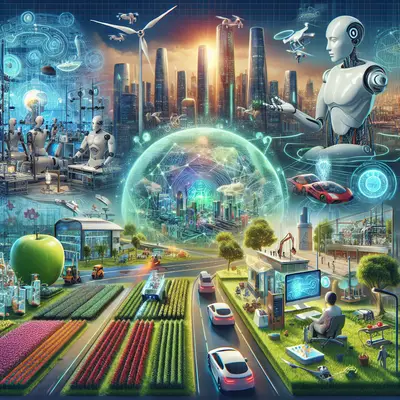
If your mental image of AI is still “chatbots and text generators,” you’re missing the weird, wonderful stuff happening just outside your screen. AI is getting eyes—and sometimes ears, wheels, and even a sense of touch. It’s starting to move through the real world, not just your browser tab, and that’s where things get seriously interesting.
Let’s walk through some of the most fascinating ways AI is breaking out of the chat window and into actual, everyday reality.
1. AI That Understands What It’s Looking At (Not Just Labels)
We’ve had “AI vision” for a while: models that can say “cat,” “car,” or “pizza” when you show them a photo. That’s old news. The new wave is AI that can actually reason about what it’s seeing.
Modern vision-language models can:
- Look at a messy desk and tell you where you left your keys
- Explain what’s happening in a video in normal language
- Answer questions like, “Is this outlet safe to use?” or “Which route looks less crowded?”
This isn’t just slapping labels on pixels—it’s combining what it sees with what it “knows” from training. That’s why you’re seeing things like:
- Phones that can describe photos out loud for visually impaired users
- Smart cameras that can detect unusual activity instead of just motion
- Tools that help diagnose medical scans by flagging suspicious areas for doctors to review
We’re slowly moving from “camera as sensor” to “camera as coworker.” Slightly creepy? Maybe. Incredibly useful? Definitely.
2. AI Co-Drivers: Your Car Is Quietly Learning to Think
Most people think of self-driving cars as either “fully autonomous robotaxi” or “not real yet.” The truth is way more gradual—and more interesting.
Today’s cars are already packed with “mini AIs” that:
- Watch lane markings and gently steer you back if you drift
- Slam the brakes faster than you can if someone cuts in front of you
- Read speed limit signs and warn you when you’re pushing it
- Help you park by spotting obstacles and predicting your trajectory
Under the hood, these systems rely on a combo of cameras, radar, and machine learning models trained on absurd amounts of driving data.
The cool part: the AI doesn’t have to be perfect to be useful. You don’t need a fully driverless car to benefit from AI that:
- Reduces accidents
- Makes long drives less exhausting
- Nudges bad drivers toward safer behavior
We’re living through a “slow upload” of driving skills from humans into algorithms, one feature at a time.
3. Smart Homes That Actually Feel Smart (Not Just “Connected”)
“Smart home” used to mean shouting at a speaker to turn on your lights. Now, AI is starting to give your gadgets a bit of shared brainpower.
Instead of you manually programming everything, AI can:
- Learn your routines and adjust lights, temperature, and blinds automatically
- Notice when energy use spikes and suggest changes (or make them for you)
- Recognize unusual activity (like a door opening at a weird time) and send alerts
- Sync across devices—so your TV, lights, and speakers respond together, not as separate islands
The big shift is from rules to patterns. Old smart homes: “If time = 7:00 AM, turn on lights.” New smart homes: “You usually wake up around sunrise, and today that’s 6:42 AM, so let’s ease the lights on slowly.”
It’s still early days, and the privacy questions are real. But the idea of a home that quietly adjusts to you—without constant app flicking—feels a lot closer than it did a few years ago.
4. AI-Enhanced Creativity That Stays in Your Style
We’ve all seen AI-generated art and music, but the flashy “look what the AI made!” demos miss a more subtle (and honestly more exciting) trend: AI that helps you create more, in your own style.
Creative tools are starting to act like assistants who know your taste:
- Image tools that learn your visual style and keep it consistent across projects
- Music software that suggests chord progressions or fills that match your vibe
- Video editors that automatically cut, sync, and subtitle content, so you focus on storytelling
- Writing tools that adapt to your tone instead of forcing you into generic “AI voice”
The interesting part for tech enthusiasts: this isn’t about AI replacing creatives—it’s about compressing all the “boring glue work” between ideas and finished projects.
Think of it like this: AI doesn’t have to be a full-on artist. It just has to be good enough at the repetitive stuff that you can stay in the fun zone longer.
5. Everyday Objects Are Quietly Getting “Situational Awareness”
One of the most overlooked shifts: regular objects are starting to understand context. Not just “on or off,” but “what’s happening right now, and what should I do about it?”
We’re seeing this with:
- Wearables that can spot irregular heart rhythms or dangerous falls and contact help
- Headphones that auto-switch between noise-canceling and transparency based on your environment
- Security cameras that differentiate between your dog, the mail carrier, and a stranger lurking around
- Industrial sensors that predict machine failures before anything actually breaks
This is “small AI” rather than sci-fi AI—tiny models running on boards and chips, making quick decisions without sending everything to the cloud.
For enthusiasts, the exciting angle is edge AI: models running directly on devices, with lower latency, better privacy, and more reliability when your connection sucks. Your gear starts feeling less like a dumb terminal and more like a local sidekick.
Conclusion
AI isn’t just text boxes and hype slides anymore. It’s:
- Learning to see and reason about the real world
- Sliding into your car as a quiet co-pilot
- Making your home feel more responsive and less scripted
- Amplifying human creativity instead of trying to replace it
- Giving everyday objects just enough “awareness” to be genuinely useful
The most interesting AI shift right now isn’t about making something that feels human. It’s about making tools that feel tuned to humans—our routines, our environments, our preferences.
We’re not heading toward one big, all-powerful AI brain. We’re heading toward a swarm of smaller, specialized AIs woven into the stuff we already use. And for tech fans, that’s where things get really fun.
Sources
- [Google AI Research – Vision-Language Models](https://ai.googleblog.com/2021/01/transformers-for-image-recognition-at.html) – Overview of how modern models combine visual understanding with language
- [NHTSA – Automated Vehicles for Safety](https://www.nhtsa.gov/technology-innovation/automated-vehicles-safety) – Details on how AI-assisted driving features are being deployed and regulated
- [U.S. Department of Energy – Smart Home Technologies](https://www.energy.gov/energysaver/smart-home-technologies) – Explains how intelligent systems manage home energy and automation
- [MIT CSAIL – AI and Creativity](https://www.csail.mit.edu/research/ai-creativity) – Research on how AI systems support rather than replace human creators
- [Microsoft – What Is Edge AI?](https://azure.microsoft.com/en-us/resources/cloud-computing-dictionary/what-is-edge-ai) – Clear breakdown of how AI runs directly on devices and why it matters
Key Takeaway
The most important thing to remember from this article is that this information can change how you think about AI.