AI isn’t just answering questions or auto-filling your emails anymore—it’s starting to invent things. New photos that never existed. Voices that belong to nobody. Paintings in the style of artists who never lived. Whole fake cities used to train self-driving cars.
Welcome to the age of “synthetic” everything, where AIs don’t just react to the world, they generate it. And it’s way stranger—and more powerful—than most people realize.
Below are five corners of AI-generated stuff that are quietly reshaping tech, creativity, and even what “real” means online.
1. Photos of People Who Don’t Exist (But Look Weirdly Real)
AI can now generate hyper-realistic faces of people who have never been born. If you’ve ever seen one of those “this person does not exist” websites, that’s exactly what’s happening.
These systems:
- Learn from millions of real photos of real people
- Mix and match patterns—eyes, skin, hair, lighting—into entirely new images
- Produce portraits that look like they came straight from a DSLR
What’s wild is how cheap and fast this is. Any developer can spin up a model, feed it some training data, and generate endless “people” for ads, stock photos, characters in games, or profile pics that keep your real identity hidden.
The flip side: it gets harder to know what’s real online. Fake social media accounts can use AI faces that pass at a glance. Stock photo libraries might be full of humans who never existed. Spotting the tells—off earrings, mismatched eyes, glitchy backgrounds—is becoming its own mini-skill set.
Synthetic faces started as a neat demo. Now they’re an infrastructure layer for everything from marketing to privacy to misinformation.
2. AI-Generated Voices That Sound Like Your Friend on the Phone
Text-to-speech used to sound like a bored robot reading a weather report. Today, AI voice models can:
- Copy tone, pacing, and accent from just a few seconds of audio
- Add emotion—excited, calm, annoyed, dramatic—on command
- Generate entire podcasts, audiobooks, or tutorials without a human voice actor
It’s already practical: creators use AI voices for YouTube explainers, indie developers drop them into games, and support centers use them for automated phone systems that sound way less like 1998.
The problem is: it’s now insanely easy to fake someone’s voice.
You can:
- Pull a short voice clip from a TikTok or interview
- Feed it into a cloning tool
- Generate new sentences that person never said
That has serious implications for scams (“Hey, it’s me, I need money right now”), deepfakes, and even politics. That’s why companies and researchers are scrambling to watermark AI audio and build detectors that can tell synthetic voices from real ones.
We’re in this awkward phase where AI voices are powerful and useful, but trust around audio is starting to erode.
3. Synthetic Data: Fake Worlds That Train Real AI
A lot of AI needs massive data to learn—images, driving footage, medical scans, conversations, you name it. But real-world data is messy, private, and hard to collect.
So researchers started doing something clever: they generate fake data.
Think:
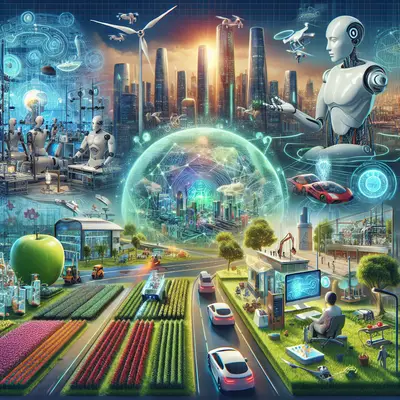
- Virtual cities full of simulated cars and pedestrians to train self-driving systems
- Synthetic medical images that look like real x‑rays or MRIs, but don’t belong to any patient
- Artificial user behavior—clicks, swipes, purchases—to test recommendation algorithms safely
This “synthetic data” lets companies:
- Avoid some privacy headaches (no real people in the dataset)
- Generate rare scenarios on demand—like unusual diseases or weird driving situations
- Scale up training quickly without waiting for real-world events to happen
But it’s not magic. If the fake world doesn’t match reality closely enough, the AI learns bad habits. A model that drives perfectly in a clean virtual city might freak out at a real-world pothole or a poorly painted lane line.
The interesting tension: we’re teaching AIs about reality using worlds that are increasingly unreal, and the quality of those fake worlds matters a lot.
4. AI as a Creative Partner (That Never Sleeps)
We’ve hit a strange new point where AI can:
- Sketch out logos and branding ideas
- Draft lyrics, story outlines, and dialogue
- Compose background music that fits a mood
- Generate concept art based on short text prompts
Most of this content isn’t “finished” on its own, but it’s an amazing jumpstart. Creators use AI to:
- Break creative blocks (“Give me 10 variations of this idea”)
- Rapidly prototype—characters, scenes, thumbnails, poster layouts
- Explore styles they don’t normally work in
The fun twist: AI tools have become part of the creative process the way Photoshop or 3D modeling apps did a generation ago. It’s less “AI vs human” and more “AI as a rough-draft machine.”
Of course, it raises messy questions:
- Who owns the rights to an AI-generated image?
- Should artists get paid if their work helped train the model?
- Is a song “yours” if an AI wrote the backing track?
You don’t need to solve the ethics to see the pattern: creators who treat AI like a flexible assistant—rather than a replacement—are moving faster and experimenting more than ever.
5. AI That Learns Your Style—and Starts Mimicking You
Modern AI tools don’t just generate generic content. Many of them now tailor their output to you.
Over time, they:
- Pick up your writing tone—formal, sarcastic, minimalist, emoji-heavy
- Notice which suggestions you accept or ignore
- Adjust their recommendations—music, videos, articles—based on your history
This shows up in subtle ways:
- Email tools that offer suggested replies that actually sound like you
- AI writing assistants that stop over-explaining once they see you prefer short answers
- Code assistants that remember your favorite libraries or patterns
Under the hood, the system isn’t “understanding” you like a human would. It’s just pattern-matching based on your behavior. But the end result feels surprisingly personal.
The upside: less friction, more time saved, more “this is actually helpful” moments.
The downside: it’s super easy to get wrapped in a bubble—your taste, your opinions, your routines—constantly reinforced by an AI tuned to your past choices. Discovery becomes narrower unless you actively push against it.
We’re entering a world where your tools don’t just respond to commands—they quietly learn your habits and start pre-empting what you’ll want next.
Conclusion
AI isn’t just crunching numbers in some distant server rack anymore. It’s:
- Inventing people who don’t exist
- Speaking with voices nobody owns
- Training on worlds that were never real
- Co-writing our art, videos, and code
- Quietly learning our styles and preferences
That mix of power and weirdness is exactly why this moment in tech is so interesting. The line between “real” and “synthetic” is getting blurrier, and most of the time you can’t tell which side of the line you’re standing on.
The question for the next few years isn’t just “What can AI do?” but “What do we still need to be real—and what are we okay outsourcing to algorithms that make things up?”
Sources
- [NVIDIA: StyleGAN – Official Research Page](https://research.nvidia.com/publication/2018-12_style-based-generator-architecture-generative-adversarial-networks) - Technical overview of the AI model family behind many hyper-realistic synthetic faces
- [MIT Technology Review – The coming age of AI-generated fake images](https://www.technologyreview.com/2019/01/10/137969/the-coming-age-of-ai-generated-fake-images/) - Explains how generative models create convincing fake photos and the implications
- [Stanford HAI – Synthetic Data for AI](https://hai.stanford.edu/news/synthetic-data-ai) - Breaks down what synthetic data is, why it’s used, and its pros/cons for training AI
- [FTC Consumer Alert – Voice Cloning Scams](https://www.ftc.gov/business-guidance/blog/2023/03/scammers-using-voice-cloning-technology) - Discusses real-world misuse of AI-generated voices and how scams are evolving
- [Harvard Gazette – AI and Creativity](https://news.harvard.edu/gazette/story/2023/03/how-ai-tools-like-chatgpt-can-boost-human-creativity/) - Looks at how AI can augment creative work rather than simply replace it
Key Takeaway
The most important thing to remember from this article is that this information can change how you think about AI.