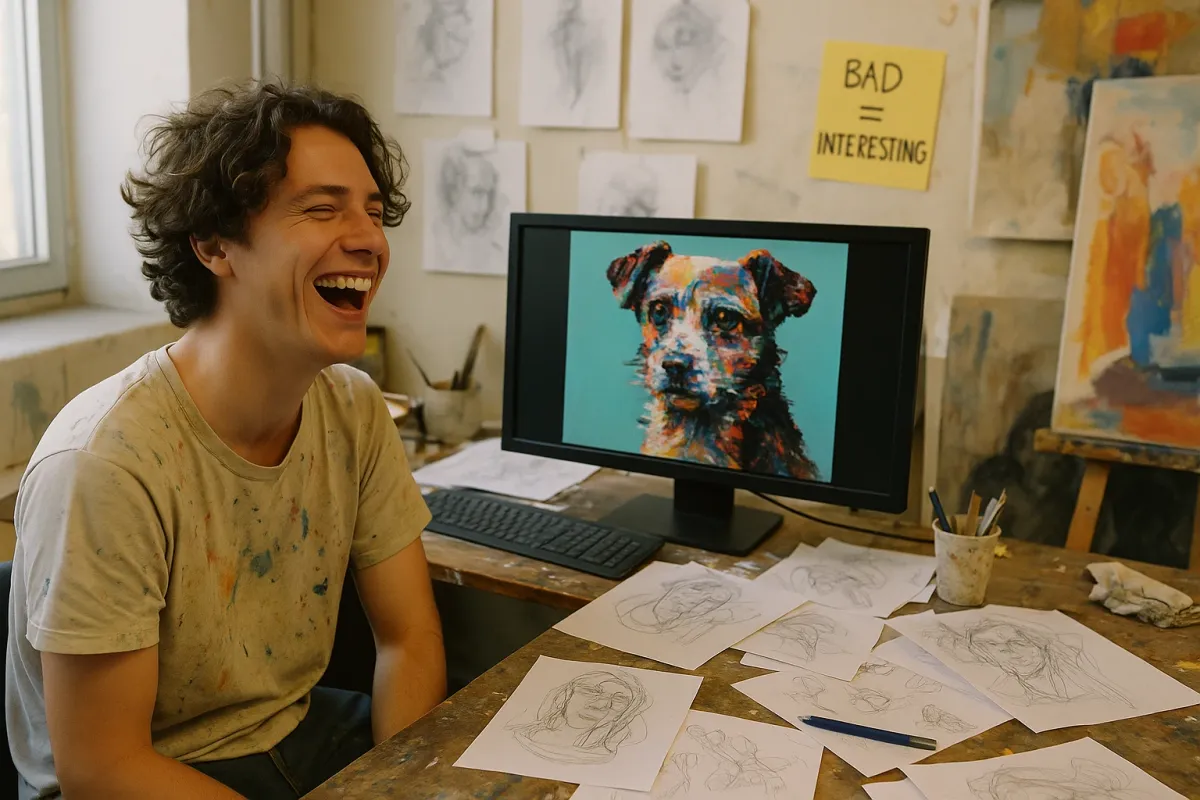
If you’ve been doomscrolling today, you probably saw the story about Phil Heckels — the British dad who draws hilariously “terrible” pet portraits under the name Hercule Van Wolfwinkle and has raised over £13.6k for charity doing it. His drawings are purposely bad, the internet loves them, and somehow this has turned into a legit fundraising machine.
Now put that side‑by‑side with what AI art tools are doing right now.
We’ve got hyper‑realistic AI image generators that can spit out museum‑grade “art” in seconds… and a guy with a marker and a chaotic sense of humor absolutely cleaning up online with deliberately awful drawings. That contrast says a lot about where AI and human creativity are heading — and why “low‑tech” chaos might actually be the secret weapon in the AI era.
Let’s unpack it.
1. AI Can Draw “Perfect” Pets, But The Internet Still Loves The Human Mess
Right now, tools like DALL·E, Midjourney, and Stable Diffusion can create insanely detailed, realistic portraits of your dog in whatever style you want — oil painting, cyberpunk, Studio Ghibli, you name it. You type “golden retriever in a spacesuit eating ramen on Mars,” hit enter, and boom: instant art.
So why are people lining up to get a wonky, wrong‑proportioned, totally cursed drawing from Van Wolfwinkle instead of a flawless AI render?
Because his art comes with:
- A human backstory (dad, bored, did a joke, internet went nuts)
- A personality you can feel in every crooked line
- Tiny imperfections that scream “a real person did this”
- A charity angle that makes the whole thing more meaningful
AI is great at “technically impressive.” Humans are still better at “emotionally sticky.” That’s why his doodles go viral while perfect AI pet portraits mostly just float past in the feed.
2. The Future Of “Art” Might Be More About Story Than Skill
Traditional thinking:
Talent = skill with your hands or tools. If you can’t draw, paint, or design, you’re out.
2025 internet thinking:
Talent = who can tell the most interesting story around what they post.
AI has basically democratized technical skill. You don’t need to spend 10 years learning to shade fur when you can prompt an AI in 10 seconds. The scarce resource now is voice — a recognizable vibe you bring to everything you make.
That’s exactly why Van Wolfwinkle works:
- His “brand” is consistent: gloriously bad portraits
- You instantly know his style when you see it
- The joke is built into the art — you’re in on it
- The story (terrible drawings = serious charity money) is share‑able in one sentence
AI can copy styles, but it can’t live a life or be accidentally funny in the very specific way one British dad is. As AI keeps improving, we’re going to see more creative niches that look like his: technically simple, emotionally strong, and powered by personality.
3. AI Is Becoming The Straight Man In A Comedy Duo
Right now, a ton of creators are quietly doing this: use AI for the “serious” part, lean on human chaos for the fun part.
Imagine Van Wolfwinkle 2.0:
- He takes your pet photo
- An AI generates a ridiculously majestic, hyper‑real painting of your cat as a Roman general
- Then he draws his usual monstrosity version
- You get both: the epic AI portrait and the cursed human sketch
The AI becomes the straight‑laced, overachieving sidekick that makes the human version even funnier by contrast. It’s like a comedy duo: AI sets the bar; the human gleefully limbos under it.
And this isn’t just about art:
- AI writes a polished product description → human adds the savage, meme‑y caption
- AI cuts a clean video edit → human layers in chaotic commentary and in‑jokes
- AI builds the “nice” version → human breaks it in ways that go viral
The pattern: AI handles the competent; humans handle the memorable.
4. “Bad On Purpose” Might Be One Of The Safest Spaces From AI
AI keeps eating tasks that reward being clean, efficient, and accurate. But there’s one area it still struggles with: being deliberately, creatively awful in a way people like.
AI can produce random or distorted images, sure, but they usually feel:
- Glitchy, not intentional
- Repetitive once you’ve seen a few
- Soulless if there’s no human commentary or framing
Van Wolfwinkle’s portraits work because there’s a clear, human intent: he’s trying to draw your pet, and failing in very specific, inventive ways each time. That gap between intention and outcome is where a lot of comedy — and humanity — lives.
In an AI‑heavy world, we might see whole creative scenes where the “flex” isn’t “look how good this is,” but:
- “Look how specifically wrong I made this”
- “Look how badly I drew this on purpose and you still love it”
- “Look at how my personal style leaks through the chaos”
AI can mimic a style, but it doesn’t have actual embarrassment, ego, or a sense of risk. People do. That’s partly what we’re laughing with.
5. Charity, Community, And Why AI Still Feels Like A Tool — Not A Movement
The other big piece of this story: money. Van Wolfwinkle has turned his silly art into real‑world impact — over £13.6k for charity and counting. People aren’t just paying for a bad drawing; they’re buying into:
- Helping a cause
- Being part of an in‑joke
- Getting something uniquely theirs
- Sharing something their friends will react to
AI can help scale this kind of thing (automatic posters, merch mockups, campaign visuals), but it doesn’t replace it. The trust and goodwill come from knowing there’s a real human behind the project who chose the cause, shows up online, and reacts to the community.
That’s a recurring theme in AI right now:
- AI makes things cheaper and faster
- Humans make things feel worth paying for
The tech is powerful, but the reason we care almost always traces back to a human decision, face, or story.
Conclusion
Today’s “crappy pet portrait” headline isn’t just wholesome internet content — it’s a snapshot of how AI and human creativity are starting to coexist.
On one side: models that can generate flawless art in seconds.
On the other: a guy with a pen, leaning fully into being terrible, and somehow winning the internet and raising charity money.
The lesson for the AI era isn’t “learn to out‑draw the machine.” It’s closer to:
- Let AI handle the polished stuff
- Double down on your weird, specific, human flavor
- Build a story people can retell in one breath
The future doesn’t look like humans vs. AI. It looks like AI doing the heavy lifting in the background — while humans, like Hercule Van Wolfwinkle, stand in the spotlight and say, “Cool, now watch me absolutely butcher this on purpose.”
And honestly? That’s way more fun.
Key Takeaway
The most important thing to remember from this article is that this information can change how you think about AI.