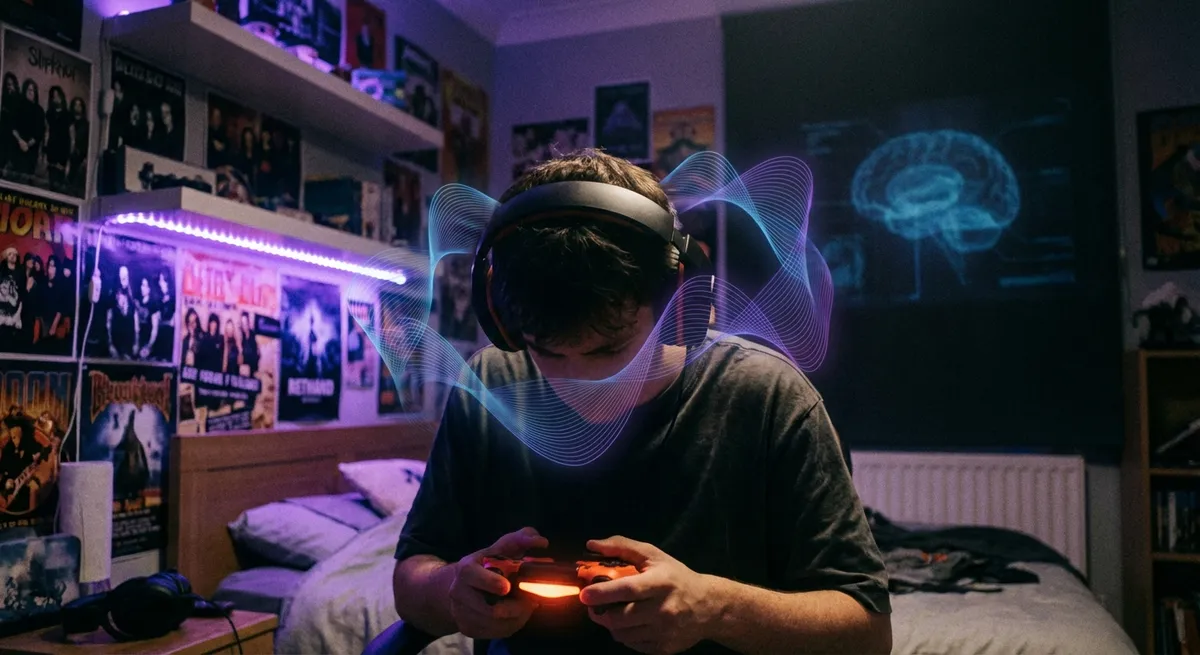
Game graphics get all the hype, but the real puppet master is often something you barely notice: the sound.
From the click of a reload to the faint footsteps behind a wall, modern game audio is doing psychological parkour in the background—guiding your emotions, boosting your reflexes, and even changing how you remember a game.
Let’s dig into how.
How Games Use Sound to Hack Your Focus
You know that “zone” feeling when a game suddenly feels easier and smoother? Audio is a big reason that happens.
Game soundtracks and effects are often tuned to gently push you into something close to a flow state—that sweet spot between boredom and panic where your brain is fully locked in.
- Many games use steady, rhythmic background music during normal play to keep you calm and focused.
- When things get dangerous, the tempo often ramps up, your heart rate follows, and you start reacting faster without really knowing why.
- Subtle sounds—like the soft “ding” when you land a hit or complete an action—act as instant feedback loops. Your brain loves that tiny reward and learns to repeat the behavior.
You’re not just “getting better” from practice. The game is training you with sound cues, almost like an audio-based Pavlov experiment that rewards timing, aim, and reactions.
Why Game Soundtracks Stick in Your Head for Years
There’s a reason you can still hum the theme from a game you played as a kid.
Game music is designed to be:
- Loopable: It has to repeat for hours without driving you insane. That usually means simple, catchy melodies and predictable structure.
- Contextual: Different areas, bosses, or menus have their own themes, which turns the soundtrack into a kind of memory map of your experience.
- Emotionally tagged: That one boss theme? Your brain has labeled it “stressful but epic,” so it sticks.
Because you hear the same tracks while actively making decisions and reacting, your brain links the music with emotions and events. It’s not just background audio; it becomes part of the memory.
For a lot of players, listening to a game’s soundtrack years later instantly pulls back not just images, but feelings—frustration from that one level, satisfaction from finally beating it, late-night sessions with friends. That’s not nostalgia accidentally happening; that’s audio doing its job.
The Science Behind “I Heard Footsteps” Panic
In competitive games, audio can be as important as aim. Footsteps, weapon reloads, doors creaking—those tiny sounds change how you move and think.
Modern games often use:
- Positional audio: Sounds are placed in a 3D space around you, so your brain can locate enemies by ear alone.
- Dynamic mixing: Important sounds (like nearby footsteps) get bumped up in volume while less important noises fade back, even if everything is technically happening at once.
- Audio “tells”: Specific sounds that give away what another player is doing—healing, reloading, charging an ability—let you predict their next move.
Your brain is wired to care about unusual sounds in your environment. Evolution trained us to notice that twig snapping in the forest; now it’s doing the same thing for virtual footsteps in a hallway.
That’s why your whole body tenses up when you hear movement behind you in a game. Your lizard brain has absolutely no idea it’s 3 a.m. and you’re just in your chair.
When Silence Is Louder Than Any Explosion
Not all audio tricks are about bigger, louder, more intense.
Sometimes, nothing is the loudest move a game can make.
Developers will intentionally:
- Drop the music right before a big moment, so every tiny sound suddenly feels important.
- Strip back ambience to make you hyper-aware and uncomfortable.
- Use long stretches of quiet to reset your emotions, so the next scare or action spike hits harder.
Silence is also used to create contrast. If the game is usually noisy and chaotic, a sudden quiet section feels eerie, even if nothing is technically happening. Your brain starts filling in the gaps, expecting something to go wrong.
That tension—built mostly by the absence of sound—can be more effective than any jump scare.
How Game Audio Tech Is Crossing Into Real Life
The cool part? The tech and techniques behind game sound are bleeding into other areas.
You can see game-style audio design showing up in:
- Fitness apps that use reactive soundtracks to keep you in a rhythm.
- Productivity tools that play subtle “completion” sounds to make tasks feel more rewarding.
- VR and AR experiences that rely on 3D sound to guide you when screens aren’t enough.
- Therapeutic and training simulations, where realistic audio is key to immersion—think flight simulators or medical training.
Game audio tech has been pushing real-time sound processing, spatial audio, and adaptive music for years. Now those same tools are helping shape how we work, learn, and train outside of games.
The line between “game audio” and “everyday audio design” is getting blurrier—but gamers have been living with this stuff the longest.
Conclusion
Next time you boot up a game, pay attention to what you hear instead of just what you see.
That rising tension in your chest? That instinctive turn toward a sound? That weird comfort you feel when a familiar theme kicks in?
It’s not an accident.
Game audio is doing quiet, invisible work: steering your emotions, sharpening your reactions, and turning pixels into memories. The graphics may grab your eyes, but the sound is what grabs your brain.
Sources
- GDC Vault – Audio Track Sessions – Developer talks on game sound design, adaptive music, and audio psychology
- “The Psychology of Video Game Soundtracks” – BBC Future – Explores how music influences mood, focus, and behavior, with gaming examples
- Dolby – Game Audio and Spatial Sound – Overview of spatial and surround audio tech used in modern games
- “The Interactive Audio in Video Games” – MIT OpenCourseWare – Academic look at how game audio responds to player actions
- American Psychological Association – Video Games and Attention – Research on how games affect focus, attention, and cognitive skills, relevant to how audio feedback shapes performance
Key Takeaway
The most important thing to remember from this article is that this information can change how you think about Gaming.