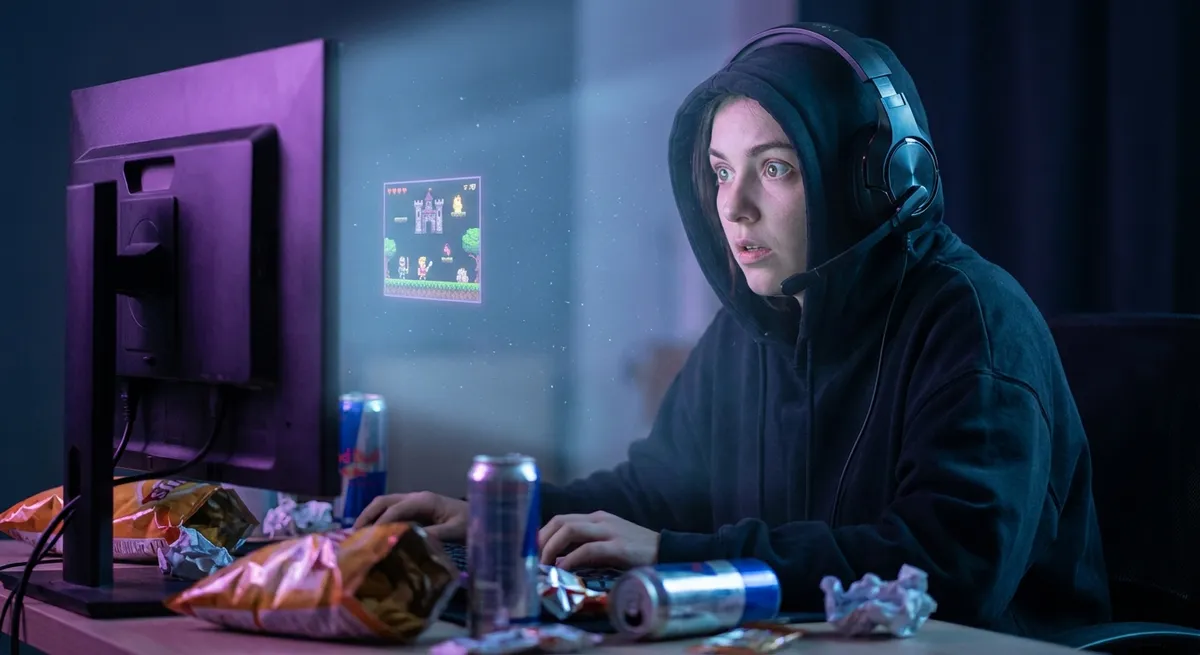
There’s a very specific magic moment in gaming: you look up, swear only 20 minutes have passed, and realize it’s somehow 3 a.m. Your drink is warm, your messages are unread, and you’re weirdly proud of the imaginary house you built for your imaginary cat. That “how did time vanish?” feeling isn’t an accident—it’s design, psychology, and tech all working together.
Let’s dig into what’s actually happening in your brain and on your screen when a game completely pulls you in—and why that matters for where gaming is headed next.
Games Are Basically Flow Machines
There’s a psychology concept called flow—it’s that laser-focus state where you’re fully absorbed in what you’re doing, not bored, not overwhelmed, just locked in.
Games are secretly built to shove you right into that zone.
They do it by:
- Giving you clear goals (“reach the next checkpoint,” “beat this boss,” “don’t let your villagers starve”).
- Matching challenge to your skill level (easy early enemies, then slowly ramping the difficulty as you improve).
- Delivering instant feedback for your actions (health bars, hit markers, sound effects, XP bars, loot drops).
When that balance is right, your brain basically says, “Cool, everything else can wait.” You get just enough resistance to stay engaged, but not so much that you give up and uninstall out of spite.
This is also why poorly tuned games feel “off.” If enemies are way too strong or the game holds your hand too much, that flow state never clicks. Good game design isn’t just about graphics or story—it’s about managing your brain’s boredom and frustration thresholds second by second.
Your Brain Thinks Loot Is a Slot Machine (Because It Kind Of Is)
That little thrill when a legendary item finally drops? Your brain loves that—and there’s real science behind it.
A lot of games use variable rewards, which is a fancy way of saying “you never quite know what you’re going to get.” Sometimes the chest has junk, sometimes it has god-tier loot. That unpredictability is dopamine fuel.
Here’s what’s going on:
- Anticipation is addictive – Your brain releases dopamine not just when you get the reward, but while you’re expecting it.
- Random rewards hit harder – Fixed rewards (“every 10th chest is good”) are less exciting than “this one might be insane.”
- Progress bars calm your brain – Battle passes, XP meters, and collection screens give you a visual sense of progress, which is weirdly satisfying even when the “reward” is just a badge or cosmetic.
None of this automatically makes loot systems evil, but it’s why some games feel like they’re farming you, not the other way around. As tech gets better at tracking how you play, expect reward systems that feel more and more “personal”—both in good ways (better tailored challenges) and slightly creepy ways (keeping you hooked on purpose).
Modern Game Worlds Are Quietly Studying How You Play
Behind that smooth open world or tight shooter are a ton of systems quietly reacting to you.
A few ways games are getting “smarter” about your behavior:
- Adaptive difficulty – Some games subtly adjust enemy toughness, spawn rates, or item drops depending on how often you die or win. Ideally, you stay right in that flow sweet spot without ever noticing.
- Heat maps and telemetry – Developers can see where players keep dying, where they get stuck, which areas they ignore, and where they spend most of their time. Future updates—and even sequels—are shaped by this data.
- Dynamic content – Enemies patrol where players usually go, side quests pop up along common routes, and events may trigger based on your habits instead of fixed scripts.
As more games lean on online connections—even in single-player modes—the line between “static game” and “live system that keeps learning” gets blurrier. That’s powerful for making better experiences, but it also raises questions: how much should a game know about you to be fun?
Sound Design Is Doing Way More Work Than You Realize
You probably notice great graphics. You rarely notice great sound—until it’s missing.
Audio is one of the sneakiest tools games use to pull you in:
- Positional sound tells you exactly where threats are without cluttering your screen with markers.
- Dynamic music ramps up as you enter combat, then chills out as you explore, cueing your emotions in real time.
- Subtle cues—like a faint hum near a secret room or a slightly different footstep sound on hollow floors—reward players who pay attention without throwing obvious hints.
Modern games use pretty advanced tech under the hood: spatial audio algorithms, real-time mixing, and procedural sound layers that blend depending on what’s happening.
It’s why turning the music off often makes a game feel “empty” even though nothing else changed. If graphics are what you look at, audio is the glue quietly holding your immersion together.
Your Game Time Is Training You (Usually In Good Ways)
Spending hundreds of hours gaming sounds like wasted time—until you look at what your brain is actually practicing.
Research has linked some types of gaming with:
- Improved spatial awareness – Navigating 3D worlds, tracking moving targets, mentally rotating objects.
- Faster reaction times – Especially in action or competitive games where milliseconds matter.
- Better task switching – Juggling cooldowns, objectives, resources, and enemy behavior trains you to manage multiple inputs at once.
- Stronger pattern recognition – Understanding enemy attack patterns, puzzle logic, and meta shifts.
No, that doesn’t mean “play 10 hours a day, doctor’s orders.” Context matters, and not every game is equally beneficial. But the stereotype that gaming just melts your brain is… outdated at best.
What’s interesting for the future: studios and researchers are already exploring games designed specifically to train certain skills—attention, memory, even managing anxiety. Think “mentally nutritious” games that are still actually fun, not just glorified homework with graphics.
Conclusion
Next time you realize you’ve been glued to a game for hours, there’s a lot more happening than “I lost track of time.”
You’re riding a carefully tuned balance of challenge and reward, your brain is chasing unpredictable loot highs, your playstyle is quietly feeding data back into the game’s systems, immersive audio is doing half the storytelling, and you’re probably training more skills than you think.
Gaming isn’t just getting prettier. It’s getting smarter—about psychology, about design, and about you. The real question is whether we’ll use that power just to keep people playing longer, or to build game worlds that feel deeper, healthier, and actually worth getting lost in.
Sources
- [American Psychological Association – The Benefits of Playing Video Games](https://www.apa.org/news/press/releases/2013/11/video-games) - Overview of research on cognitive, emotional, and social effects of gaming
- [NIH / NCBI – Neural Basis of Video Gaming](https://www.ncbi.nlm.nih.gov/pmc/articles/PMC4263192/) - Research review on how games affect the brain and behavior
- [GDC Vault – Telemetry in Game Design](https://gdconf.com/news/gdc-vault-free-video-using-telemetry-take-guesswork-out-game-design) - Talk on how developers use player data and heat maps to refine games
- [BBC Future – How Video Games Are Changing Your Brain](https://www.bbc.com/future/article/20140819-how-video-games-change-your-brain) - Accessible breakdown of scientific findings on gaming and cognition
- [Dolby – What Is Spatial Audio in Games?](https://www.dolby.com/about/support/guide/spatial-audio-in-games/) - Explanation of modern game audio tech and its impact on immersion
Key Takeaway
The most important thing to remember from this article is that this information can change how you think about Gaming.