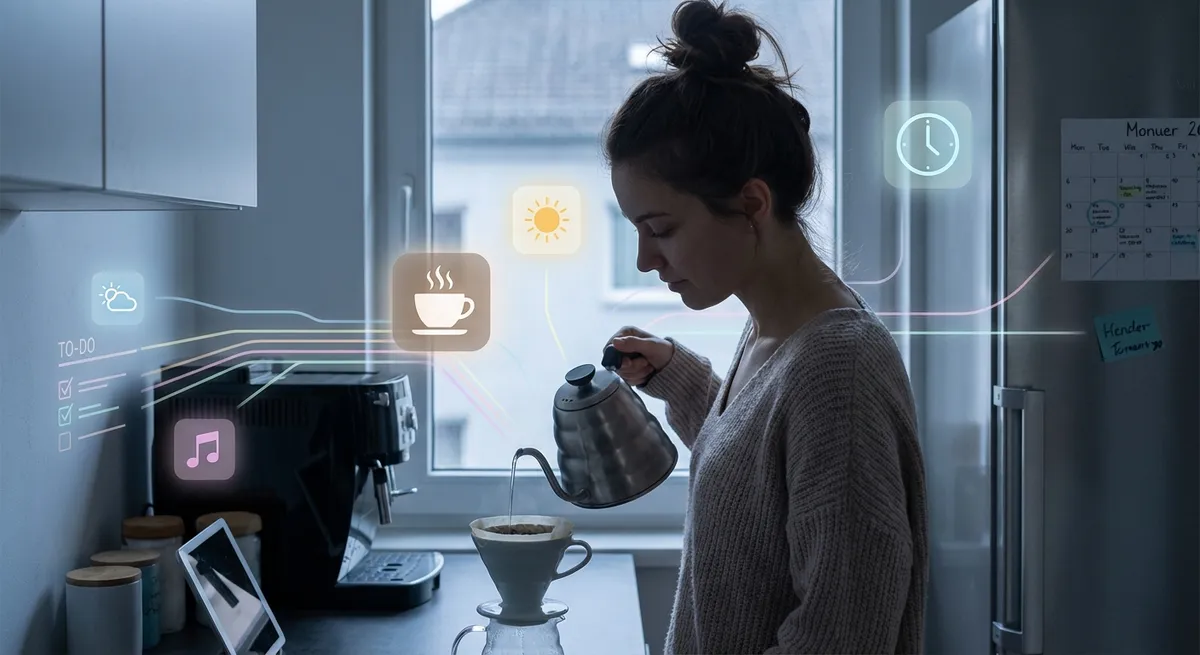
Most of the apps you use every day aren’t the ones sitting on your home screen.
They’re the ones you never open on purpose—quietly syncing, suggesting, nudging, and tracking in the background. They don’t ask for your attention the way social media does, but they shape everything from the music you hear to the routes you take to the ads you see.
Let’s look at some of the most interesting ways apps are slipping into the background—and why that’s actually where the most fun tech is hiding.
1. Your Phone Is Already an Automation Hub (Even If You Never Set Anything Up)
You don’t need to be a “power user” to be running automations. Your phone is already doing it.
Your photos back themselves up. Your messages sync across devices. Your health data quietly moves between your smartwatch, your phone, and sometimes your doctor’s app. All of that is automation, just with friendlier branding.
On iOS, things like Shortcuts can trigger actions based on time, location, or even what app you open—like automatically turning on Focus mode when you open a note-taking app. On Android, features like Routines can change your settings based on context, like muting notifications when you connect to your work Wi‑Fi.
The interesting part? A lot of this happened without you explicitly asking. Default settings plus “Allow” taps at install time slowly turn your device into a low‑key automation engine. You’re already living with app‑driven workflows—even if you’ve never opened a settings menu on purpose.
2. Recommendation Engines Quietly Rewrite Your Taste
If you’ve ever thought, “My playlist is actually fire today,” that’s not an accident.
Streaming apps use recommendation systems that learn your habits:
- What you skip
- What you replay
- What you add to playlists
- What you listen to at different times of day
Over time, that data doesn’t just predict what you like—it nudges you toward what you’re likely to like. Your taste subtly reshapes around whatever the algorithm keeps feeding you.
The fun twist: different apps train your taste in different ways. Spotify leans heavily on your behavior plus what people with similar habits like. YouTube mixes watch time, click history, and “session” length to keep you in the app. TikTok basically runs rapid-fire experiments on you with each swipe.
For tech enthusiasts, these recommendation systems are like black boxes we get to poke in real time. Every skip, like, and follow is input. The output? Your future self, who thinks they “always liked” this kind of content—even though you probably didn’t three months ago.
3. “Context-Aware” Apps Are Learning to Read the Room
Apps are getting better at understanding what’s going on around you—not just what you tap.
Location is the obvious one: maps apps suggest routes, weather apps warn you before the storm, and food apps surface restaurants nearby. But the context game goes deeper:
- Fitness apps switch from “move reminders” to “recovery suggestions” if you’ve had intense activity recently.
- Calendar and email apps can suggest when to leave for meetings based on traffic.
- Camera apps auto‑adjust for low light, motion, or HDR scenes without you changing settings.
Devices can now combine multiple signals—time of day, motion sensors, location, even Bluetooth devices nearby—to guess what you’re doing. Walking? Driving? At the gym? As far as your apps are concerned, these are all different “modes” of you.
This is where things get both powerful and slightly creepy. The more context apps have, the smoother things feel. But it also means your device is quietly building a rich model of your daily patterns. When it works well, it feels like the app “just knows.” When it doesn’t, it feels like overreach.
4. Super Apps Are Trying to Become Your Operating System (On Top of Your Operating System)
In some parts of the world, people basically live inside a single app.
Think of apps like WeChat in China: messaging, payments, food delivery, ride‑hailing, shopping, booking services—all bundled into one interface. These “super apps” aim to be the default layer between you and… well, everything.
In the West, we don’t really have one dominant super app yet, but a lot of big players are clearly trying:
- Payment apps adding messaging and shopping
- Social apps adding in‑app stores, payments, and mini‑apps
- Ride‑hailing apps turning into “mobility” hubs with scooters, bikes, and even public transit info
From a tech perspective, this is interesting because it blurs what an “app” even is. Instead of one app per task, you get a single container with dozens of “mini apps” inside. Your choice of that one platform ends up shaping what you see, what you buy, and how many other apps you don’t download.
The trade‑off is convenience vs. lock‑in: smooth experience now, potential frustration later if everything you do depends on one gatekeeper.
5. Apps Are Getting Better at Disappearing—On Purpose
Some of the most interesting apps right now are the ones trying to be less visible.
You see it in:
- System integrations: Password managers filling in logins without you opening them.
- Background protections: Security and privacy apps scanning for leaks, blocking trackers, or warning you about sketchy links with zero manual effort.
- OS‑level features: Focus modes, screen time reminders, and sleep schedules blending into the operating system so they feel more like a feature than “an app.”
Instead of fighting for your attention, these tools aim to melt into the background of your digital life. They’re there when something goes wrong or when you need an assist—but they don’t ping you just to remind you they exist.
For people who like tech but don’t want their entire life to revolve around glowing rectangles, this “disappearing app” trend is promising. The best tools are starting to feel less like standalone destinations and more like quiet upgrades to how your devices behave.
Conclusion
The most interesting apps right now aren’t necessarily the flashiest ones on the top charts—they’re the ones you barely notice.
They automate repetitive stuff, tune your recommendations, read your context, bundle services, and quietly protect you in the background. They don’t scream for your attention; they just subtly reroute your habits.
If you like experimenting with tech, this is a fun playground: tweak your settings, explore automation features, try different recommendation ecosystems, and see how much of your daily routine you can offload without turning your phone into a distraction machine.
Invisible apps are already running your day. The fun part is deciding how much you want them to run—and how much you want to run them.
Sources
- [Apple – Shortcuts User Guide](https://support.apple.com/guide/shortcuts/welcome/ios) – Official documentation on how automation and shortcuts work on iOS
- [Google – Routines in Google Assistant](https://support.google.com/assistant/answer/7672032) – Overview of how contextual and automated routines function in Google’s ecosystem
- [Spotify – How Spotify Recommendations Work](https://newsroom.spotify.com/2021-12-16/how-spotify-playlists-and-algorithms-work/) – Explains how Spotify’s algorithms shape music discovery and recommendations
- [Pew Research Center – How Americans Navigate a World of Digital Information Overload](https://www.pewresearch.org/internet/2024/01/10/how-americans-navigate-a-world-of-digital-information-overload/) – Provides context on how people interact with apps, notifications, and information
- [MIT Technology Review – The Race to Build the Super App](https://www.technologyreview.com/2023/02/08/1067900/super-apps-race-fintech-wechat/) – Discusses super apps, mini‑apps, and the push to become all‑in‑one platforms
Key Takeaway
The most important thing to remember from this article is that this information can change how you think about Apps.