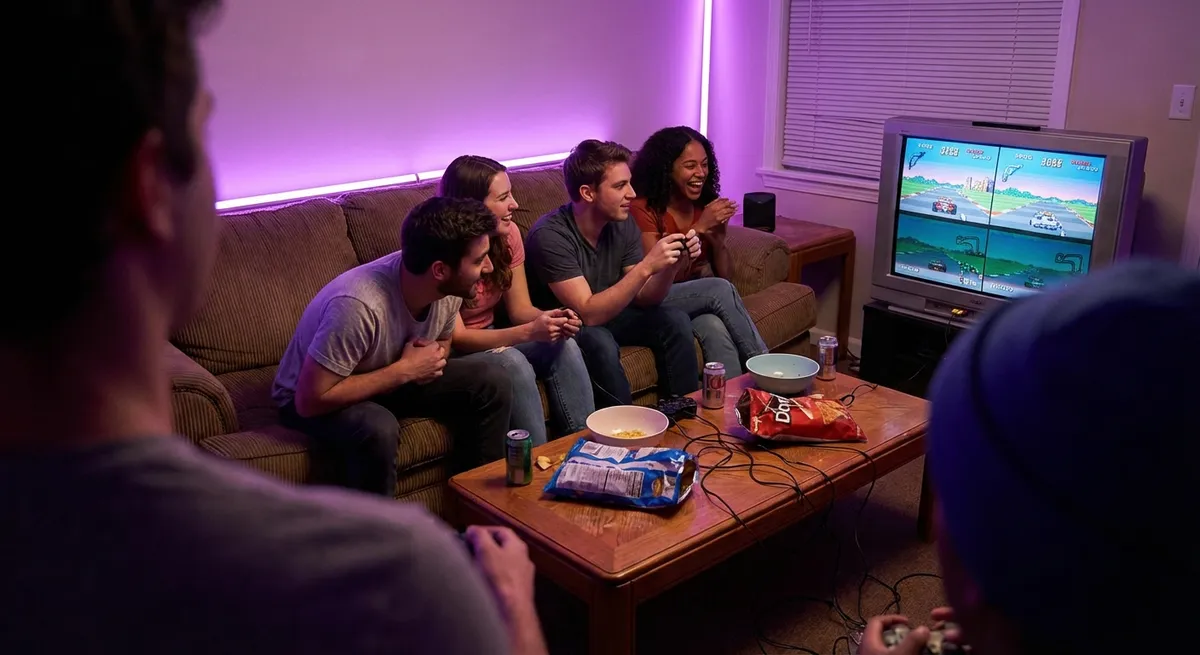
Remember when “multiplayer” meant sharing a couch, not a Wi‑Fi password? For a while, it felt like local split‑screen gaming was getting quietly replaced by online lobbies, friend codes, and party chat. But lately, it’s sneaking back into the spotlight—and not just as nostalgia bait.
Couch co-op and competitive split‑screen are having a low-key revival, powered by better hardware, smarter design, and players who are tired of shouting “can you hear me?” into headsets. And under the surface, there’s a lot of cool tech making it work.
Let’s dig into why split‑screen is still alive, and how modern gaming tech is quietly keeping it sharp.
1. Your Console Is Doing Way More Math Than You Think
When you fire up a split‑screen game, you’re not just “sharing the screen”—you’re basically asking your console or PC to run multiple viewpoints of the same world at once. That’s brutal on hardware.
Each player camera means:
- Extra geometry to render
- More lighting and shadows to calculate
- More physics and AI to simulate in visible areas
Old consoles could only handle this by dialing everything down—blurry textures, choppy frame rates, empty environments. That’s why a lot of “HD era” games dropped split‑screen; it was easier to just support online.
Modern hardware changed the math:
- More powerful GPUs can chew through multiple views without breaking 60fps as easily.
- Smarter resolution scaling lets games dynamically lower resolution or effects only when needed.
- Engine-level optimizations (like Unreal and Unity’s built-in tools) help devs reuse computations between player views instead of duplicating everything.
So even when it looks like “just a simple couch mode,” your system is optimizing like crazy in the background to keep it smooth.
2. AI Directors Make Local Co‑Op Feel Personal
One of the best parts of couch co-op: chaos. One friend rushes ahead, another loots everything, someone falls off a ledge. Keeping that fun instead of frustrating is weirdly hard from a design perspective.
Enter the “AI director” style systems—tech that quietly tunes the game moment to moment:
- Some games ramp enemy spawns up or down based on how well the whole group is doing.
- Others subtly adjust health drops, ammo, or special abilities to keep the session from flatlining.
- Difficulty can be tuned to the vibe—if everyone’s getting wrecked, the game gently eases off.
This stuff was originally popularized in online games (like Left 4 Dead), but it works insanely well in split‑screen, where:
- You often have mixed skill levels on the same couch
- People drop in and out mid-session
- You’re there to hang out, not sweat ranked ladders
That “how is this still fun even though we’re terrible?” feeling is often the result of invisible AI systems micro-managing the experience in the background.
3. Dynamic UI Is Secretly Solving the “Who Am I?” Problem
If you’ve ever shouted “wait, which one is me?” during a hectic split‑screen match, you’ve run into one of the biggest issues in local multiplayer: visual clarity.
Modern games quietly use a bunch of tricks to keep you oriented:
- Per-player color coding – HUD, health bars, cursors, and outlines all match “your” color.
- Adaptive HUD placement – your info moves closer to your character or your half of the screen.
- Smart camera framing – some games slightly zoom, tilt, or pivot to keep critical info in view.
- Context-aware indicators – if you’re off-screen or stunned, big on-screen markers or arrows guide you back.
On newer consoles and higher-res displays, developers can comfortably pack more UI in each quadrant without it turning into pure noise. That’s why modern split‑screen menus and HUDs feel cleaner than the 4-way chaos you might remember from the PS2 era.
4. Cross-Play’s Best Friend Might Actually Be Local Co‑Op
It sounds backwards, but the rise of cross-play (Xbox + PlayStation + PC + Switch all in one lobby) has actually made split‑screen more attractive, not less.
Here’s why:
- One couch, multiple platforms – Two people can share a console on split‑screen while playing online with friends on other systems.
- Lower friction – Don’t own the same console? Doesn’t matter as much. One copy of the game + one couch is enough to get people in.
- Hybrid sessions – You might have two people local, two people remote, all in one game.
Behind the scenes, that’s a lot of syncing:
- Local players share one internet connection and one machine, but need separate profiles, stats, and inputs.
- Netcode has to juggle split-screen’s demands (tight local responsiveness) with online latency.
- Input and camera data for multiple local players get packed through the same online pipeline.
It’s invisible when it works well—but it’s a nice reminder that local and online play aren’t enemies. They actually amplify each other when the tech holds up.
5. Indie Devs Are Turning Couch Modes Into Their Secret Weapon
Big studios sometimes skip split‑screen because it’s complicated and expensive to test. Indie devs, though? They’re leaning into it hard.
Why?
- Events and demos – Local multiplayer kills at conventions and festivals. One screen, instant crowd.
- Low barrier to entry – No account creation, no online setup, just “press start to join.”
- Built-in shareability – Streaming and TikToks of couch chaos are marketing gold.
On the tech side, smaller teams are getting way more power for less effort:
- Engines like Unity and Unreal have templates or plugins for split-screen setups, input mapping, and player joins.
- Local-only games skip a ton of online complexity (servers, matchmaking, anti-cheat), and put that dev time into fun physics, wild abilities, or clever level design.
- Some indies use simple art styles (flat shading, stylized models, pixel art) that are GPU-friendly, freeing up horsepower for four player views at once.
Result: more weird, creative, chaotic party games that you can spin up in seconds when people are over—without everyone having to own the game.
Conclusion
Couch gaming isn’t just nostalgia—it’s a surprisingly advanced tech challenge hiding under a pile of snacks and controllers.
Modern split‑screen and local co-op depend on:
- Serious graphical optimization
- Smart AI tuning the experience on the fly
- Clever UI and camera tricks
- Netcode that balances local and online play
- Accessible tools that let indie devs go all‑in on local chaos
It all adds up to something pretty simple from the player side: you grab a controller, sit down next to someone, and share the same ridiculous, broken, wonderful moment in the same room.
Online lobbies are great. But as long as there are couches—and people willing to talk trash at point-blank range—split‑screen isn’t going anywhere.
Sources
- [Valve Developer Community – AI Director (Left 4 Dead)](https://developer.valvesoftware.com/wiki/AI_Director_(L4D)) – Overview of how dynamic difficulty and pacing systems work in Left 4 Dead, a key influence on modern co-op AI design
- [Unreal Engine Documentation – Split Screen](https://docs.unrealengine.com/5.0/en-US/split-screen-multiplayer-in-unreal-engine/) – Technical breakdown of how Unreal Engine handles multiple viewports and local multiplayer setups
- [Unity Manual – Multiplayer and Networking](https://docs.unity3d.com/Manual/UNetOverview.html) – Background on Unity’s networking and multiplayer concepts, including local and online combinations
- [Digital Foundry (Eurogamer) – Performance Analyses](https://www.eurogamer.net/digitalfoundry) – Numerous breakdowns of how modern consoles handle demanding rendering tasks, including split-screen modes
- [GDC Vault – Design and Technical Talks](https://www.gdcvault.com/) – Collection of conference talks where developers discuss local multiplayer design, UI strategies, and engine-level optimizations
Key Takeaway
The most important thing to remember from this article is that this information can change how you think about Gaming.