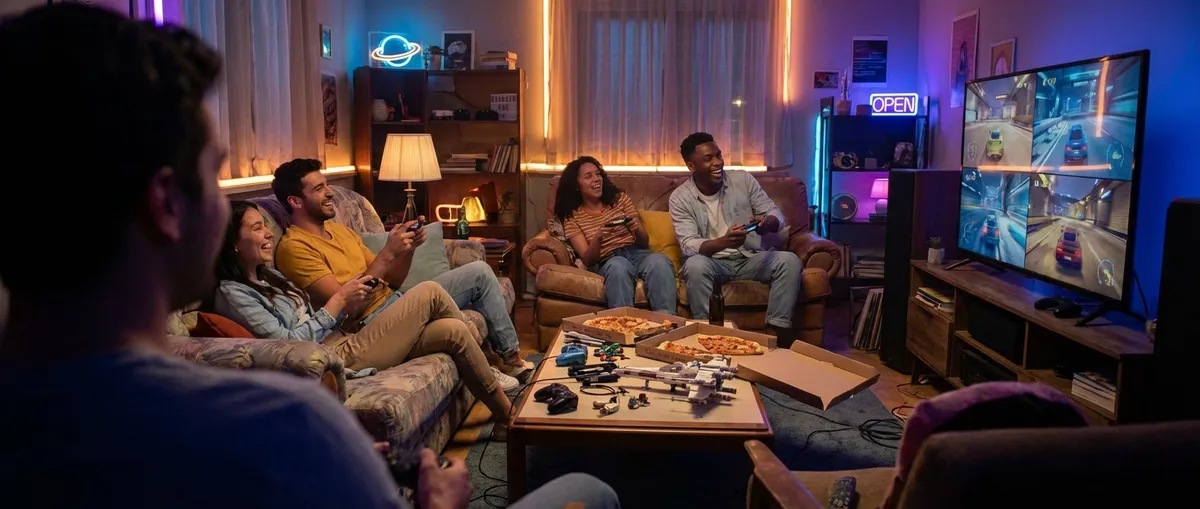
Remember when “playing games” meant sitting alone, staring at a screen and button-mashing in silence? That era’s basically over. Modern gaming is less “isolated hobby” and more “digital hangout spot” — part Discord server, part coffee shop, part competitive arena.
If you’re into tech at all, gaming is now one of the most interesting spaces to watch. It’s where social trends, new hardware, AI, and even economics all quietly collide. Let’s dig into some of the wild shifts happening right now that are turning games into the internet’s most underrated social network.
1. Games Are Turning Voice Chat Into a Real-Time Studio
Voice chat used to be chaotic background noise: crackly mics, yelling, and someone’s fan blasting at full volume. Now? It’s edging into “live audio production” territory.
Modern titles and platforms are quietly leveling up what “talking in a game” means:
- Spatial audio makes voices sound like they’re actually coming from the direction of the player on-screen, which helps with immersion and teamwork. Footsteps, callouts, and enemy pings all feel more natural.
- Built-in noise suppression kills keyboard clicks, snack crunches, and fan noise before your squad ever hears it.
- Cross-platform voice is becoming the norm, so your friends on console, PC, and even mobile can talk in the same squad without juggling six apps.
- Some devs are experimenting with on-the-fly transcription and translation, turning voice chat into text or bridging language gaps in real time.
For tech folks, the cool part is what’s under the hood: low-latency codecs, clever noise models, and edge computing that make all this happen without melting your ping. Socially, though, it means voice chat is shifting from “barely tolerable” to “surprisingly close to hanging out in person.”
2. Your Gaming Rig Is Slowly Becoming an AI Playground
Even if you’re “just gaming,” your hardware is starting to look a lot like an AI workstation in disguise.
Modern GPUs and consoles aren’t only about pushing frames anymore:
- Upscaling tech (like DLSS, FSR, etc.) uses AI-style techniques to take lower-res images and sharpen them on the fly, turning mid-range hardware into something way more capable.
- NPC behavior and enemy AI are gradually moving away from predictable patterns toward more reactive, “feels human” responses, powered by smarter models and better pathfinding.
- Studios are experimenting with AI-assisted content generation behind the scenes — from testing to level prototyping — which shortens dev cycles and enables weirder ideas.
- We’re starting to see early moves toward personalized in-game experiences, where the game quietly shapes difficulty, pacing, and story beats based on how you play.
For tech enthusiasts, games are becoming one of the most practical, visible testing grounds for AI that actually has to run in real time, on regular hardware, for millions of people. It’s like a global live demo of what “everyday AI” looks like at scale.
3. Gaming Is Quietly Reinventing “Second Screens”
You’re probably not just “playing a game” anymore. You’re playing, plus:
- Streaming a build guide on YouTube
- Watching a speedrun on another monitor
- Checking live stats or weapon spreadsheets in a browser
- Chatting in Discord or a clan server
Games are now designed with this second-screen (or third, or fourth) lifestyle in mind. UI layouts leave room for overlays. Spectator modes make matches fun to watch even if you’re not playing. Some games even push live data to companion apps, so your phone becomes a little control panel or dashboard.
On the hardware side:
- Ultrawide and dual-monitor setups are no longer “enthusiast-only”—they’re quietly becoming the default dream setup for serious players.
- Capture cards and built-in streaming tools lower the friction to go live on Twitch, YouTube, or TikTok.
- Game overlays from tools like Discord, Steam, and performance trackers have evolved from “clunky add-ons” to pretty polished layers that feel native.
So while everyone talks about “the metaverse,” players are already living in a practical version of it: a stack of connected apps, windows, and overlays orbiting a single game at the center of the screen.
4. Cross-Play Broke the Platform Wall — And That Changes Everything
Platform wars used to define gaming: PC vs. console, Xbox vs. PlayStation, mobile vs. “real” games. Now, more titles than ever let all those devices play together — and that shift is bigger than it looks.
Cross-play and cross-progression mean:
- Your friends list is finally more important than your hardware choice.
- You can switch from console to PC (or even cloud) and keep your unlocks, skins, and progress.
- Multiplayer lobbies are fuller, faster, and more globally mixed.
Behind that convenience is a ton of interesting tech and design work:
- Account systems that live across platforms (instead of being locked to one store).
- Input balancing between controllers, mouse/keyboard, and even touchscreens, so matches still feel fair.
- Network standards and infrastructure that juggle wildly different devices, regions, and connection qualities.
This all pushes gaming closer to being like email or messaging: you don’t ask, “What brand phone do you have?” before you text someone. Cross-play is dragging games in that direction — slowly, but definitely.
5. In-Game Economies Are Becoming Live Experiments in Digital Value
Cosmetics, skins, passes, and in-game currencies aren’t just “extra stuff” anymore. They’re live experiments in how digital value works — and how people emotionally respond to it.
Modern games are:
- Running dynamic economies where prices, drop rates, and events shift over time to keep players engaged.
- Building seasonal systems (battle passes, rotating shops) that create predictable cycles of content, FOMO, and rewards.
- Testing how far player trading and user-generated items can go without breaking the game balance or economy.
For tech and business nerds, this is one of the most fascinating parts of gaming right now. Studios are effectively running large-scale A/B tests on millions of users: how they spend, what they value, what feels “fair,” and when things cross the line into “too grindy” or “too predatory.”
You don’t have to love microtransactions to see the bigger picture: game economies are training a generation to understand — and question — digital ownership, virtual scarcity, and what “worth it” means when nothing physically changes hands.
Conclusion
Modern gaming isn’t just about better graphics or faster frame rates. It’s about:
- Smarter audio that makes online squads feel like real-life hangouts
- AI quietly transforming both what you see and how games are built
- Multi-screen setups turning a single match into a whole ecosystem of tools and content
- Cross-play tearing down the old platform walls
- In-game economies rewriting how we think about digital value
If you’re a tech enthusiast, gaming is one of the best windows into where consumer tech, social interaction, and digital economies are all heading next. The lobby isn’t just where you wait for a match anymore — it’s where you can see the future forming in real time.
Sources
- [ESA 2023 Essential Facts About the Video Game Industry](https://www.theesa.com/resource/2023-essential-facts-about-the-video-game-industry/) - Industry overview with stats on who plays, how they play, and platform trends
- [NVIDIA DLSS Technology Overview](https://www.nvidia.com/en-us/geforce/technologies/dlss/) - Official explanation of AI-powered upscaling and how it improves performance and visuals
- [PlayStation Cross-Play and Cross-Platform Play Guide](https://www.playstation.com/en-us/editorial/guides/crossplay-cross-platform-ps5-ps4-games/) - Examples of cross-play titles and how they connect players across platforms
- [Xbox: What Is Cross-Play?](https://support.xbox.com/en-US/help/games-apps/my-games-apps/cross-play-games) - Microsoft’s breakdown of cross-play functionality and supported games
- [BBC News – Video Games and the Future of Virtual Economies](https://www.bbc.com/news/technology-56084538) - Exploration of in-game economies, digital value, and how virtual goods are reshaping spending habits
Key Takeaway
The most important thing to remember from this article is that this information can change how you think about Gaming.