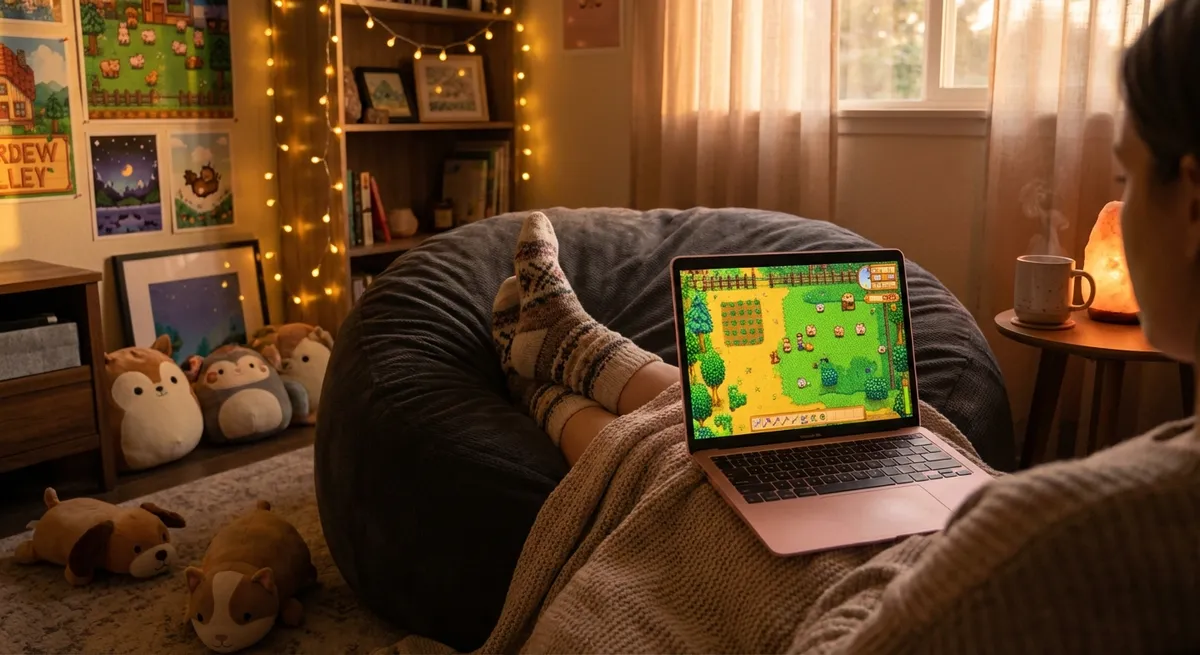
If your idea of a good time used to be headshots and high scores but now somehow involves watering digital plants at 1 a.m., you’re not alone. “Cozy games” — low-stress, low-stakes, vibe-heavy titles — are quietly taking over Steam libraries, Nintendo Switch dashboards, and mobile screens.
This isn’t just a mood shift; it’s a tech story. From clever design tricks to sneaky social features, cozy games are reshaping how and why we play.
Let’s dig into what’s really going on under all that digital soft lighting and cottagecore décor.
Cozy Isn’t Casual: Why These Games Feel So Different
Cozy games get lumped in with “casual,” but they’re playing a different game entirely.
Instead of chasing reflexes and fast reactions, they’re built around comfort, ritual, and low-pressure goals. Think Stardew Valley, Animal Crossing: New Horizons, Spiritfarer, or Unpacking. The tension isn’t “Will I win?” but “How do I want my little world to look and feel today?”
A few design choices make them feel so different:
- No real fail state. You rarely “lose” in a cozy game. Mess up? You can usually fix it, rewind it, or just ignore it.
- Soft progression. You’re nudged forward with gentle milestones instead of big difficulty spikes.
- Sensory focus. Sound design, lighting, and textures matter as much as mechanics. That “click” when you place furniture or harvest crops is intentionally satisfying.
- Time as a feature, not a weapon. Timers, cooldowns, and day/night cycles are usually there to create rhythm, not pressure.
For players who are tired, burned out, or just over the constant competition of ranked modes, that “it’s okay to go slow” design is incredibly appealing — and it’s turning into a major subculture in gaming.
Tech That Feels Like a Weighted Blanket
Under the cozy aesthetic, there’s some surprisingly smart technology quietly doing the heavy lifting.
Cozy game devs lean hard on:
- Dynamic soundscapes. Many titles use layered audio systems that change with what you’re doing — fishing, crafting, walking through rain — to create a sense of calm. It’s not just background music; it’s reactive ambiance.
- Gentle haptics. On platforms like the Switch, tiny vibration patterns make things like fishing, planting, or opening drawers feel tactile without being overwhelming.
- Deliberate frame pacing. These games often avoid hyper-slick, snappy animation in favor of slower, more deliberate movement. Your character doesn’t zip around; they stroll.
- Soft UI and color science. Rounded shapes, desaturated colors, and minimal clutter are used to lower visual “noise” and mental load. You’re not bombarded with quest markers and red warning icons.
The result is something tech enthusiasts will recognize: a carefully tuned feedback loop where small actions (place a chair, pet a cat, cook a meal) feel soothing, responsive, and just “right.” It’s UX design turned into a mood.
Social Without the Stress: Multiplayer, But Make It Cozy
Cozy games didn’t skip the social wave — they just rewired it.
Instead of leaning on leaderboards and ranked modes, they create space for:
- Low-pressure shared spaces. In Animal Crossing: New Horizons, visiting a friend’s island feels more like dropping by someone’s apartment to hang than “playing a match.”
- Asynchronous connections. Leaving notes, sending in-game mail, sharing designs and screenshots — you’re playing “together” even if you’re never online at the same time.
- Soft collaboration. Games like Stardew Valley co-op let you work on a farm together, but it’s okay if someone logs off mid-season. Nobody’s team is ruined; progress keeps flowing.
- Show-and-tell culture. A huge part of the fun is sharing your setups on Reddit, TikTok, and Discord: room layouts, outfit combos, weird villagers, or perfectly arranged bookshelves.
For tech-minded players, there’s something interesting here: these games are basically social platforms disguised as farms, towns, and apartments. The mechanics are built for connection, but without ping anxiety or “play every day or fall behind” pressure.
The Hidden Systems Behind “Do Whatever You Want” Gameplay
Cozy games feel simple, but under the hood they often run on surprisingly intricate systems.
Some of the tech-y bits hiding under the chill surface:
- Schedule-based NPCs. Villagers and characters often run on internal routines (wake up, eat, roam, sleep) that make the world feel alive, even if it never gets in your way.
- Lightweight simulation. Crop growth cycles, weather patterns, and resource generation are often driven by simplified simulations tuned for “pleasant randomness” instead of realism.
- Progression without grind spikes. Instead of steep XP curves, cozy games often use multiple small progress tracks — collections, crafting recipes, relationship levels — so you’re always nudging something forward.
- “Toy” design inside “game” design. A lot of cozy games work like digital toys: the mechanics are loosely structured so you can improvise your own goals. Unpacking is basically physical object simulation packaged as storytelling.
From a systems perspective, that’s the clever part: everything is tuned so your brain always feels a bit of momentum without feeling like it’s clocking in for a second job.
Why Tech People Are So Into Cozy Games (Even If They Won’t Admit It)
Look around dev Twitter, programmer subreddits, or engineering Slack channels and you’ll notice a pattern: a lot of people who spend their workday in high-pressure, logic-heavy environments are unwinding with games where the biggest decision is “Do I plant pumpkins or beans?”
There are some clear reasons:
- Control without chaos. When real-world systems (or production servers) feel unpredictable, a tiny manageable world you can arrange exactly how you like is deeply satisfying.
- Low cognitive load. After debugging or long meetings, your brain doesn’t always want more challenge. It wants predictable loops and gentle rewards.
- Creativity without stakes. You can experiment with layouts, colors, and designs without the “this has to ship” pressure.
- Healthy-ish escapism. Compared to endless doomscrolling or late-night ranked queues, cozy gaming offers a slower, more intentional way to unplug.
And because so many cozy games land on PC and Switch — platforms tech fans already love — they slip easily into existing setups: Steam Deck on the couch, Switch on a flight, laptop in bed (no judgment).
Conclusion
Cozy games aren’t just a wholesome trend; they’re a quiet reset button for how games can feel.
They prove you don’t need boss fights, loot drops, or battle passes to keep people coming back. Carefully tuned feedback, gentle systems, smart audio, and low-pressure social features can be just as sticky — maybe more so for players who spend all day in high-speed, high-stakes tech worlds.
If your brain is tired of being “cracked out on productivity” 24/7, don’t be surprised if your next favorite game is the one that just asks you to water a plant, pet a dog, and watch the in-game sunset… and somehow, that’s enough.
Sources
- “Cozy Games” and the Gaming Industry’s New Love for Calm - The New York Times explores the rise of cozy games and why players are flocking to them
- The Psychology of Video Games and Relaxation - American Psychological Association summary of research on games and mental health benefits
- Animal Crossing: New Horizons Official Site - Nintendo’s page outlining key features and design focus of one of the biggest cozy titles
- Stardew Valley Official Site - Official game site detailing core mechanics and systems under a laid-back farming sim
- “Unpacking” Developer Postmortem at GDC - GDC coverage of how the devs built a minimalist, cozy experience around everyday objects
Key Takeaway
The most important thing to remember from this article is that this information can change how you think about Gaming.