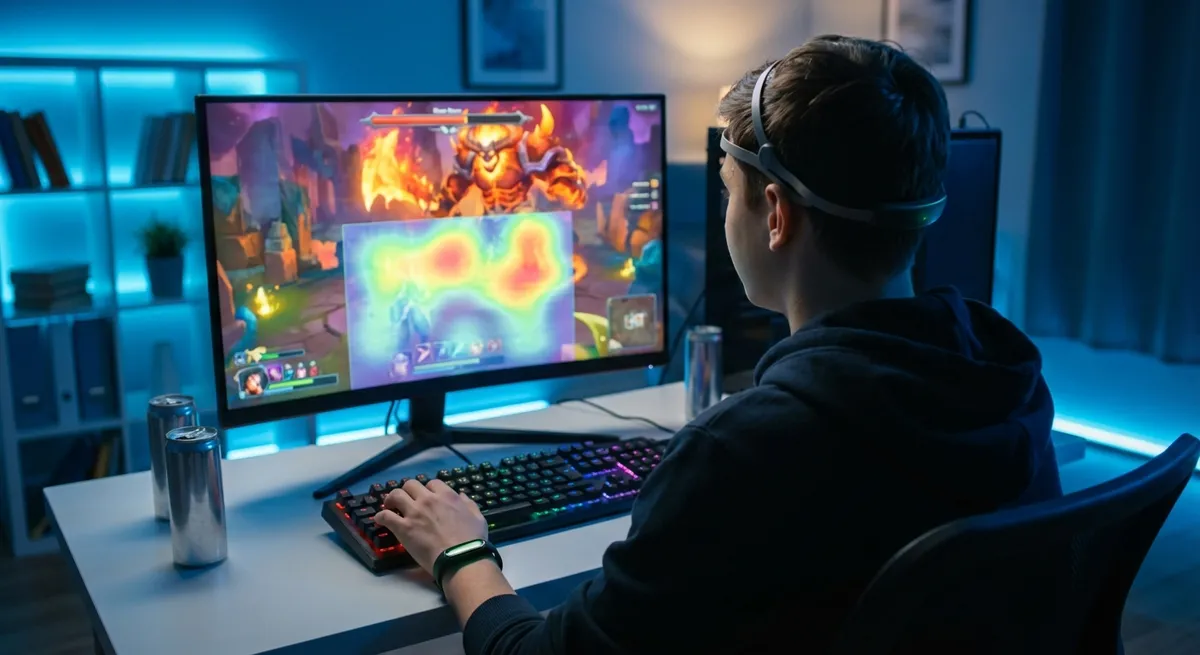
If you still think “better graphics” is the most interesting thing happening in gaming, you’re missing the good stuff. Modern games are quietly turning into mini science labs, fitness trackers, social experiments, and sometimes… lie detectors. Under the hood, there’s a ton of tech doing bizarre, clever, and occasionally creepy things to keep you playing just one more round.
Let’s dig into five surprisingly nerdy ways gaming tech is evolving that go way beyond frame rates and resolutions.
1. Your Controller Knows More About Your Body Than Your Smartwatch
The humble game controller is low-key becoming a bio-sensor without calling itself one.
High-end controllers and accessories are already tracking things like:
- Pressure on buttons and triggers (how hard you press when stressed)
- Micro-movements and reaction times
- How quickly your hands move or shake in intense moments
VR gear and some experimental controllers are going even further with:
- Heart rate tracking
- Skin temperature
- Pupil dilation (with eye-tracking headsets)
Why should you care? Because all of this can feed into the game:
- Horror games can literally detect when you’re calm and then hit you with the jump scare.
- Difficulty can adjust itself when your stress level spikes.
- Multiplayer shooters could identify when you’re “tilting” and match you more gently so you don’t rage-uninstall.
We’re not fully there yet in mainstream games, but the building blocks exist. The same sensors powering fitness apps and VR productivity tools can easily be pointed at understanding how freaked out you are in a haunted house level.
2. VR Isn’t Just a Screen on Your Face Anymore
Virtual reality started as “two tiny screens strapped to your face,” but now the headsets themselves are turning into full-blown computers with surprisingly smart tech inside.
Modern VR gear is experimenting with:
- Eye-tracking: The headset knows exactly where you’re looking. That’s used for:
- Making graphics sharper only where your eyes are focused (called foveated rendering)
- Figuring out what actually draws your attention in a game
- Hand-tracking: Some headsets let you ditch controllers completely and just use your hands
- Room mapping: Headsets build a simple 3D model of your room so you don’t punch your TV during Beat Saber
The cool part for tech geeks: a lot of this was originally built for completely different fields—like medical imaging, robotics, and automotive safety—and then got repurposed for gaming.
VR is one of the clearest examples of gaming acting as a testbed for serious tech. Headsets are training companies to design better sensors, better optics, better chips, and better real-time 3D environments that will absolutely show up in non-gaming products later.
3. AI NPCs Are Getting… Uncomfortably Aware
Non-player characters (NPCs) have always been a bit dumb. Ask them a slightly weird question and they loop back to “Hello, traveler!” like they’ve been reset.
That’s changing—fast.
Game studios are starting to experiment with:
- NPCs that remember your past choices and conversations more deeply
- Dynamic dialogue systems that aren’t just pre-scripted lines
- Enemies that adapt to your playstyle instead of following hard-coded patterns
AI tools are being used to:
- Generate more varied voice lines so characters don’t repeat themselves every five minutes
- Animate faces more realistically to match emotional tone
- Predict where you might go next and load that content in advance
The wild part isn’t just that NPCs are getting smarter. It’s that the tools used to write them are starting to assist (or partially automate) design work. That means smaller dev teams can build more complex worlds, and games can feel less like “interacting with a script” and more like hanging out in a simulation that actually reacts to you.
We’re not at full “talk to any character about anything” yet. But the idea that your favorite game might secretly be running a lot of AI behind the scenes? That’s not sci-fi anymore.
4. Gaming Hardware Is Quietly Powering Serious Research
Those high-end gaming PCs and consoles? They’re basically compute monsters that just happen to be optimized for fun.
The exact same kinds of chips that render your favorite open-world game are also used for:
- Machine learning and AI model training
- Medical imaging and simulations
- Weather prediction and climate modeling
- Scientific visualizations
Even if you never install anything more serious than Steam, you’re benefiting from that overlap. Why?
- GPU competition driven by gamers helps make faster, more efficient chips.
- Game engines (like Unreal and Unity) are reused in architecture, film production, automotive design, and even military simulations.
- Better tools for lighting, physics, and animation in games turn into better tools for real-time 3D in other industries.
At one point, people literally used PlayStation 3 consoles linked together as cheap supercomputers. Now, pro-level GPUs you can slot into a gaming rig are doing everything from training chatbots to helping detect cancer in medical scans.
Your “gaming setup” is basically a discounted version of what research labs would have killed for a decade ago.
5. Cloud Gaming Is Quietly Changing Who “Owns” the Power
Cloud gaming sounds simple on the surface: instead of running the game on your console or PC, a remote server does the heavy lifting and streams the footage to you.
But under the hood, it completely changes the equation for:
- How games are built
- How often hardware needs to be upgraded
- Where the “real” game actually lives
Instead of everyone owning a powerful device, we’re moving toward:
- Centralized data centers running high-end GPUs and CPUs
- Thin clients: phones, TVs, cheap laptops just decoding video streams
- Instant-on experiences where long installs and updates are handled remotely
The tech challenges are gnarly: low-latency streaming, smart input prediction, and dynamic scaling to handle peak loads. But the upside is huge:
- You can play demanding games on a basic device.
- Hardware constraints start to matter less to players.
- Developers can, in theory, design games assuming powerful servers, not average home setups.
For tech enthusiasts, this is fascinating because it blurs the line between “console” and “service.” Your future “console generation” might just be an app on your TV, backed by a server farm you never see—but definitely feel whenever your internet hiccups.
Conclusion
Modern gaming tech isn’t just about pretty pixels anymore. It’s:
- Reading your body and mood through sensors and inputs.
- Turning VR headsets into portable labs for optics and spatial computing.
- Letting NPCs borrow AI tricks from much more serious fields.
- Using gaming hardware as a backdoor into high-performance computing.
- Shifting raw power from your living room to cloud data centers.
If you’re into tech, gaming has become one of the most fun places to watch emerging ideas get tested in the wild. It’s messy, experimental, sometimes broken—but that’s exactly what makes it so interesting.
The next time someone says gaming is “just entertainment,” remember: the same hardware and software that renders your favorite boss fight might be quietly shaping the future of AI, medical imaging, and how we interact with digital worlds in general.
Sources
- NVIDIA: What Is a GPU? - Explains how GPUs evolved from gaming graphics to powering AI, scientific computing, and more
- Meta Quest VR: Technologies Behind the Headsets - Official overview of tracking, optics, and processing tech inside modern VR headsets
- Microsoft Azure: Cloud Gaming with Xbox Cloud Gaming - Describes how cloud infrastructure powers modern game streaming experiences
- Unity for Industry - Shows how a game engine is repurposed for automotive, architecture, film, and simulation
- Sony Interactive Entertainment: DualSense Wireless Controller Features - Details haptic feedback and adaptive trigger tech that enable more advanced input and feedback systems
Key Takeaway
The most important thing to remember from this article is that this information can change how you think about Gaming.