We like to think of gadgets as “nice-to-have” toys, but the truth is a lot we own right now would look like magic to someone from even 2005. Your watch can warn you about heart issues, your earbuds can cancel the world, your phone can map your house in 3D, and a robot might be cleaning your floor while you read this. Let’s unpack some of the most quietly wild things modern gadgets are doing—without turning it into a spec sheet snoozefest.
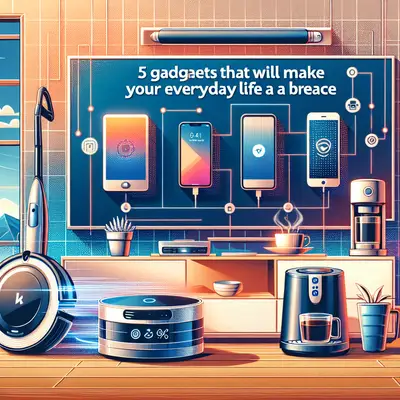
Below are 5 very real, very now gadget tricks that feel a little bit like time travel.
1. Smartwatches Are Becoming Early-Warning Systems for Your Heart
Smartwatches started as tiny notification billboards. Now they’re inching toward “on-wrist checkup” status.
Modern watches and fitness bands can:
- Run ECG-style readings to flag irregular heart rhythms (like atrial fibrillation)
- Track blood oxygen levels and breathing patterns while you sleep
- Estimate your stress level using heart rate variability
- Ping you if your heart rate is abnormally high or low when you’re just sitting there
These aren’t toys. Apple, Samsung, Fitbit and others have worked with doctors and researchers so some of these features are FDA-cleared or built on validated methods. People have literally been prompted by their watch to see a doctor—and discovered conditions early.
They’re not perfect. They can trigger false alarms, and they’re not a replacement for actual medical equipment. But as always-on, low-effort health sensors, they’re quietly changing how we think about “going to the doctor.” Instead of once a year, your body is being passively scanned all day.
2. Noise-Canceling Earbuds Are Personal Force Fields for Sound
Active noise cancellation (ANC) used to be a bulky-headphones-on-a-plane kind of thing. Now it lives in tiny earbuds that disappear into your ears.
Here’s the wild part: your earbuds are basically doing real-time math on the world around you.
- Built-in microphones listen to outside noise
- A chip instantly creates an opposite sound wave
- The two waves collide and cancel each other out before they hit your eardrum
The result: the roar of an airplane cabin turns into a soft hum, the subway sounds less like chaos, and open offices become survivable.
The tech is getting smarter, too. Some earbuds adjust cancellation based on your surroundings, and many have “transparency” modes that boost outside sound when you need awareness (walking, cycling, or trying not to miss your name at the coffee shop).
It’s not just comfort. Better sound isolation often means you listen at lower volumes, which is good news for your long-term hearing—basically, a tiny health upgrade disguised as a luxury feature.
3. Your Phone’s Camera Is Secretly a Handheld Scanner, Lab, and Studio
We talk about megapixels, but the really fun stuff is what your phone is doing with all that data.
Modern phone cameras can:
- Combine multiple photos into one sharper, brighter shot (computational photography)
- Deliver long-exposure-style night photos without a tripod
- Use AI to recognize scenes, text, pets, and even specific objects
- Turn documents into clean, readable PDFs with auto-cropping and straightening
Under the hood, your phone is crunching an absurd amount of information every time you tap the shutter. It learns where faces are, fixes colors, balances shadows, and often sharpens details it “thinks” you meant to capture.
Beyond photos, that camera is a sensor hub:
- AR apps can scan your room and place virtual furniture at realistic scale
- Visual search can identify plants, products, landmarks, and artwork
- Accessibility tools can read text out loud or describe what’s in the frame
Your “camera roll” is really a blend of optics, software, and AI pretending to be a simple lens.
4. Robot Vacuums Are Quietly Mapping Your House Like Tiny Survey Drones
If you own a robot vacuum, you probably think of it as a roaming dust collector. It’s also a rolling data collector.
Modern bots don’t just bump randomly into furniture anymore. Many:
- Use LiDAR or camera-based mapping to build a layout of your rooms
- Create digital floor plans that you can see in the app
- Remember which zones are carpet, hardwood, or “please avoid the dog’s food bowl”
- Learn more efficient cleaning paths over time
Some models even sync with your smart home, so you can say things like “clean the kitchen” and it will head straight there, steering around your sofa and table legs like it’s done the route a hundred times—which it has.
Behind that calm, circular body is:
- Obstacle detection for cords, socks, and pet messes
- Cliff sensors to avoid stairs
- Sometimes a camera system to visually recognize objects
It’s still a vacuum. But it’s also a consumer-grade robot with spatial awareness, path planning, and object avoidance—all things we used to associate with research labs and self-driving car demos.
5. Smart Lights Are Turning Your House Into a Mood Machine
Smart bulbs and LED strips sound boring on paper: “lights you can control with your phone.” Reality is a bit more fun.
With a handful of smart lights, you can:
- Shift your lighting warmth to match the time of day (cool bright in the morning, warm dim at night)
- Sync colors to movies, games, or music so your room reacts to what’s happening on screen
- Set routines that slowly brighten like a sunrise alarm instead of your phone screaming at 7:00 a.m.
- Trigger scenes: “Movie Night,” “Focus,” “Wind Down,” all with different brightness and color
This isn’t just vibes. Light affects your circadian rhythm—your internal clock. Warmer, dimmer light at night helps signal to your body that it’s time to relax; harsh blue light late at night does the opposite.
By blending simple automation with a bit of science, your lighting turns into a low-effort wellness tool and a party trick. One minute your living room looks like a quiet café; five seconds later it’s a fake neon cyberpunk bar.
Conclusion
The fun thing about modern gadgets is that most of the magic is invisible. You don’t see the algorithms keeping your heart in check, killing background noise, or plotting an efficient vacuum route around your socks—you just tap a button and it “works.”
But under the surface, your everyday tech is doing things that would have felt straight-up sci-fi not long ago. That’s the sweet spot we’re in right now: gadgets that feel simple, while quietly bending the rules of sound, light, health, and space behind the scenes.
Next time your watch nags you to stand up, your earbuds erase a plane engine, or your robot vacuum dodges your cat, remember: you’re basically living with tiny, specialized robots already. The future didn’t just arrive—it scattered itself all over your house.
Sources
- [Apple Heart Study (Stanford Medicine)](https://med.stanford.edu/appleheartstudy.html) - Overview of how consumer wearables were used to detect irregular heart rhythms in a large-scale study
- [U.S. Food & Drug Administration – Examples of AI/ML-Enabled Medical Devices](https://www.fda.gov/medical-devices/software-medical-device-samd/artificial-intelligence-and-machine-learning-aiml-enabled-medical-devices) - Details on FDA-cleared wearable and health-related devices
- [Bose – How Noise-Cancelling Headphones Work](https://www.bose.com/en_us/better_with_bose/better_with_bose_articles/2019/07/how-do-noise-cancelling-headphones-work.html) - Plain-language explanation of the tech behind active noise cancellation
- [MIT Computer Science & Artificial Intelligence Lab – Computational Photography](https://www.csail.mit.edu/research/computational-photography) - Background on techniques that power modern smartphone camera features
- [Harvard Medical School – Blue Light Has a Dark Side](https://www.health.harvard.edu/staying-healthy/blue-light-has-a-dark-side) - Discussion of how light affects sleep, circadian rhythms, and health
Key Takeaway
The most important thing to remember from this article is that this information can change how you think about Gadgets.