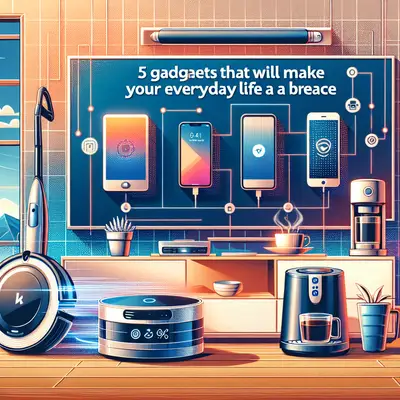
If your idea of “gadgets” is still just phones and laptops, you’re missing the quiet revolution happening in your backpack, on your desk, and maybe even stuck on your fridge. Tiny devices are getting absurdly smart, strangely personal, and way more fun than the spec sheets make them sound.
Let’s dig into some of the most interesting shifts in gadget land right now—no engineering degree required.
1. Your Gadgets Are Learning You, Not Just the Internet
A lot of new devices aren’t trying to be “smarter” in general—they’re trying to be smarter for you.
Think about earbuds that automatically switch from noise-canceling on the train to transparency mode when you start talking, or smartwatches that figure out your usual sleep schedule and nudge you when you’re wrecking it. Instead of you digging through menus, the gadget quietly adapts.
What’s changing now is where the “brains” live. More devices are shifting to on-device intelligence rather than sending everything to the cloud. That means:
- Faster responses (no waiting on a server somewhere)
- More privacy (fewer recordings flying off to the internet)
- Personalization that feels less creepy and more useful
We’re moving from gadgets that just follow commands to gadgets that start quietly anticipating what you’ll want next—without turning into a surveillance horror movie.
2. Everyday Objects Are Getting Upgrade Packs
The new gadget trend isn’t always “buy a whole new thing.” It’s “bolt on brains to the stuff you already own.”
You can already see this with:
- Tiny smart trackers you can slip in your wallet, backpack, or luggage
- Clip-on bike lights that connect to your phone and auto-adjust based on conditions
- Smart plugs that turn ancient lamps into voice-controlled lights
Instead of replacing your favorite analog gear, you’re giving it an upgrade pack.
The fun part for tech fans: this modular approach means you can build your own setup piece by piece. Your “smart home” doesn’t have to be one giant brand ecosystem anymore—it can be a weird little mashup of gadgets you actually like, all stitched together with apps and automation.
3. Batteries Are Quietly Becoming the Star of the Show
Nobody buys a gadget for the battery, but battery tech is starting to decide which devices are even possible.
We’re seeing:
- Faster charging: Power banks and phones that grab hours of use in a few minutes
- Better power management: Headphones, watches, and tiny trackers that last for days or weeks
- Smaller form factors: Thinner batteries letting devices shrink or bend
This matters because it changes what’s realistic:
Wearables went from “charge every night” to “charge once a week.” Smart rings, health trackers, and even tiny fitness sensors are only viable because newer chips sip power instead of chugging it.
The next wave of cool gadgets probably won’t be defined by wild new features—it’ll be defined by things that used to be annoying (like plugging in constantly) quietly disappearing.
4. Screens Are Sneaking Off the Gadget and Onto Anything
The classic gadget look—slab of glass, black rectangle—is starting to feel… boring. So companies are asking: what if the screen didn’t have to live on the device?
We’re seeing early hints of this with:
- Compact projectors that can turn any wall into a temporary TV
- Wearables that project simple visuals onto your skin or a surface
- E-ink displays in unexpected places (keyboards, note-taking gadgets, even coffee mugs)
The goal isn’t always “4K cinema in your pocket.” Sometimes it’s just about moving information closer to where you need it: a softly glowing notification on your desk, a projected keyboard on a table, or a low-power screen you can actually read in sunlight.
For gadget lovers, this opens the door to gear that blends in with your space instead of dominating it—tech that feels more like part of your environment than a glowing rectangle demanding your attention.
5. Tiny Sensors Are Turning Your Life Into a Quiet Data Stream
The most powerful part of a lot of modern gadgets isn’t the display or the processor—it’s a cluster of sensors you never see.
In a single small device you might get:
- An accelerometer (movement)
- A gyroscope (rotation)
- A heart-rate sensor
- A temperature sensor
- A light sensor
- A microphone array
Individually, they’re simple. Together, they can paint a surprisingly rich picture of what you’re doing and how you’re doing.
That’s how:
- Fitness gadgets can tell whether you’re walking, running, or lifting
- Some headphones can auto-pause when you take them off
- Smart tags know if something’s been moved or dropped
We’re inching toward a world where your gadgets quietly understand context: “You’re biking home at night in the rain” instead of just “You pressed button X.” The real magic isn’t in one flashy feature; it’s in how all these tiny sensors work together to make your stuff feel less dumb.
Conclusion
Gadgets used to be all about raw specs: more pixels, more cores, more “Pro” in the name. Now the interesting stuff is happening in the background—how devices adapt, connect, and fade into your life instead of shouting for attention.
The fun part for tech enthusiasts? You don’t need to wait for some distant sci-fi future. The weirdly smart, quietly clever, slightly magical gadgets are already here—you just have to look beyond the usual rectangles.
Sources
- [Apple – iPhone: Privacy and on-device processing](https://www.apple.com/privacy/features/) - Explains how modern phones handle more tasks locally for speed and privacy
- [Google AI Blog – On-device machine learning](https://ai.googleblog.com/2021/03/on-device-ml-what-it-is-and-why-it.html) - Overview of why more intelligence is moving onto gadgets themselves
- [MIT Technology Review – The future of battery technology](https://www.technologyreview.com/2023/01/03/1064871/battery-technology-breakthroughs-energy-storage/) - Covers advances in battery tech that enable longer-lasting portable devices
- [Harvard Gazette – Wearable sensors and health tracking](https://news.harvard.edu/gazette/story/2020/05/how-wearable-technology-is-changing-health-care/) - Discusses how small sensors in gadgets are reshaping health monitoring
- [The Verge – The rise of ambient computing](https://www.theverge.com/2019/12/19/21029805/ambient-computing-smart-home-always-on-devices) - Explores how gadgets are blending into environments instead of acting as standalone screens
Key Takeaway
The most important thing to remember from this article is that this information can change how you think about Gadgets.