AI headlines are everywhere, but they usually sound either apocalyptic or painfully boring. What’s actually happening in the middle is way more interesting: AI is sneaking into unexpected places, picking up “skills” nobody planned for, and changing how we create and interact with tech.
Let’s dig into five ways AI is quietly getting strange, surprisingly creative, and a lot more personal—without drowning in jargon.
1. AI Is Starting to “Dream” Up Things That Never Existed
Most people know AI can answer questions or write some text. But the really wild part? It’s getting good at inventing things from scratch: images, music, voices, 3D objects, even fake people.
These are called “generative” AIs—they don’t just classify or label stuff, they create new content based on what they’ve seen before. Give them a prompt like “a retro-futuristic city made of glass” and they’ll generate something humans haven’t drawn, photographed, or built yet.
This is why:
- Artists use tools like DALL·E and Midjourney to sketch ideas faster than they can draw.
- Designers test dozens of logo or layout concepts in minutes.
- Game devs prototype characters, worlds, and props without modeling every tiny detail by hand.
- Musicians experiment with AI to generate backing tracks, remixes, or sound design ideas.
It doesn’t replace creativity, but it does change it. Instead of staring at a blank canvas, you’re more like a DJ: you remix, guide, and refine what the AI spits out. The people who get the best results aren’t “coding” the AI—they’re prompting it, then editing, combining, and polishing.
The weird twist: AI sometimes generates things that don’t fully make sense—misshapen hands, impossible geometry, nonsense text in images. Those glitches are like a peek under the hood, reminding us this isn’t “magic,” it’s pattern remixing with style.
2. Your Devices Can Read the Room Better Than They Read You
A lot of current AI isn’t focused on you as a person—it’s watching the environment instead.
Phones, cars, cameras, and smart home devices are getting insanely good at “scene understanding,” which is basically: What’s happening right now, and what should I do about it?
Some examples:
- Your phone’s camera switches modes automatically because it recognizes low light, a face, or a moving subject.
- Cars use AI to spot pedestrians, road signs, and lane markings, then adjust steering, braking, or alerts.
- Video doorbells detect packages, people, or pets without you watching the feed 24/7.
- Smart thermostats learn when you’re usually home and adjust temperature patterns on their own.
Under the hood, these systems are analyzing images, audio, or sensor data in real time, not just reading a script. They’re not “understanding” in the human sense, but they’re pretty good at the pattern recognition part.
The result: tech that feels less like a tool and more like a coworker that’s always paying attention. Sometimes that’s convenient (“thanks for turning on Night Mode”), sometimes creepy (“how did my phone know I was in a car?”), and sometimes lifesaving (collision warnings, fall detection, early fire alerts).
The more context AIs get, the more they’ll quietly act on your behalf—often before you even realize there was a decision to be made.
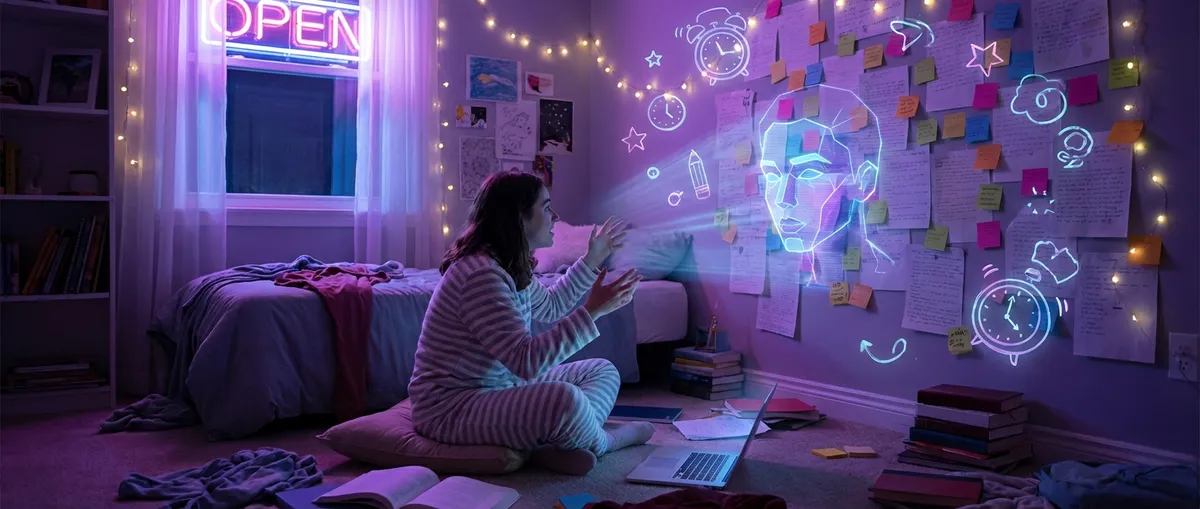
3. AI Is Becoming the New Creative Sidekick, Not Just a Calculator
Early AI felt like a fancy spreadsheet: useful, but not exactly inspiring. Now it’s turning into a surprisingly decent creative partner.
Writers, coders, designers, and video editors use AI less as an answer machine and more as a brainstorming buddy:
- Writers draft outlines, alternative headlines, or character ideas with AI, then rewrite in their own voice.
- Developers use AI copilots to suggest code, catch bugs, or convert one language to another.
- Video creators use tools that automatically cut, subtitle, or even reframe videos for different platforms.
- Designers generate mood boards, color palettes, or concept art to explore ideas faster.
The key shift: You’re not asking AI “Do this for me,” you’re saying “Help me move faster from rough idea to polished thing.”
But there’s a trap. Overusing AI can make everything feel same-y—generic blog posts, bland designs, repetitive videos. The fun stuff usually comes when:
- You use AI for the messy middle: drafts, variations, experiments.
- You keep a strong personal style or brand voice.
- You treat AI outputs as raw material, not finished work.
In other words: AI can massively speed up the boring parts of creativity—but the taste, judgment, and weirdness still have to come from you.
4. AI Models Are Starting to Talk to Each Other (and That’s a Big Deal)
Right now, most of us interact with AI in a one-on-one way: you type, it responds. But behind the scenes, we’re moving toward a world where multiple AI systems collaborate—sometimes without you directly in the loop.
Think of it like this:
- One AI filters spam from your inbox.
- Another AI summarizes the important emails.
- A third AI drafts replies for you to tweak and send.
They’re not one giant brain; they’re specialized bots handing off tasks like a digital assembly line.
This is showing up in:
- Customer support, where chatbots pull answers from documentation, your account data, and past tickets.
- Productivity tools that connect AI to calendars, docs, and task lists so actions happen automatically.
- Developer tools where AI agents search code, write tests, and propose fixes while another system checks security.
The interesting part for tech enthusiasts: “multi-agent” setups change the game. Instead of you micromanaging every prompt, you might set a goal (“Organize my week” / “Optimize this codebase” / “Prepare a project brief”) and a swarm of behind-the-scenes AIs negotiate the steps.
We’re still early—but this shift is what might make AI feel less like a chatbot and more like an invisible, hyperactive assistant team that never sleeps.
5. The New Superpower Isn’t Just Using AI—It’s Questioning It
Here’s the plot twist: as AI gets more powerful, the most valuable skill isn’t feeding it better prompts—it’s knowing when not to trust it.
AI can:
- Make up facts with total confidence (this is called “hallucination,” but “confident nonsense” is more accurate).
- Repeat biases found in its training data (on gender, race, politics, you name it).
- Generate fake images, audio, and video that look real enough to fool people who aren’t paying attention.
So the real superpower is becoming “AI literate”—you don’t have to become a researcher, but you do want some instincts, like:
- Always double-check important facts, especially health, finance, legal, or news-related info.
- Look for original sources when something sounds too wild or too convenient.
- Treat AI content like a rough draft, not a final decision.
- Learn the basics of how these systems are trained and where they might fail.
The good news: governments, universities, and tech companies are starting to release guidelines, tools, and rules around responsible AI. Watermarks for AI images, fact-check tools, and clearer labeling of AI-generated content are all part of that.
In the same way people had to learn “don’t believe every random website,” we’re now in the “don’t believe every confident AI output” era. The people who thrive with AI aren’t the ones who blindly trust it—they’re the ones who know how to push, verify, and correct it.
Conclusion
AI isn’t just a buzzword or a black box—it’s turning into a strange mix of creative partner, hyper-attentive background helper, and occasionally overconfident storyteller.
For tech enthusiasts, this moment is particularly fun because:
- The tools are finally accessible without a PhD.
- The most interesting uses are coming from regular creators, not just giant companies.
- The “rules” are still being written, both technically and ethically.
If you treat AI as a collaborator instead of a replacement, stay skeptical about its answers, and keep your own style and judgment in the driver’s seat, it stops being scary and starts being exactly what No Bored Tech is about: powerful toys that actually do something interesting.
Sources
- OpenAI – About and Research Overview – Background on how modern generative AI models are developed and what they’re being used for
- MIT CSAIL – Artificial Intelligence Research – Examples of cutting-edge AI work in perception, multi-agent systems, and human–computer interaction
- Stanford University – AI Index Report – Data-driven overview of how AI is evolving in creativity, productivity tools, and industry use
- U.S. Federal Trade Commission – AI and Algorithms Guidance – Practical look at risks, bias, and responsible AI practices from a regulatory perspective
- Harvard University – “The Risks of Deepfake Technology” – Discussion of AI-generated media, misinformation, and why critical thinking around AI outputs matters
Key Takeaway
The most important thing to remember from this article is that this information can change how you think about AI.