If you’ve ever told someone “I swear, gaming makes me smarter,” this one’s for you. Behind all the loot drops, killstreaks, and late‑night raids, there’s a surprising amount of real science happening in your brain and in your hardware.
Let’s pull back the curtain on what’s actually going on when you boot up your favorite game—and why tech geeks should absolutely care.
Reaction Time: Your Brain on 144Hz
If you’ve ever switched from a 60Hz monitor to 120Hz or 144Hz and thought, “Wow, this feels faster,” you’re not imagining it.
Higher refresh rates and lower input lag don’t just look smoother—they literally change how quickly and accurately your brain can react to what’s on screen. Competitive gamers especially are basically training ultra-fast perception loops without realizing it.
Researchers have found that:
- Action games can improve visual attention, letting you track more objects at once.
- Gamers can sometimes detect subtle changes on screen faster than non-gamers.
- Even short sessions over time can sharpen reaction times in certain tasks.
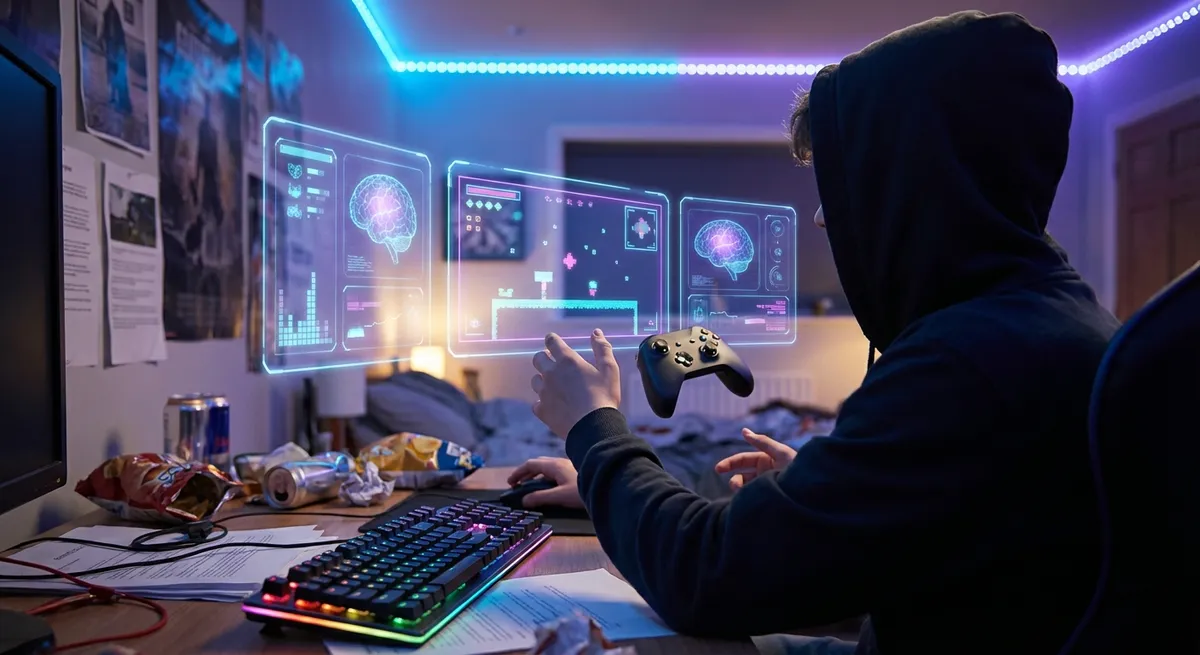
Your mouse clicks, key presses, and joystick flicks are all feeding into a feedback loop that tightens your hand–eye coordination. That ranked grind you’re doing? It might actually be low-key cognitive training.
Game Worlds as Sandbox Simulations
Underneath the pretty graphics, many modern games are essentially full-blown simulation engines.
Think about it:
- Open-world games simulate day/night cycles, weather, physics, AI behavior, and resource systems.
- Strategy games quietly run predictive models to simulate economies, battles, and population changes.
- Driving and sports games often pull from real-world physics equations to keep movement believable.
What’s wild is how game tech overlaps with “serious” simulations:
- Urban planners and researchers use game-like 3D environments to model traffic and city growth.
- Pilots and soldiers train in sims that share core tech with consumer games.
- Architects and designers use game engines (like Unreal Engine) to create interactive building walkthroughs.
So when you’re messing around in a massive open world, you’re actually playing inside a highly optimized, user-friendly version of the same kind of tech used for research, training, and design decisions in the real world.
Game Music Is Basically Mood Engineering
That moment when the music swells right before a boss fight? That’s emotional manipulation—and game audio teams are very good at it.
Game soundtracks aren’t just “background noise”:
- Dynamic music systems adjust tempo and intensity based on what you’re doing.
- Subtle sounds (like footsteps, distant gunfire, or wind) cue your brain to feel tension, safety, or curiosity.
- Some games change key or instrumentation without you noticing, slowly pulling you into a different emotional state.
From a tech perspective, your console or PC is constantly mixing dozens of audio layers in real-time:
- Different instruments or tracks fade in as enemies appear.
- Filters and reverb change depending on where you are (cave, open field, city, underwater).
- Spatial audio tech can simulate where sounds are coming from, making VR and FPS games feel way more immersive.
Your headset isn’t just delivering sound—it’s delivering carefully engineered emotional cues that guide how you experience each moment.
Matchmaking: Algorithms Deciding Your Fun
You hit “Play,” get dropped into a lobby, and assume it’s random. It almost never is.
Modern multiplayer games lean hard on matchmaking algorithms that sort players based on:
- Skill level (often using ranking systems like ELO or hidden “MMR” ratings)
- Recent performance (to avoid putting you into total stomp-fests)
- Connectivity and ping
- Player behavior, if the game tracks reports or toxicity
From a tech point of view, your game server is constantly trying to balance:
- Fairness (evenly matched teams)
- Engagement (you should win sometimes, lose sometimes, and always almost feel like you could have done better)
- Queue times (faster matches vs. perfect balance)
- Region and latency
That “suspiciously sweaty” lobby after a win streak? That’s the algorithm trying to keep you in a sweet spot between frustration and boredom. It’s data science, psychology, and network engineering rolled into one invisible system.
Cloud Gaming and the “Your Console Is Somewhere Else” Future
Cloud gaming flips the usual setup on its head. Instead of your console or PC doing the heavy lifting, a remote server farm is running the game—and just streaming the video to you.
What’s happening under the hood:
- Your inputs (button press, mouse move) are sent over the internet to a remote machine.
- That machine renders the frame, encodes it as a video stream, and sends it back.
- This entire round trip has to feel instant, or the game feels laggy and unplayable.
This is why cloud gaming is such a big technical challenge:
- Latency has to be insanely low, especially for fast-paced games.
- Data centers need powerful GPUs and CPUs to run many game instances at once.
- Compression tech has to keep the stream looking good while staying responsive.
For players, the payoff is huge: no big downloads, no hardware upgrades, and the ability to play demanding games on weaker devices like phones, tablets, or basic laptops. For the industry, it’s also a shift in control—from “you own the box” to “you borrow the experience over a connection.”
Conclusion
Gaming looks like pure fun from the outside, but under the surface it’s a mashup of neuroscience, simulation tech, audio engineering, data science, and cloud infrastructure—all wrapped in a controller-shaped package.
So the next time someone says, “It’s just a game,” you can nod, queue up your next match, and quietly appreciate the wild amount of tech and brainpower that makes your favorite worlds possible.
Sources
- [American Psychological Association – Video Games Play May Provide Learning, Health, Social Benefits](https://www.apa.org/news/press/releases/2013/11/video-games) - Overview of research on how video games can affect cognition, perception, and behavior
- [Nature – Action Video Game Modifies Visual Selective Attention](https://www.nature.com/articles/nn1025) - Research article on how action games can change visual attention and reaction times
- [Epic Games – Unreal Engine Uses in Architecture, Simulation, and Training](https://www.unrealengine.com/en-US/solutions) - Examples of how game engines power simulations beyond entertainment
- [NVIDIA – What Is Cloud Gaming?](https://www.nvidia.com/en-us/geforce-now/cloud-gaming/) - Explanation of cloud gaming tech and how remote game streaming works
- [Dolby – What Is Spatial Audio?](https://www.dolby.com/experience/spatial-audio/) - Breakdown of spatial audio concepts that underpin immersive game sound design
Key Takeaway
The most important thing to remember from this article is that this information can change how you think about Gaming.