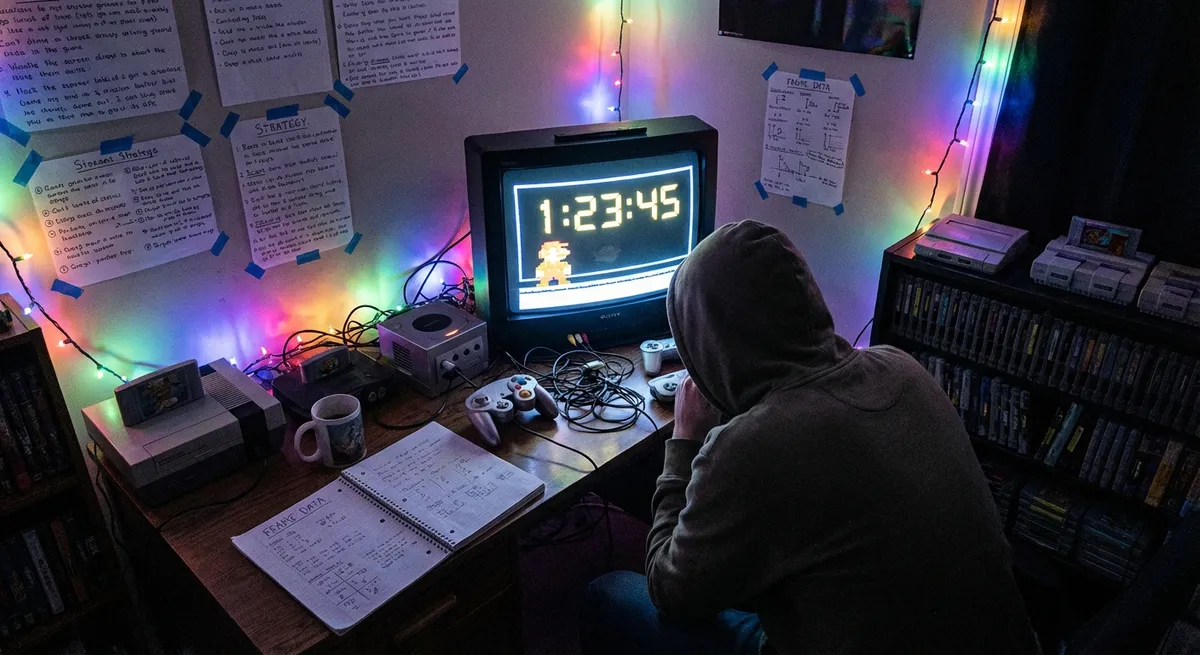
Speedrunning used to be that one weird corner of the internet where people beat old games in ridiculous times and yelled a lot on Twitch. Now? It’s basically a full-on tech-powered science lab built on frame counts, glitches, custom tools, and community detective work.
If you’re into gaming and tech, speedrunning is one of the most fascinating subcultures out there. It’s not just “finish the game fast.” It’s “rebuild the game’s physics in your head, bend it until it breaks, and prove it with data.”
Let’s dig into five ways speedrunning quietly turned gaming into a high-tech playground.
1. Beating Games Fast Starts With Reverse-Engineering
Speedrunners don’t just “learn routes” — they reverse-engineer how games actually work.
They’ll pop open emulators with built-in memory viewers and watch what’s happening under the hood: player coordinates, timers, health values, RNG seeds. Once they understand which values control what, they figure out ways to force the game into doing what they want.
Want to clip through a wall? They’ll test angles, positions, and movement speeds until they find a specific combination that makes the collision system freak out. Want a perfect item drop? They’ll learn how the random number generator is seeded and manipulated.
This turns casually “pressing buttons faster” into something closer to applied computer science. The wild part: a lot of this is done by non-programmers who just learned by tinkering, sharing screenshots, and comparing notes in Discord servers, Reddit threads, and Google Docs that read like mini research papers.
2. Tool-Assisted Runs Are Basically Controlled Lab Experiments
You’ve probably seen “TAS” mentioned on speedrun videos. That stands for Tool-Assisted Speedrun — and it’s where the science-lab vibe really kicks in.
In a TAS, players use emulators to:
- Slow the game down to inspect what’s happening frame by frame
- Rewind and rerecord inputs until every move is perfect
- Use scripts to test thousands of possibilities (like jump timings or item routes)
The idea isn’t to “cheat” but to answer questions like:
- What is the absolute fastest way this game can be completed if every input is perfect?
- Are there glitches that are theoretically possible but nearly impossible for humans to pull off consistently?
- Is a world record for humans anywhere near the theoretical limit?
TAS runs often discover new strategies that human runners later adapt in “real-time” runs, just toned down to be more realistic. It’s basically simulation research that later gets applied to “live” competition.
3. Randomness Isn’t Random When You Treat It Like a System
If you’ve ever shouted “this game is rigged” at your monitor, speedrunners would like a word — because they’ve probably already proven exactly how it’s “rigged.”
Most games don’t use true randomness; they use pseudo-random number generators (PRNGs). These are algorithms that spit out numbers based on an initial value (a “seed”). Change the seed or the order in which the game asks for random values, and you change your outcomes.
Speedrunners have:
- Mapped which actions advance the random number generator (like moving, attacking, or opening menus)
- Figured out precise inputs to force favorable outcomes, like rare drops or specific enemy patterns
- Built tools that visualize PRNG states to “read” the game mid-run
This turns things like boss patterns and loot into something closer to a script you can manipulate than pure luck. In some games, runners will deliberately stall, swing at nothing, or open menus just to land on the perfect RNG state—something casual players would never notice.
4. Community Collaboration Looks a Lot Like Open-Source Dev
If you zoom out from any big speedrun scene (say, Super Mario 64 or The Legend of Zelda: Ocarina of Time), what you’ll see looks a lot like an open-source project:
- Public documents outlining routes, with constant version history
- Changelogs describing new “strats” and why old ones are deprecated
- “Patch notes” written every time someone discovers a shortcut or glitch
- Debate over optimal techniques like devs arguing about implementations
You’ll also see heavy use of:
- Spreadsheets for comparing route variations
- Custom-made tools that simulate movement or boss fights
- Scripted bots that analyze recorded runs for timing or input accuracy
Instead of updating software, they’re iterating on the meta of a game: what’s the overall fastest, safest, and most reliable way to beat it under a given category’s rules. The social and technical structure mirrors collaborative software development — except the “product” is shaving fractions of seconds off runs.
5. Hardware, Displays, and Even Cables Actually Matter
Speedrunning doesn’t just live in software. Once you start optimizing for time, suddenly the tech you’re using — from your controller to your TV — becomes part of the run.
A few ways hardware quietly changes everything:
- Input lag: Modern TVs and monitors often add delay unless you use “Game Mode.” For some classic console runs, CRT TVs are still preferred because their near-zero latency lets players react frame-perfectly.
- Controllers: Slightly different d-pads, stick tension, or button layouts can affect consistency. Some runners swear by original controllers; others mod or choose third-party pads designed for precision.
- Loading times: On some games, SSDs, faster consoles, or even different game versions can radically change load times. Many leaderboards separate “real-time” and “in-game time” to account for this.
- Capture setups: Streaming and recording can add a tiny bit of delay or affect how players see their inputs. Advanced setups try to mirror the signal with minimal processing so what you see is as close to instant as possible.
It’s a reminder that “skill” in these high-level runs is always connected to actual physical tech — displays, chips, ports, cables — not just what’s on screen.
Conclusion
Speedrunning is one of the purest intersections of gaming and tech: part esports, part research project, part group obsession with making numbers go down.
You’ve got:
- Reverse-engineering and memory watching
- Tool-assisted experiments pushing games to their limits
- RNG manipulation that makes “luck” feel programmable
- Open-source-style collaboration to discover and refine strategies
- Hardware awareness that treats every frame like it matters
If you’re a tech enthusiast who loves puzzles, systems, and the feeling of breaking things in just the right way, diving into speedrunning might be the most fun “informal lab work” you’ll ever watch — or do.
Sources
- Speedrun.com – Leaderboards and Resources – Central hub for speedrunning communities, categories, and records across thousands of games.
- Games Done Quick (GDQ) – Charity speedrunning marathon showcasing top runners and techniques, plus VODs for studying runs.
- “TASVideos: Tool-Assisted Speedruns” – Archive of tool-assisted speedruns, technical explanations, and documentation on game mechanics and glitches.
- GDC Talk: “Speedrunning Mario: Learning from Super Players” – Game Developers Conference session discussing what devs learned from speedrunners of Mario games.
- MIT CSAIL – “Playing Games with AI and Game Theory” – Broader context on computational approaches to games and optimization that parallel speedrunning methods.
Key Takeaway
The most important thing to remember from this article is that this information can change how you think about Gaming.