If modern games are giant digital playgrounds, they’re also chaos machines. Thousands of things are happening at once—NPCs wandering around, physics doing its thing, your GPU melting—yet somehow it all feels smooth and fun instead of total disaster. The wild part? Under the hood, a lot of that chaos is carefully controlled so your brain never notices the seams.
Let’s dig into five quietly brilliant tricks that keep your favorite games feeling alive, fair, and way more fun than the hardware should realistically allow.
1. Your Game Is Cheating to Make You Feel Good (On Purpose)
Plenty of games quietly bend the rules in your favor—especially when it matters emotionally.
In many shooters, “luck” is often… not luck. Some titles secretly increase your accuracy or critical hit chance when you’re low on health, outnumbered, or on a losing streak. The goal isn’t realism; it’s drama. You get those last-second escapes and clutch wins that make you want to keep playing.
Racing games do something similar with rubber-banding: AI opponents magically slow down if you’re far behind or speed up if you’re too far ahead. It’s not trying to be fair, it’s trying to be tense. The ideal race is one where you barely win, not one where you’re 20 seconds ahead and bored.
Even enemy damage can be “massaged.” Some games quietly reduce damage from hits that would feel cheap or frustrating—like getting one-shot from off-screen—while boosting damage from hits you see coming. That way, when you fail, it feels like your fault, and when you succeed, it feels like skill… even when the numbers disagree.
2. Worlds Feel Huge Because They’re Built Like Stage Sets
Open-world games are famous for their massive landscapes, but they’re not actually simulating everything, everywhere, all at once. They’re more like a movie set: rich where the camera is, cardboard where it isn’t.
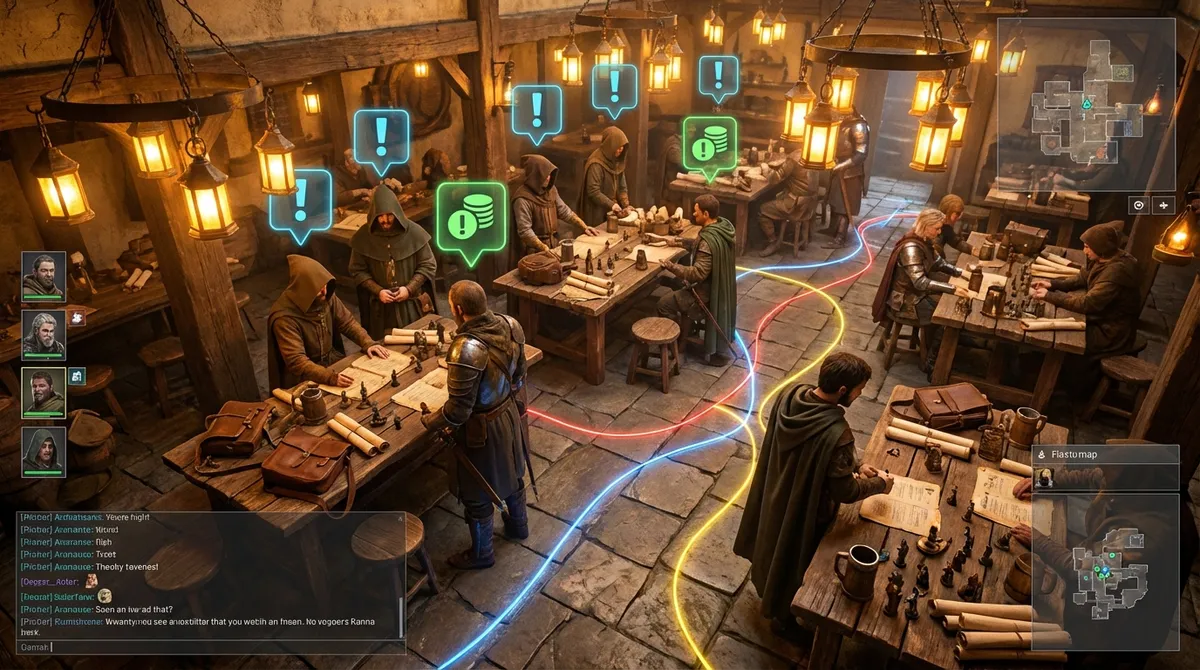
When you’re exploring a city, the game is usually only fully “awake” in the space around you. NPCs that seem to have daily routines might actually be spawned just out of your line of sight and removed when you walk away. Cars, birds, enemies—many of them only exist when you’re close enough to care.
Background buildings might be low-detail shells with detailed interiors only for the places you can actually enter. Trees in the distance? Often just flat textures or simple shapes until you walk near them. This lets developers squeeze more beauty out of limited processing power by putting detail where your eyes are, not where they aren’t.
The illusion works so well that players often believe in fully simulated cities and ecosystems. In reality, the world is constantly being rearranged just off-camera like a backstage crew frantically moving props between scenes.
3. Your Brain Is Doing More Rendering Work Than Your GPU
One of the biggest “cheats” in games isn’t in the code—it’s in your head.
Game designers lean heavily on how your brain fills in gaps. You don’t need a perfectly realistic face to feel a character’s emotions; you just need eyes that track you, expressive animations, and solid voice acting. Your mind connects the dots and builds the rest.
Lighting is another big one. Instead of simulating every possible ray of light perfectly, a lot of games use clever fakes—pre-baked lighting, approximations, or shortcuts. As long as the shadows move how you expect and the mood feels right, your brain accepts it as “real enough.”
Sound design does similar magic. Footsteps echoing in a hallway, muffled music through a wall, distant gunfire—these cues trick your brain into believing in spaces the game isn’t even showing you. You feel like you’re in a giant, continuous world, even if half that world doesn’t meaningfully exist until you walk into it.
In a way, games are less about simulating reality and more about convincing your brain to do half the work for them.
4. Multiplayer Games Are Constantly Fixing Time Behind Your Back
Online games have a physics problem: it’s impossible for every player to see the same thing at the exact same time. Your internet connection has latency. So does everyone else’s. Yet shooters, battle royales, and fighters still manage to feel (mostly) fair.
To pull this off, a lot of online games quietly mess with time.
When you fire a shot in a competitive shooter, the server might roll the world back a tiny fraction of a second to where the target was when you pulled the trigger, based on your connection delay. This lets your hit register even if, on someone else’s screen, they were already a step to the side.
On your end, your movement feels instant and responsive because your game “predicts” what the server will say you did and shows that immediately. If the server disagrees a moment later, the game corrects your position—usually in tiny, subtle ways so you don’t notice a snap or a jitter.
It’s basically time travel plus guesswork, happening dozens of times per second, so everyone can argue about “lag” in group chat while the system quietly keeps the whole thing from falling apart.
5. Games Are Secretly Testing Future Tech Before the Rest of the World
Games are often where wild tech ideas get tried first—long before they become normal in everyday life.
Take graphics tech like real-time ray tracing. The push to simulate realistic lighting, reflections, and shadows in games has driven GPU design hard, and that same hardware is now deeply involved in AI workloads, scientific visualization, and creative tools.
Haptics (vibration feedback) in controllers started with simple buzzes; now you’ve got finely tuned resistance in triggers and nuanced feedback that matches on-screen textures or tension. Those same ideas influence how we think about touch feedback in phones, wearables, and even medical or training simulators.
Even virtual economies and digital ownership got early trial runs in MMOs and online games—long before anyone started arguing about NFTs, “the metaverse,” or virtual land. Games have been quietly running complex social, economic, and technical experiments at massive scale for decades.
If you want to see where mainstream tech might be headed, watching what games are experimenting with is often a pretty strong early signal.
Conclusion
Modern games are less like static products and more like live, carefully managed illusions. Underneath the explosions, dramatic cutscenes, and open worlds is an absurd amount of quiet trickery: bending the rules to make you feel skilled, faking huge worlds with small slices of real simulation, repairing time in online matches, and using your own brain as a co-processor.
For tech enthusiasts, that’s the fun part. Games aren’t just entertainment—they’re test labs for the next wave of graphics, networking, AI, and human-computer interaction. The next time you clutch a win or get lost in a world that feels way too big for a plastic box under your TV, remember: it’s not just good design. It’s a whole stack of invisible hacks working together to keep the chaos playable.
Sources
- Valve Developer Community – Lag Compensation - Explains how Source engine games handle rewinding time for hit registration in online play
- NVIDIA – What Is Ray Tracing? - Overview of real-time ray tracing and how games pushed it into consumer hardware
- GDC Vault – The Illusion of Intelligence: The Integration of AI and Level Design in F.E.A.R. - Talk on how games fake complex AI behaviors to feel more realistic
- Sony Interactive Entertainment – DualSense Wireless Controller Features - Details on advanced haptics and adaptive triggers used in modern game controllers
- Rockstar Games – Red Dead Redemption 2: Technology Overview (Digital Foundry) - In-depth look at how a major open-world game streams and manages its massive environment
Key Takeaway
The most important thing to remember from this article is that this information can change how you think about Gaming.