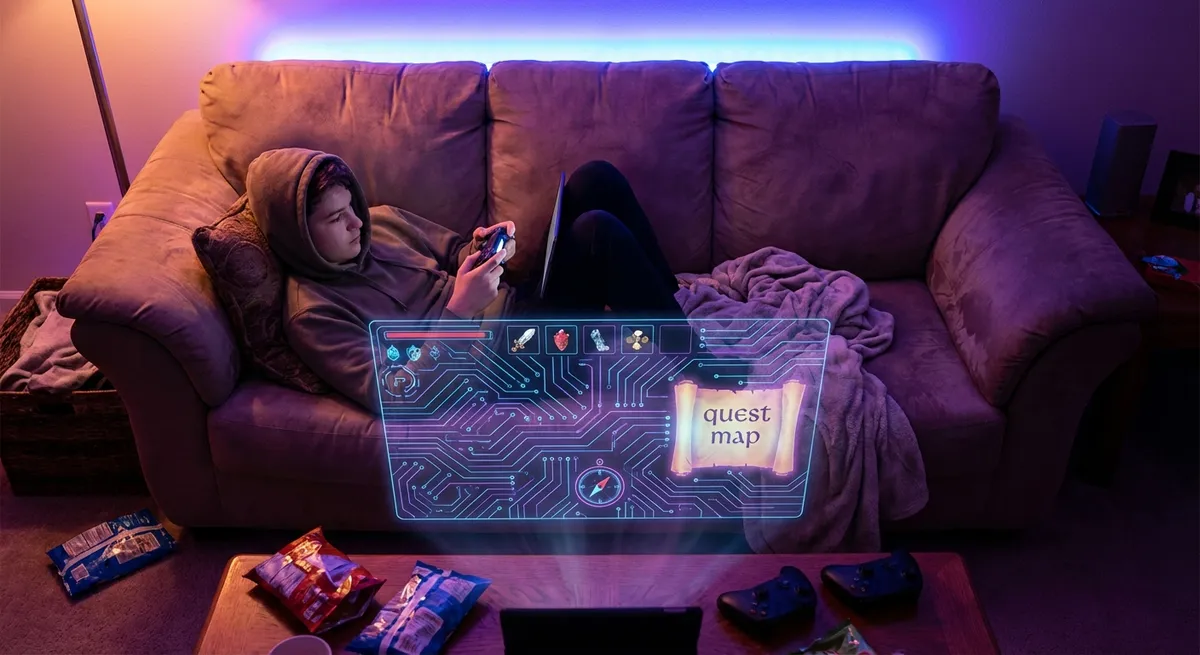
Gamers get a lot of heat for “wasting time,” but your brain is doing way more than button-mashing when you boot up a game. Modern titles are basically interactive labs for attention, memory, strategy, and creativity—just with better soundtracks and fewer boring graphs.
We’re not talking about “edutainment” or obvious brain-training apps. This is about regular games—RPGs, shooters, strategy, racing—quietly reshaping how you think, react, and process the world.
Here are five ways your favorite games are secretly running a full-on firmware update on your brain.
1. Your Reaction Time Is Getting a Stealth Upgrade
Fast-paced games—think shooters, action RPGs, racing games—are basically reflex boot camps.
You’re tracking enemies, dodging projectiles, swapping weapons, all in fractions of a second. Your brain has to filter what matters (that sniper glint in the corner) and ignore what doesn’t (random clutter, background effects).
Studies have found that people who regularly play action games tend to be faster at making decisions without losing much accuracy. It’s not just “hand–eye coordination” in a vague sense; your brain is getting better at rapidly scanning a scene, figuring out what’s important, and acting on it.
In real life, that shows up in places you don’t really connect to gaming: noticing a cyclist in your blind spot, reacting quickly when someone drops something in front of you, or just feeling sharper when you’re juggling multiple tasks at work or school.
You’re not just “getting good” at the game—you’re training your mental sprint speed.
2. You’re Low‑Key Learning Complex Systems (And Actually Remembering Them)
Games love systems: damage types, crafting trees, skill builds, economy loops, cooldowns, resistances, faction relationships, you name it.
The wild thing? You willingly memorize all of this.
You’ll forget what you had for lunch two days ago, but you can probably still explain:
- How armor scaling worked in a game you haven’t touched in years
- The optimal build path for a character
- The exact timing for a combo you learned by feel
- Try a new mechanic → get instant feedback (it works or it fails)
- The game nudges you to adapt, retry, and refine
- Your brain locks in the patterns that lead to progress
That’s your memory system getting a workout. Games reward you constantly for learning and applying new information:
It’s essentially spaced repetition plus interactive feedback, wrapped in a story or challenge you care about. That combo makes your brain treat the information like it actually matters—because in the context of the game, it does.
So when someone says “games rot your brain,” remind them you’re casually running multi-variable optimization problems in your head for fun.
3. Team Games Are Secret Communication Labs
If you’ve ever tried to coordinate a squad in an online match, you know: it’s chaos… but it’s organized chaos.
Multiplayer games quietly force you to:
- Give quick, clear instructions (“Two left, one flanking mid, rotate now”)
- Read other people’s intentions from small cues (positioning, movement, pings)
- Handle conflict (that one teammate who rushes alone every round)
- Adjust your role on the fly (support, entry, shot-caller, anchor)
- Leadership – Calling plays, staying calm when things fall apart
- Collaboration – Syncing your timing, covering mistakes, sharing info
- Emotional control – Not tilting when things go badly… or at least recovering faster
That’s social and communication training in disguise. You’re building skills like:
A lot of workplaces pay consultants to teach this stuff. You just picked it up from late-night queue sessions.
And even when voice chat is cursed, games that use pings or nonverbal signals still train your ability to coordinate with minimal communication—something that translates surprisingly well to real-world group projects.
4. Open Worlds Are Quietly Training Your Sense of Direction
Open-world games basically drop you into unfamiliar territory and say, “Figure it out.”
You start building mental maps without really thinking about it:
- “The village is east of the river, behind the broken bridge.”
- “That dungeon entrance is just past the clearing with those weird trees.”
- “The fast travel point is near the big cliff with the tower silhouette.”
Researchers call this spatial navigation—and games, especially 3D ones, give it a serious run.
You’re constantly:
- Recognizing landmarks and using them to orient yourself
- Planning routes from memory instead of staring at a minimap
- Remembering where resources, enemies, or shortcuts are located
Over time, this can bleed into real life. You might find it easier to remember how to get around a new city, store, or campus because your brain is used to building and updating mental maps from scattered clues.
So yeah, wandering for hours in a digital landscape might actually be doing something for your real-world sense of direction—beyond just “I now know the exact layout of this fictional planet.”
5. Strategy Games Turn You Into a Risk–Reward Calculator
Strategy games, tactics games, and even certain RPGs are basically friendly risk simulators.
Every turn, fight, or decision is a trade:
- Do you push now or wait one more turn to build resources?
- Do you commit all your units to this lane or keep some in reserve?
- Do you pick the safe option or gamble for a big payoff?
- Predicting outcomes based on limited info
- Weighing short-term pain vs long-term gain
- Accepting that sometimes you make the right call and still lose
- Decide whether to change jobs
- Pick between saving more or investing
- Choose whether to ship a project now or polish longer
Your brain gets used to:
That’s decision-making under uncertainty—the same skill you use when you:
The game just compresses the feedback loop. You see the result of your choices in minutes instead of months. Failures are low-stakes, so you can afford to experiment, get burned, learn, and try again.
Over time, you get better at asking, “What’s the worst outcome here, and can I live with it?” That’s a pretty solid question to carry outside the game.
Conclusion
You don’t need a “brain training” label for a game to work your mind.
Whether you’re dropping into a fast-paced shooter, sinking hours into a giant RPG, or getting lost in a strategy title, your brain is:
- Reacting faster
- Learning and remembering complex systems
- Communicating and coordinating with real humans
- Navigating 3D spaces more confidently
- Making better calls under pressure
None of this means “play games and you’ll magically become a genius.” But it does mean gaming isn’t just idle time. It’s interactive, feedback-heavy, and mentally loaded in ways that a lot of passive entertainment just… isn’t.
So next time someone side-eyes your playtime, you don’t have to hit them with a research paper—but you can say: “I’m not just playing. I’m training.”
(And then, obviously, queue up another match.)
Sources
- [American Psychological Association – Video Games Play May Provide Learning, Health, Social Benefits](https://www.apa.org/news/press/releases/2013/11/video-games) – Overview of research on cognitive and social effects of video games
- [Nature – Action Video Game Modifies Visual Selective Attention](https://www.nature.com/articles/nn1345) – Study on how action games can improve attention and reaction-related skills
- [Frontiers in Human Neuroscience – Video Games and Spatial Cognition](https://www.frontiersin.org/articles/10.3389/fnhum.2014.00386/full) – Research on how video games affect spatial navigation and visual skills
- [National Institutes of Health (NIH) – Video Games and Neural Plasticity](https://www.ncbi.nlm.nih.gov/pmc/articles/PMC5070952/) – Review of how gaming can change brain structure and function
- [Harvard Medical School – Cognitive Benefits of Playing Video Games](https://www.health.harvard.edu/blog/benefits-of-video-games-201509239434) – Accessible breakdown of studies on the mental impacts of gaming
Key Takeaway
The most important thing to remember from this article is that this information can change how you think about Gaming.