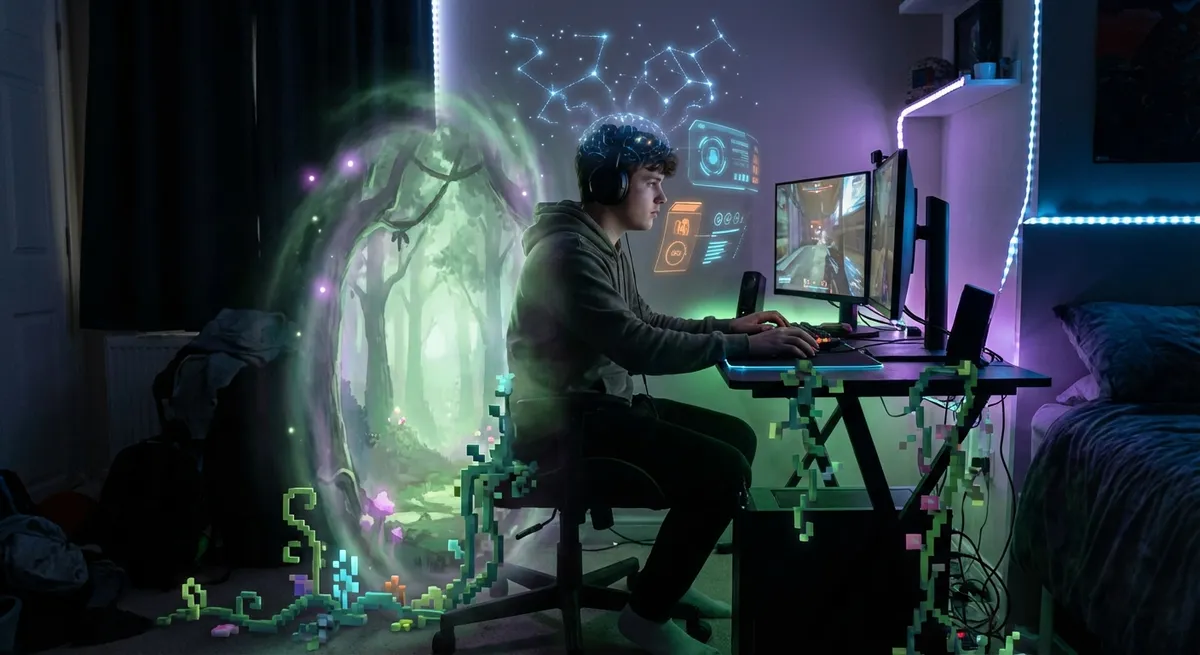
Games aren’t just pixels, high scores, and rage-quits. Under the hood, they’re quietly testing your memory, nudging your choices, and rewiring how you react to the world—often without you noticing.
If you’re into tech, gaming is one of the most fun “interfaces” between human brains and software design. Let’s dig into some of the weird, clever ways modern games play with perception, attention, and motivation.
1. Your Brain Loves the Feedback Loop (And Games Exploit It)
Every time you see a level-up animation, hear a “ding,” or get showered in virtual rewards, your brain gets a tiny hit of satisfaction. This is called a feedback loop: you do something, the game reacts, your brain evaluates, and you either keep going or try something new.
Smart game design leans hard on this:
- Instant feedback: Miss a jump in a platformer? You fail immediately and respawn in seconds. That quick cycle is addictive because you don’t sit around stewing in frustration.
- Clear goals + visible progress: XP bars, quest trackers, combo meters—these are all just visual progress meters for your brain.
- Tiny wins stacked together: Daily quests, small unlocks, and achievements create a steady stream of “you’re doing great” signals, even if you only play for 10 minutes.
A lot of productivity apps and learning platforms copy this exact structure—because games proved how effective it is at keeping people engaged.
2. Open Worlds Quietly Teach You to Navigate Like a Pro
Big open-world games (think: giant maps, no clear path, tons of icons) are like low-key navigation training for your brain.
When you play:
- You start building mental maps of locations: where shops are, enemy zones, shortcuts, and safe spots.
- You learn to orient yourself using landmarks (a big mountain, a tower, a weird tree) rather than just the mini-map.
- You get better at planning: “I’ll go here, then loop around that area, then fast travel back.”
Researchers have actually found that navigating 3D environments can light up the parts of your brain linked to spatial awareness and memory. Games can’t replace real-world experience, but they do give your brain a safe training ground to practice getting un-lost.
3. Multiplayer Games Double as Social Labs
If you’ve ever:
- Negotiated loot drops after a big raid
- Juggled roles on a team
- Muted someone toxic mid-match
…you’ve basically been doing a messy, real-time social experiment.
Multiplayer games are fascinating because:
- They force collaboration even when people don’t know each other.
- Roles matter: tanks, healers, supports, leaders, shot-callers—these are all social positions as much as gameplay roles.
- Player culture shapes the game: “House rules,” unwritten etiquette, and memes spread faster than any official patch.
Tech-wise, this is a goldmine. Online games are massive, live environments where human behavior, communication patterns, and group dynamics are happening 24/7. It’s like a constantly running testbed for how people coordinate with strangers using only voice, text, and UI cues.
4. Difficulty Settings Are Becoming More About You Than the Game
Difficulty used to be a simple menu choice: Easy, Normal, Hard. Modern games are getting way more subtle—and more personal.
Some games now:
- Track how you play and quietly adjust: If you keep dying at a boss, the game might dial down the damage or tweak enemy behavior without telling you.
- Offer assistance instead of judgment: You get optional hints, aim assist, puzzle skips, or UI tweaks instead of a “git gud” wall.
- Let you customize the pain: You can keep enemies tough but remove time limits, or keep puzzles hard but combat easier.
This is powered by data and clever design: the game watches patterns (where people struggle, where they quit, where they breeze through) and then uses that info to make the experience feel challenging but not brutal. It’s a tiny step toward games that feel like they’re “reading the room” instead of just punishing you.
5. Your Choices Are Less Free Than You Think (In a Really Interesting Way)
You know those “morality choices” in games? Save this person or that one, join this faction or the other, peaceful route or violent route. It feels like a wide-open sandbox of possibility—but the game is gently nudging you the whole time.
Designers influence your decisions through:
- Framing: How the choice is presented (“heroic sacrifice” vs “cowardly escape”) shifts what feels right.
- Rewards and consequences: Better loot, special story scenes, or unique abilities tied to certain decisions create subtle pressure.
- Visual cues: Lighting, camera angles, music, and character expressions all tilt your emotional response one way or another.
This is basically interactive psychology. The same techniques show up in UI design, marketing, and app onboarding flows—games just make it fun and obvious. Once you start noticing how games guide your choices, you’ll start spotting the same tricks in non-gaming tech too.
Conclusion
Gaming is way more than “just entertainment.” It’s this massive, living experiment in how humans think, decide, cooperate, and stay motivated—wrapped in art, sound, and code.
If you’re a tech enthusiast, game worlds are worth looking at not just as players, but as systems: how they push you, protect you from boredom, and keep you coming back. The next time you boot up a game, watch how it handles feedback, navigation, difficulty, social play, and choices—you’ll start seeing the design magic under the surface.
Sources
- [BBC Future – How video games change your brain](https://www.bbc.com/future/article/20140715-how-video-games-change-your-brain) - Overview of research on how gaming affects memory, attention, and perception
- [American Psychological Association – The benefits of playing video games](https://www.apa.org/news/press/releases/2013/11/video-games) - Summarizes studies on cognitive, motivational, emotional, and social impacts of games
- [Nature – Navigational experience and the hippocampus](https://www.nature.com/articles/mp2016320) - Research on spatial navigation and brain structure, relevant to exploring 3D environments
- [MIT Technology Review – How online games can teach us about cooperation](https://www.technologyreview.com/2010/08/25/200807/how-online-games-can-teach-us-about-cooperation/) - Looks at multiplayer games as large-scale social experiments
- [GDC Vault – The science of difficulty in game design](https://www.gdcvault.com/play/1015401/Advanced-Game-Design-The-Science) - Talk on how designers balance challenge, feedback, and player behavior
Key Takeaway
The most important thing to remember from this article is that this information can change how you think about Gaming.