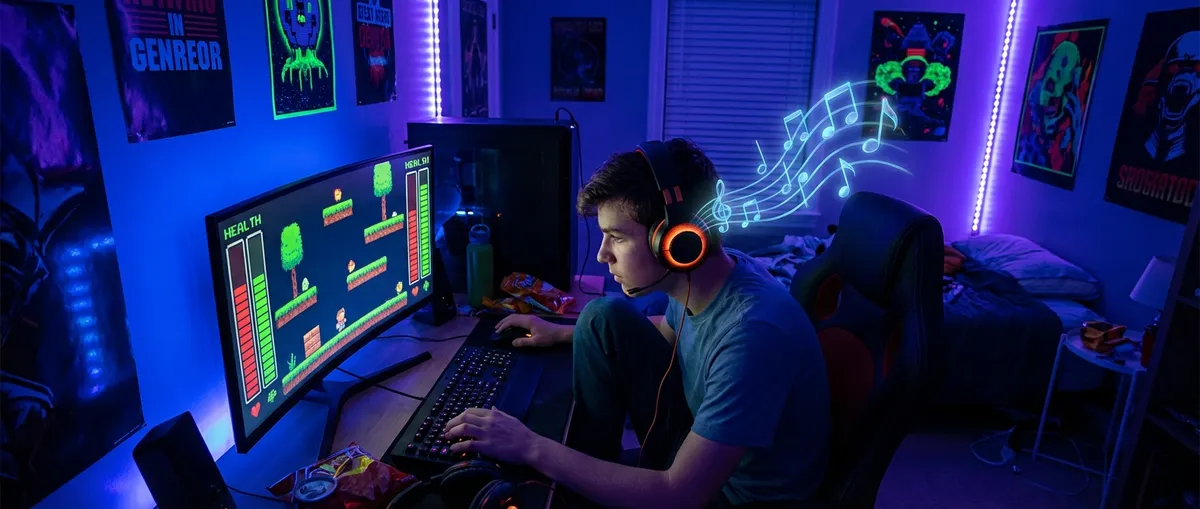
Game graphics get all the love, but the real silent MVP of your favorite games is the soundtrack quietly rewiring your brain in the background. From that boss fight anthem that makes your palms sweat to the cozy village theme you could loop for hours, game music is doing way more than just “setting the mood.”
Let’s dig into how modern game audio is secretly one of the most advanced—and underrated—parts of gaming tech, and why your brain is so into it.
1. Your Brain Treats Game Music Like a Performance-Enhancing Drug
No, not literally. But close.
Game soundtracks are often designed to push you into “flow” mode—where you’re focused, calm, and locked in. Studies on music and attention show that certain tempos and patterns can boost concentration and reaction time. Game composers lean into that on purpose.
Fast-paced tracks in action games tend to use strong rhythms and clear patterns that your brain can predict, which helps you time jumps, shots, and dodges. Slower, more ambient tracks in exploration or puzzle games keep you relaxed enough to think while still engaged enough not to get bored.
It’s not magic—it’s repetition, rhythm, and reward. When the music hits right as you nail a combo or clear a level, your brain links that sound with success. Over time, just hearing similar tracks can put you back into that “I got this” mindset, even before you press a button.
2. Dynamic Soundtracks React to You Like a Co‑Op Partner
Old-school games used to just loop a track in the background. Modern games can basically “DJ” in real time based on what you’re doing.
This is called adaptive or dynamic music. The game listens to your actions—combat, stealth, exploration—and then adds or removes layers of music to match.
Sneaking around in a stealth game? You might just hear a low drone and a couple of tense notes. Get spotted? Suddenly the percussion slams in, strings jump an octave, and your pulse spikes. Win the fight? The track might resolve into a calmer version with the same melody, signaling safety.
Under the hood, this can be surprisingly technical: audio engines slice music into loops and stems that can crossfade perfectly without sounding choppy. The result for the player: no harsh cuts, just music that feels like it’s reading your mind.
Once you notice it, it’s wild how often the soundtrack “knows” when to chill out and when to go full chaos.
3. Iconic Game Themes Literally Shape Your Memories
Ever hear a few notes from an old game and instantly remember exactly where you were when you played it? That’s not nostalgia being dramatic—that’s your brain tying sound to memory.
Your auditory system has a direct line to brain areas responsible for emotion and long-term memory. That’s why many people remember game music from their childhood more clearly than what was on the radio at the time.
Developers lean into this by:
- Reusing a main theme across different games in a series
- Bringing back older melodies in a new style (like a “haunted” version in later story beats)
- Saving a special music motif for huge emotional moments
The result: themes turn into emotional triggers. A triumphant melody used for early victories might come back later in a sad, slower version when things go wrong—and your brain feels the difference even before you fully process what happened on screen.
This is why some game tracks end up in concert halls and orchestras: they’re not just background noise, they’re story anchors.
4. 3D Audio Turns Your Headphones into Superpowers
If you’ve ever survived a match because you heard footsteps behind you before you saw anyone, you’ve already used one of the coolest audio tricks in gaming: spatial sound.
Modern games can simulate where sounds are coming from in 3D space—above, below, behind, or off to the side—even if you’re just wearing stereo headphones. They do this by subtly changing:
- Volume (louder on the side closer to the sound)
- Timing (milliseconds of difference between your “left” and “right” ear)
- Frequency (slightly muffled if “behind” or “through a wall”)
Your brain is absurdly good at decoding those tiny differences. That’s how you can “locate” enemies, vehicles, or projectiles just by listening.
Hardware and software from big players like Sony, Microsoft, and various PC audio systems are doubling down on this, adding features like “tempest” or “spatial sound” modes. It’s not just fancy marketing—when done right, this can genuinely change how you play.
Casual bonus: it also makes non-action games feel more real. Rain that sounds like it’s actually above you? Ambient chatter that feels like it’s coming from a tavern corner? That’s audio tech quietly leveling up immersion.
5. Game Music Has Evolved into Its Own Listening Genre
Game soundtracks used to be “just” chip tunes stuck on a cartridge. Now, they’re charting on Spotify, selling out concert tours, and getting vinyl releases with ridiculous album art.
A few reasons tech lovers find this especially cool:
- Hybrid sound design: Many modern scores blend orchestras with synths, sampled textures, and effects that couldn’t exist without digital tools.
- Loop-friendly design: Tracks are built to be repeatable without getting annoying, which makes them perfect background music for studying, coding, or late-night grinding—both in and out of games.
- Platform reach: Composers now build music knowing it’ll be streamed, performed live, and dissected on YouTube as much as it’ll be heard in-game.
The cool twist? People who’ve never even played some of these games still add the soundtracks to their playlists, just because the music stands on its own.
Game audio has quietly turned into a legit gateway for discovering composers, genres, and sound design techniques you wouldn’t bump into otherwise.
Conclusion
Game music isn’t just there to “fill silence.” It’s tuning your focus, steering your emotions, guiding your decisions, and stamping memories into your brain—all while you’re busy dodging, crafting, or speedrunning.
The next time you boot up a game, try this: play with the music off for a few minutes, then turn it back on. Notice how different everything feels—not just sounds. That gap between “pretty quiet” and “I’m in this world now” is where some of the most underrated tech and creativity in gaming lives.
Sources
- [BBC – How Video Game Music Evolved](https://www.bbc.com/culture/article/20140721-the-strange-magic-of-game-music) – Overview of the history and emotional impact of game soundtracks
- [MIT – The Science and Art of Video Game Music](https://cmsw.mit.edu/science-art-video-game-music/) – Explores how game music is composed and designed to interact with players
- [Sony PlayStation – 3D Audio on PS5](https://www.playstation.com/en-us/ps5/3d-audio/) – Official explanation of spatial audio tech used in modern console gaming
- [National Institutes of Health – Music and the Brain](https://www.ncbi.nlm.nih.gov/pmc/articles/PMC3734071/) – Research-backed look at how music affects memory, emotion, and cognition
- [Game Developers Conference (GDC) – Dynamic Music in Games](https://gdcvault.com/play/1026654/Dynamic-Music-in) – Industry talk on how adaptive and reactive game music systems are built
Key Takeaway
The most important thing to remember from this article is that this information can change how you think about Gaming.