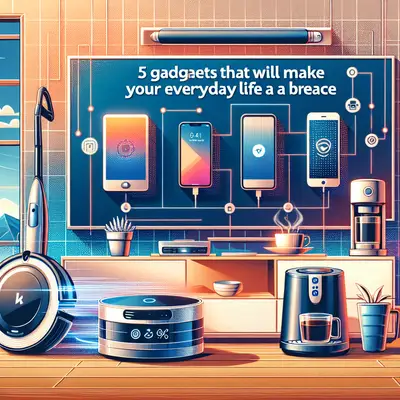
Most gadgets get bought for one obvious reason: a nicer camera, better battery, cooler design. But the really fun part? The weird, “wait, it can do THAT?” tricks hiding just under the surface.
From phones that quietly act as medical scanners to earbuds turning into real-time translators, the latest wave of gadgets is less about specs and more about secret side quests. Let’s dig into some of the wild, very real ways everyday tech is leveling up.
1. Your Phone Is Quietly Turning Into a Medical Toolkit
We already use phones to track steps and sleep, but the health features baked into recent devices are getting surprisingly serious.
Many smartwatches and phones can now flag irregular heart rhythms that might be signs of atrial fibrillation (a major stroke risk). Some devices can generate ECG-style readings you can share with your doctor. Others can measure blood oxygen levels, detect hard falls, or even listen for signs of breathing trouble at night.
These aren’t toys—some features are cleared by regulators in certain regions, which is why you see them marketed as health tools rather than just “fitness extras.”
What’s really interesting is how passive they’re becoming. You don’t have to remember to open an app; the device just monitors in the background and taps you on the wrist when something looks off. It’s the kind of “always-on” health check that used to live in hospitals, now hiding in a watch you mainly bought because the band looked nice.
2. Earbuds Are Sneaking Into the World of Hearing Tech
Noise-canceling earbuds started out as a way to mute crying babies on flights. Now they’re starting to blur into hearing aids—without calling themselves that.
Some models can enhance voices around you while dialing down background noise, making it easier to follow conversations in loud spaces. Others offer “conversation mode,” where you tap an earbud and it focuses on the person in front of you like a directional mic. And several brands are experimenting with features that let you boost specific frequencies, similar to basic hearing assistance.
Add in live translation—where your earbuds stream a translated version of what someone is saying—and suddenly these little buds are less “music accessories” and more “wearable audio computers.”
The most interesting part is social: using earbuds for subtle hearing help is a lot less stigmatized than wearing big, obvious, traditional devices. For a lot of people, that may be the difference between struggling to hear and actually doing something about it.
3. Smart Home Gadgets Are Becoming “Feel” Sensors, Not Just Switches
Most smart home gear started with simple promises: turn lights on with your voice, lock doors from your phone, that kind of thing. Now, many of these devices are getting a sense of presence—they’re not just reacting to commands; they’re learning your patterns.
Some smart thermostats and motion sensors can tell when you’re home without you tapping anything. They watch movement, temperature, even how often doors open, then tweak heating, cooling, and lighting automatically. Newer devices use radar-style sensing to detect people rather than just “something moved,” so a pet won’t trigger the same response as a person.
Smart speakers and displays are also quietly doubling as home monitors. A speaker might listen for glass breaking or a smoke alarm and send an alert. Some smart cameras use on-device processing to distinguish between a package drop-off and a random car driving by, so your phone doesn’t explode with notifications.
We’re moving from “remote control for your house” to “house that sort of reads the room,” which is both handy and… worth thinking carefully about from a privacy angle.
4. Everyday Accessories Are Becoming Ultra-Precise Location Beacons
Key finders used to be a novelty gift—loud, clunky, and forgettable. Modern tracking tags are operating on an entirely different level.
Small trackers can now piggyback on massive phone networks to update their location, even if they don’t have a GPS chip or data plan. If your bag goes missing at an airport, tiny tags inside can quietly ping their location using nearby phones on the same ecosystem, often without the owners of those phones ever knowing they helped.
Newer versions are adding anti-stalking protections: if a tag that isn’t yours is traveling with you for a while, your phone will warn you. That opens up some surprisingly useful scenarios beyond “where are my keys?”—like tracking luggage across continents or keeping tabs on where you actually parked three hours ago.
Combined with ultra-wideband chips in phones, some devices can guide you to a lost item with an on-screen arrow and distance estimate, like a mini real-life radar. We’re not quite at sci-fi “find anything, anywhere, anytime” yet—but the gap is closing fast.
5. Laptops Are Morphing Into Quietly Smart Collaboration Hubs
Laptops used to be mostly about raw power and battery life. Now, a lot of the interesting stuff is happening in the weird little details around the screen and keyboard.
Modern webcams and microphones can automatically track your face, blur your messy background, clean up your audio, and mute keyboard clacks. Some laptops can sense when you’re looking away and dim the display to save battery—or warn you if someone is peeking over your shoulder.
We’re also seeing dedicated chips just for “smart” tasks: background blur, eye-contact correction, live captions, and even on-device AI that can summarize a meeting as it happens. Paired with better microphones and speakers tuned for voice, many laptops are basically built around the assumption that video calls are your new default workspace.
Even the humble function key row is changing. Some keyboards now include dedicated controls for muting mic/video, toggling AI features, or quickly launching collaboration tools. It’s a quiet shift, but it shows where manufacturers think we’re spending most of our time: on calls, with cameras on, in shared digital spaces, using laptops as portable studios instead of just word processors.
Conclusion
We still buy gadgets for the headliners—better cameras, brighter screens, longer battery life. But the most interesting stuff is happening in the side features: health tools masquerading as watch apps, earbuds that double as translators and hearing helpers, trackers that turn an entire phone network into a lost-and-found grid.
If you’re shopping for your next piece of tech, it’s worth digging one layer deeper than the spec sheet. The secret superpower might be the thing you end up using every day, long after you’ve forgotten how many megapixels the camera had.
Sources
- [Apple – Health Features Overview](https://www.apple.com/healthcare/health-records/) – Details on how Apple integrates health monitoring and health records across its devices
- [U.S. Food & Drug Administration – Wearable and Digital Health Technologies](https://www.fda.gov/medical-devices/digital-health-center-excellence/wearables) – Background on how health-related wearable features are evaluated and regulated
- [National Institute on Deafness and Other Communication Disorders (NIDCD)](https://www.nidcd.nih.gov/health/hearing-aids) – Context on hearing assistance tech and how consumer devices intersect with hearing support
- [Google – Nest Aware and Home Monitoring](https://support.google.com/googlenest/answer/9546395) – Examples of how smart home devices are used for presence detection and home monitoring
- [MIT Technology Review – The Future of Smart Gadgets](https://www.technologyreview.com/2023/10/17/1081582/the-future-of-smart-gadgets-ai-everywhere/) – Discussion of how AI and sensors are reshaping everyday consumer devices
Key Takeaway
The most important thing to remember from this article is that this information can change how you think about Gadgets.