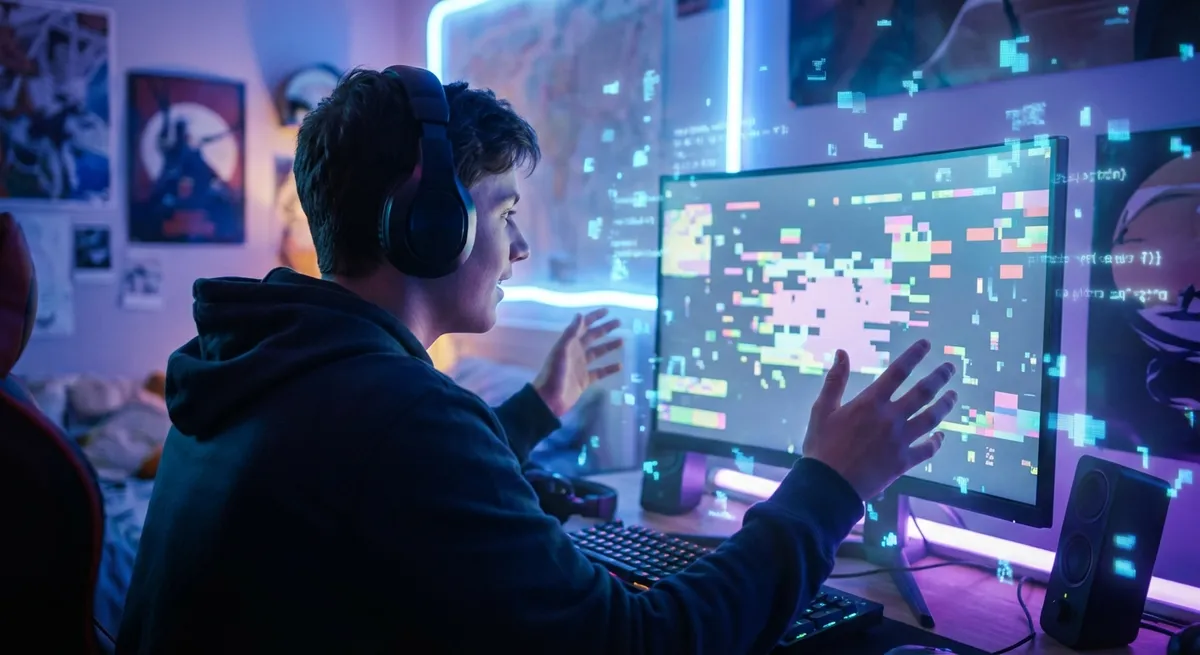
Some of the coolest moments in games don’t come from story or graphics—they come from the weird tech tricks hiding under the hood. That perfect headshot that “shouldn’t” have hit, the way enemies suddenly feel smarter, or how your game somehow runs smoothly on a potato laptop? None of that is an accident.
Let’s pull back the curtain on a few gaming tricks that tech nerds (and curious players) will appreciate.
1. Your “Perfect Timing” Shots Are Sometimes Kind of Fake
You know those moments where you swear you fired after the enemy ducked, but still landed the hit? That’s not lag being annoying—that’s actually your game trying to be fair.
Online games use something called lag compensation, but in plain English:
your game politely lies a little so your bad internet doesn’t ruin the fun.
Here’s what’s happening:
- When you click to shoot, your computer sends that info to the server a fraction of a second later.
- The server “rewinds” the game state to what it looked like when you actually clicked, not when the packet arrived.
- Then it checks: “At that moment-in-the-past, was your crosshair on the target?”
- If yes, it registers the hit—even if, in the present, the enemy has already moved behind cover.
To you it feels like you pulled off a clutch shot. To the game, it’s math plus time travel.
Fun side effect: this is why sometimes you feel like you were already behind a wall when you got hit. The server is being “fair” to the other player’s past, not your present.
2. Enemies Don’t Get Smarter – They Just Cheat Better
You’re not imagining it: sometimes it really does feel like the AI knows exactly where you are.
That’s because… kind of, yeah.
Game AI often has:
- Extra information: Bots might “see” through walls on a data level, even if they act like they can’t.
- Aim assistance: Many shooters quietly give bots hidden aim-smoothing so they look human instead of aimbots.
- Scripted “smartness”: Faking intelligence with patterns like “flank if player stays in cover too long.”
But here’s the twist: developers don’t always want the AI to play optimally. Perfectly efficient AI is usually:
- Boring (predictable patterns)
- Frustrating (inhuman reactions)
- Unfair (instant detection, laser aim)
So designers deliberately nerf their own AI:
- They add reaction delays to simulate human hesitation.
- They limit what info enemies can “see” at once.
- They inject random behavior so it feels messy and organic.
The best AI often isn’t the smartest—it’s the best at pretending to think like a person.
3. Open Worlds Feel Massive Thanks to Clever Recycling
Those ridiculously huge open-world games that somehow fit on your SSD? They’re held together by smoke, mirrors, and a lot of copy-paste disguised as variety.
Under the hood, you’ll find tricks like:
- Procedural generation: Algorithms place rocks, trees, loot, and enemies based on rules, not by hand. That forest “designed” by the devs? Mostly math.
- Tile sets and modules: That sci‑fi corridor you’re running through? It probably shares 90% of its parts with 30 other corridors.
- Streaming worlds in chunks: The world loads only what’s near you. That’s why you sometimes see textures popping in or why elevators are suspiciously long… they’re loading screens in disguise.
On the hardware side, modern SSDs changed the game:
- Faster load times mean worlds can stream data way more aggressively.
- Games can hide less and show more, because the drive keeps up.
The result: a world that feels hand-crafted and huge… even if a lot of it was built by rules instead of humans.
4. Your Controller Is Doing More Work Than You Think
Your controller isn’t just a plastic remote—it’s a little sensor hub quietly doing real-time data processing.
Inside most modern controllers you’ll find:
- Gyroscopes and accelerometers: These detect motion, tilt, and rotation (think Switch, PS5, or mobile games with “tilt-to-aim”).
- Haptics: Advanced vibration motors that can simulate textures, impacts, and even tension. The PS5’s DualSense triggers can literally push back against your fingers.
- Low-latency wireless tech: Controllers now use optimized wireless protocols to cut delay to a few milliseconds.
Games then get creative with that data:
- Using subtle vibration patterns to warn you about off-screen threats.
- Letting you “feel” surfaces—gravel, rain, recoil—without needing extra sound or visuals.
- Turning aiming into a mix of stick + tilt for more precise control in shooters.
So when a game just “feels good” to play, it’s usually because the devs are nailing the combo of input (sensors) and feedback (haptics), not just the on-screen action.
5. Your Favorite Game Settings Are Really Trade Deals in Disguise
Every time you tweak graphics options—FPS vs resolution, ray tracing on or off, high vs ultra—you’re making tiny hardware negotiations behind the scenes.
A few of the cool tech tricks involved:
- Dynamic resolution scaling: If your frame rate starts dropping, the game quietly lowers resolution in busy scenes, then cranks it back up when things calm down. Ideally, you never notice.
- Upscaling magic (DLSS, FSR, XeSS): These techs render the game at a lower resolution, then use smart algorithms (and sometimes AI) to “fill in” missing detail so it still looks sharp.
- Frame generation: Some systems literally create in-between frames using motion data, making games feel smoother even if your GPU isn’t truly rendering that many frames.
There’s also a reason some settings barely change how the game looks but crush performance: they’re GPU killers (looking at you, ultra shadows and extreme volumetric fog).
If you’ve ever wondered why your 5-year-old PC can still run new games decently, it’s because a lot of modern graphics tech is built around this idea: do less, but fake it better.
Conclusion
A lot of what makes games feel good isn’t raw power—it’s clever illusions. Servers rewinding time, AI faking personality, worlds stitched together on the fly, controllers acting like mini science labs, and graphics engines constantly negotiating what to draw and what to fake.
Next time something in a game feels weirdly satisfying—a hit that lands, a world that feels bigger than your hard drive should allow, that perfect rumble at the right time—there’s probably some strange and brilliant tech behind it, quietly doing its thing so you never get bored.
Sources
- [Valve Developer Community – Lag Compensation](https://developer.valvesoftware.com/wiki/Lag_compensation) - Technical breakdown of how Source engine games rewind time to handle hits in online play
- [GDC Vault – “The Illusion of Intelligence: The Design of AI in The Last of Us”](https://www.gdcvault.com/play/1020791/The-Illusion-Of-Intelligence-The) - Talk on how game AI focuses on appearing smart and believable, not just accurate
- [NVIDIA Developer Blog – “What Is DLSS?”](https://developer.nvidia.com/rtx/dlss) - Explains how AI upscaling works to boost frame rates while keeping image quality high
- [Sony Interactive Entertainment – DualSense Wireless Controller Features](https://www.playstation.com/en-us/accessories/dualsense-wireless-controller/) - Official overview of adaptive triggers, haptics, and motion sensors in modern controllers
- [Microsoft Game Dev – Procedural Content Generation](https://developer.microsoft.com/en-us/games/blog/procedural-content-generation-in-games/) - High-level look at how procedural systems help build large, varied game worlds
Key Takeaway
The most important thing to remember from this article is that this information can change how you think about Gaming.