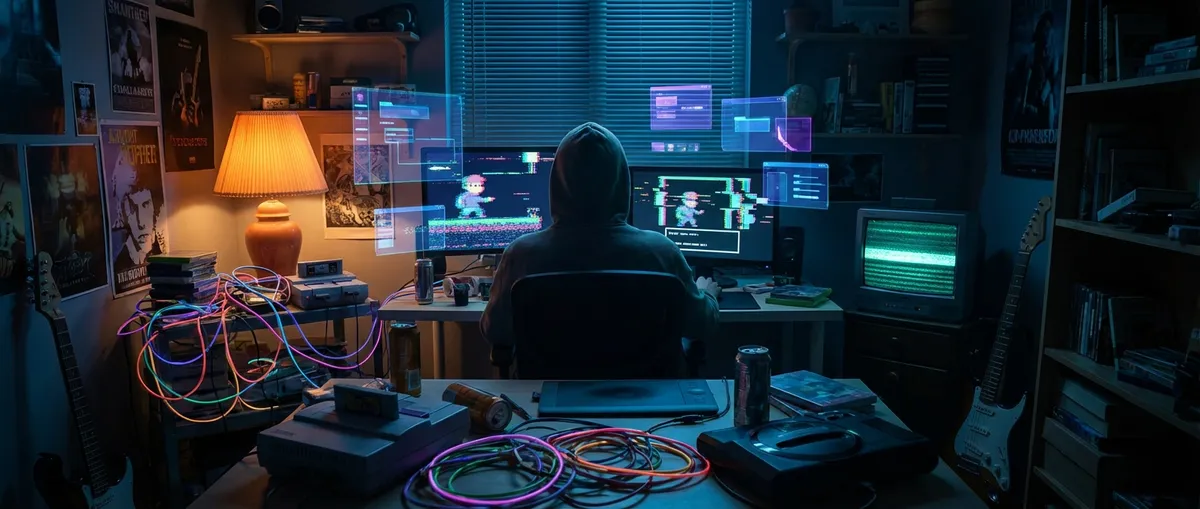
There’s the game you see on screen… and then there’s the Frankenstein monster of code, hacks, and clever tricks underneath it. Modern games are held together by some seriously weird (and brilliant) tech decisions that most players never notice—but once you do, you can’t unsee them.
Let’s peel back the curtain on a few of the strangest, coolest bits of gaming tech hiding in plain sight.
1. Your Favorite Game Level Might Be One Giant Illusion
Open-world games make it feel like you can go anywhere, but the hardware in your console or PC would actually melt if it tried to load everything at once.
So developers cheat. A lot.
Instead of loading a full world, games stream in tiny chunks of it as you move. Corridors, elevators, long hallways, slow door-opening animations—these are often just cleverly disguised “please wait while we load the next bit” moments. That awkwardly slow gap you squeeze through in an action game? It’s not for dramatic effect. It’s a loading screen in a trench coat.
To pull this off, games:
- Keep only nearby areas fully loaded
- Fake distant scenery with low-detail “billboards”
- Use fog, darkness, or walls to hide the edges of the loaded area
- Shuffle data in and out of memory while you’re busy walking, climbing, or looting
The result: it feels like one seamless world, but under the hood it’s more like a really fast stage crew swapping out sets while you’re facing the other way.
2. Sound in Games Is Smarter Than Most People’s Speakers
Visuals get all the hype, but audio tech in games has quietly become wild.
Modern games don’t just play sound—they simulate how sound moves through space. When you hear footsteps around a corner or a gunshot echoing in a tunnel, the game is doing quick math about:
- How far the sound travels
- What it bounces off
- Whether a wall is between you and the sound
- How your virtual “head” would hear it in 3D
Some engines use something called HRTFs (head-related transfer functions)—basically, recordings of how sound hits human ears from different angles—to create a fake 3D audio space inside your headphones. That’s why in some games you can tell if an enemy is above you, not just “somewhere near.”
And that’s before we even get to:
- Dynamic music that changes based on what you do (combat, sneaking, exploring)
- Occlusion (sounds getting muffled behind walls or doors)
- Environmental effects (rain, metal, glass, wood all sounding different)
If you’ve ever turned off game music and suddenly everything felt flat and awkward, that’s because the audio design was doing way more work than you realized.
3. NPC “Intelligence” Is Often Just Organized Chaos
Non-player characters (NPCs) look smarter than they really are. And that’s the point.
Most AI in games is less “robot overlord” and more “very determined Roomba.” Instead of deep thinking, NPCs usually follow a bunch of layered rules and routines like:
- “If I see the player, shout and attack.”
- “If I hear a loud noise, investigate.”
- “If I’m low on health, run behind cover.”
- “If I can’t find a path, panic a little and try again.”
What makes them feel smart is how messy and reactive it all looks in motion. Games mix in:
- Randomness (so enemies don’t behave identically every time)
- Simple memory (“search the last place I saw you”)
- Group behavior (enemies flanking you or calling for backup)
- Fake “awareness meters” that fill up as they notice you
Even “crowd AI” in open-world cities—hundreds of pedestrians and cars—often runs on ultra-simple scripts and reused patterns. But when you throw enough of it on screen at once, our brains fill in the complexity.
The magic isn’t just in advanced algorithms; it’s in designing dumb-but-convincing behavior that feels alive.
4. Game Controllers Are Quietly Becoming Science Experiments
On the surface, controllers haven’t changed much: buttons, sticks, triggers, done. Underneath, though, they’re turning into weird little haptic labs.
Modern controllers don’t just vibrate; they simulate texture, weight, and tension. That “feel” is powered by:
- Adaptive triggers that can push back on your fingers (think bowstrings or jammed guns)
- Precision haptics that can simulate raindrops, engine revs, or sliding on ice
- Gyroscopes and accelerometers for motion aiming and gestures
Developers can literally “program” how your hands feel during a moment in the game—like making the trigger hard to press when your weapon overheats, or giving just enough rumble to let you know you’re driving on gravel instead of asphalt.
It’s subtle, but once you get used to it, going back to basic rumble feels like switching from a smartphone to a pager.
5. Photo Mode Shows How Ridiculously Advanced Game Cameras Are
Photo modes aren’t just for Instagram-flexing your screenshots—they quietly reveal how advanced in-game cameras have become.
When you mess around in photo mode, you’re basically hijacking a tiny virtual film rig. Behind the scenes, the game is simulating:
- Focal length (wide-angle vs zoom)
- Depth of field (cinematic background blur)
- Exposure and shutter-like effects (motion blur, brightness)
- Color grading (filters that mimic movie looks)
The engine is constantly balancing realism with “what actually looks good to the player.” That’s why games often tweak camera shake, perspective, and field of view to feel more dramatic than real life.
Even the way the camera snaps to your character during combat or cutscenes? That’s carefully scripted choreography—timed cuts, zooms, and pans—designed like a miniature action movie.
So when you pause and line up that perfect shot of your character mid-leap with a sunset in the background, you’re basically using a simplified—and very powerful—virtual cinematography tool.
Conclusion
Underneath the flashy graphics and big explosions, games are powered by a mess of clever shortcuts, illusions, and tiny tech miracles.
Worlds load in pieces, sound bounces around realistically, NPCs fake intelligence, controllers poke your fingers with science, and virtual cameras behave like movie gear. None of it is obvious when it’s working right—and that’s exactly the goal.
The better the trick, the more you forget it’s a trick at all.
Sources
- [Gamasutra / Game Developer: Streaming Worlds in Game Engines](https://www.gamedeveloper.com/programming/dirty-coding-tricks-from-game-developers) - Developer insights on occlusion, level streaming, and other behind-the-scenes tricks used to keep large game worlds running smoothly.
- [Dolby: Game Audio and Spatial Sound](https://www.dolby.com/gaming/) - Overview of how modern spatial audio and surround technologies enhance immersion in games.
- [Sony Interactive Entertainment: DualSense Wireless Controller Features](https://www.playstation.com/en-us/accessories/dualsense-wireless-controller/) - Official breakdown of adaptive triggers, haptics, and motion sensors in modern controllers.
- [NVIDIA: Ansel and In-Game Photography](https://www.nvidia.com/en-us/geforce/technologies/ansel/) - Explains the tech powering advanced photo modes, including camera control and post-processing.
- [Unity Learn: Introduction to Game AI](https://learn.unity.com/tutorial/introduction-to-ai) - Educational overview of how basic game AI systems work, from pathfinding to simple decision-making.
Key Takeaway
The most important thing to remember from this article is that this information can change how you think about Gaming.