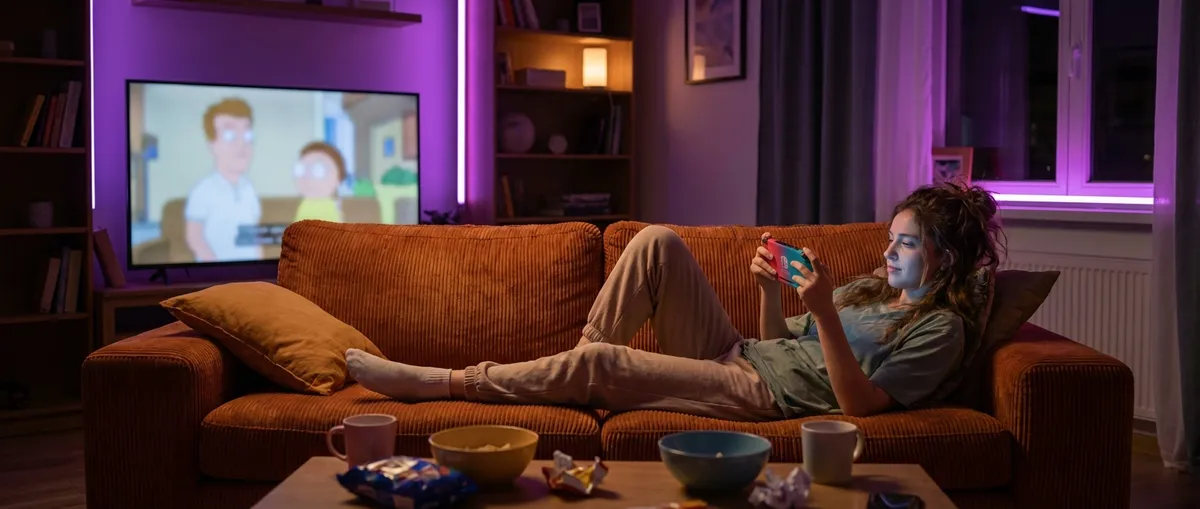
If you’ve ever queued for a match while scrolling TikTok, watched a stream while grinding XP, or played a “chill game” on your second monitor, you’re part of a growing trend: gaming as a background activity. Games aren’t just big, cinematic events anymore—they’re becoming something you dip in and out of all day, like checking your messages or putting on a podcast.
And the tech behind this shift is way more interesting than it looks.
Let’s dig into how “side play” is quietly reshaping gaming, and why tech enthusiasts should be paying attention.
Gaming Is Turning Into a Second Screen (On Every Screen)
We used to talk about “second-screen experiences” like it was some futuristic thing: watch TV on one screen, interact with an app on another. That’s now just…life. But games have fully joined that mix.
Today, a lot of people aren’t treating games as the main event, but as:
- Something to run while you listen to a podcast
- A comfort loop while you’re on Discord
- A grind to run while you watch YouTube or Twitch
- A routine check-in, like logging into a mobile game a few times a day
Tech-wise, this is made possible by:
- Lightweight launchers and background clients that don’t hog resources like they used to.
- Cloud saves that let you bounce between PC, console, and phone without losing progress.
- Instant resume features on consoles and handhelds that make “quick sessions” actually quick.
Games are quietly optimizing for being low-friction: short load times, daily tasks, quick rewards. They don’t need your full attention every second—and that’s by design.
“Sessionable” Games Are Engineered for Micro-Habits
A lot of modern games are built around short, loopable “sessions” that fit into your day the way checking email does. Even big, complex titles often bake in systems that reward logging in for just a few minutes.
You’ll see this in:
- Daily and weekly quests designed to be doable in small chunks
- Idle or semi-idle mechanics, where progress continues even when you’re not actively playing
- Match-based structures, where one round is 10–20 minutes tops
- Drop-in/drop-out co‑op, so you don’t need a fixed squad night to make progress
From a tech and design perspective, this means:
- Servers and matchmaking systems tuned for short, repeat sessions rather than marathon sittings.
- Data-driven balancing to keep those micro-goals rewarding without breaking the economy.
- Smart notifications (especially on mobile) that nudge you back at “good” times—when energy refills, events reset, timers end.
Games are basically turning into “habit machines,” and the line between a productivity check-in and a gaming check-in is getting thinner.
Game Launchers Are Starting to Feel Like Operating Systems
Steam, Epic Games Store, Battle.net, Xbox app, PlayStation, Nintendo, mobile app hubs—these aren’t just “game lists” anymore. They’re slowly acting like mini operating systems for your playtime.
Some under-the-hood and front-end changes tech folks will appreciate:
- Unified overlays that handle screenshots, streaming, performance metrics, and game invites without alt-tabbing.
- Cloud integration for saves, captures, and even controller profiles, so your “environment” follows you around.
- Built-in social graphs that track who’s online, what they’re playing, and how you can jump in.
- Deep links and widgets on mobile that take you straight to in-game events, not just the main menu.
At first glance, this is just convenience. But it’s also about ownership of your attention. Every platform wants to be the place you check “what to play next,” “what your friends are doing,” and “what’s new,” the way you’d open a browser tab by default.
In other words: your game library is quietly trying to become your gaming desktop environment.
Cross-Device Play Is Turning Your Whole Life Into One Big Save File
Cloud saves used to be a nice bonus. Now they’re the expectation. But beyond simple backup, the tech around seamless progression is getting way more interesting.
We’re seeing:
- Cross-play and cross-progression between PC, console, and mobile. Buy or unlock something once, use it everywhere.
- Cloud gaming that lets you start a game on your TV and continue it on your phone without a big download.
- Smart sync that tracks your last activity and drops you back into the right spot—sometimes even down to your last position or mission.
For developers and platform engineers, this means solving some tricky problems:
- Keeping game state consistent across devices and networks.
- Handling account linking securely across multiple ecosystems.
- Reducing latency and packet loss enough that cloud-streamed sessions don’t feel like a downgrade.
The end result for players is that your “session” is no longer constrained by where you physically are. You can start on a big TV, continue on the couch, then sneak in five more minutes in bed. The game becomes a layer over your day, not just a thing you sit down for.
Background Gaming Is Shaping How Games Are Designed (and Monetized)
When games are something you do while you’re doing other things, that changes how they’re built—and how they make money.
Design-wise, we’re seeing:
- Low-stress modes (story mode, chill difficulty, auto-battle in some genres) that let you half-pay attention.
- Non-punitive pauses and suspends, so hopping out to answer a message doesn’t ruin your run.
- More passive progress systems, where time played—even idling in social spaces—can still be rewarding.
On the business side:
- Time spent in a game—even passively—is now an important metric.
- Battle passes, season tracks, and time-limited events are tuned around how often you drop in, not just how long you binge.
- “Just one more check-in” design loops (daily rewards, rotating shops, quick event windows) are built to slot into your existing online habits.
This doesn’t automatically make things evil or addicting, but it does mean the design incentives are shifting. Games are less about one big purchase and more about earning repeated, small slices of your attention.
For tech enthusiasts, this intersection of behavioral design, networking, and monetization is one of the most revealing parts of modern gaming. You can literally see how infrastructure decisions influence how—and how often—you play.
Conclusion
Gaming isn’t just a hobby you sit down for anymore—it’s turning into a background layer of your digital life. Between smarter launchers, session-friendly design, cross-device syncing, and low-friction online systems, games are evolving to fit into all the little gaps in your day.
For players, that means more ways to enjoy games on your own terms: short bursts, long grinds, main-screen, second-screen, or just “on while you do something else.”
For tech enthusiasts, it’s a fascinating case study in how platforms, infrastructure, and design all work together to turn “play” into something ambient.
The next time you’ve got a game running on one screen, a stream on another, and chat on your phone…you’re not just multitasking. You’re living in the new normal of background gaming.
Sources
- [Entertainment Software Association – 2024 Essential Facts About the Video Game Industry](https://www.theesa.com/resource/2024-essential-facts-about-the-video-game-industry) – Industry data on player habits, platforms, and how people are playing games now.
- [Steam Deck Overview – Valve](https://www.steamdeck.com/en/) – Example of a device built around quick-resume, portable PC gaming, and cross-device play powered by Steam’s ecosystem.
- [Xbox Cloud Gaming (Beta) – Microsoft](https://www.xbox.com/en-US/play) – Shows how cloud streaming and cross-device progression are being implemented at platform scale.
- [“Cloud Gaming: State of the Market” – IEEE Spectrum](https://spectrum.ieee.org/cloud-gaming) – Technical and market overview of the infrastructure behind cloud and multi-device gaming.
- [Twitch Interactive – About Twitch](https://www.twitch.tv/p/en/about/) – Insight into how live gaming content has become a default “second screen” alongside active play.
Key Takeaway
The most important thing to remember from this article is that this information can change how you think about Gaming.