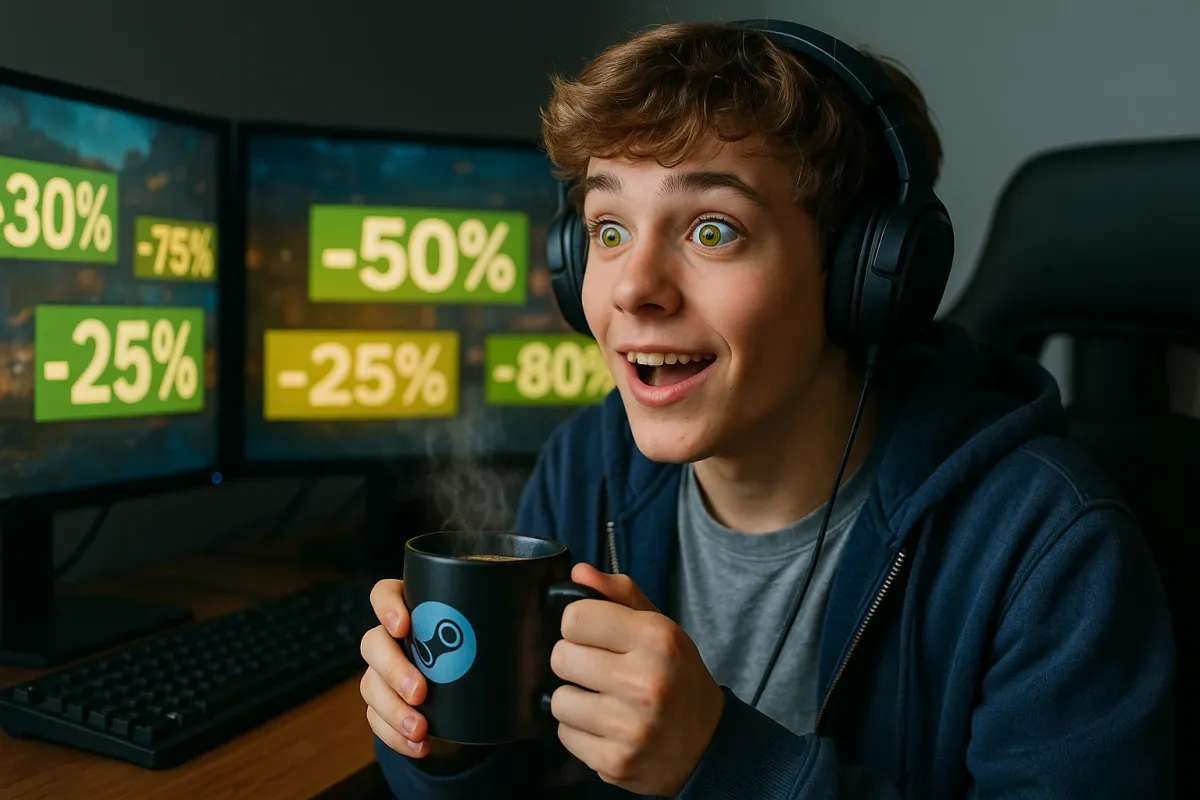
If you’re a PC or console gamer, Cyber Monday 2025 isn’t just about snagging a cheap TV anymore—it’s basically a mini Steam Sale that spilled onto the entire internet. Big retailers like Amazon, Best Buy, and Walmart are throwing down with Steam, PlayStation, Xbox, and Nintendo’s own digital stores, and the result is… absolute chaos for your backlog and your bank account.
With “19 Cyber Monday Tech Deals So Good, Your Bank Account Might Actually Forgive You” trending, it’s clear people aren’t just shopping for laptops and headphones. This year is stacked with GPU discounts, storage deals, and game sales that are quietly reshaping how (and when) we upgrade our gaming setups. Let’s break down what actually matters for gamers right now.
Cyber Monday Is Basically “Hardware Patch Day” For Your Gaming Rig
For PC gamers, Cyber Monday has quietly turned into the moment you decide if your rig is surviving 2026 or getting benched. Nvidia RTX 40‑series and AMD Radeon 7000‑series cards are seeing some of their steepest real‑world discounts yet, as retailers try to clear inventory before the next wave of GPUs in 2026. Even mid‑range cards that were massively overpriced a year ago are finally hitting prices that make sense for 1080p and 1440p gaming.
It’s not just about raw power, either. A lot of gamers are taking this chance to fix the “weak link” in their setup instead of doing a full rebuild. Maybe that’s finally jumping from a spinning hard drive to an NVMe SSD so games like Starfield or Call of Duty don’t spend half your night on the loading screen. Or upgrading from a 60 Hz monitor to a 144 Hz (or 240 Hz) panel so your frame rates actually matter. Cyber Monday has essentially become the unofficial “optimization day” where you target the bottleneck, not your wallet.
Game Stores Are in a Quiet Discount War (And You Can Win)
While Amazon and friends push TVs and tablets, the real arms race for gamers is happening between the digital storefronts. Steam’s Autumn Sale is overlapping Cyber Monday, Epic Games Store is throwing out coupons and freebies like always, and then you’ve got PlayStation Store, Xbox Store, and Nintendo eShop all running their own “Black Friday / Cyber Monday” promotions with slightly different end dates and bundles.
What’s interesting this year is how aggressive the platform holders are being about ecosystem lock‑in. Xbox is pushing deep discounts on Game Pass Ultimate bundles and controllers, essentially saying, “Get the subscription and you barely need to buy full‑price games again.” PlayStation is leaning on huge price cuts for older first‑party hits—think God of War Ragnarök, Horizon Forbidden West, Spider‑Man: Miles Morales—to keep people in the PS5 world. Nintendo continues to be Nintendo: the newest Mario and Zelda games aren’t as cheap as everything else, but you are seeing more meaningful drops on first‑party titles than you would have a few years ago.
For players, this competition means one thing: if you’re even mildly patient, there’s almost zero reason to pay full price for most games anymore. Between seasonal sales, subscription deals, and bundle promos, Cyber Monday is becoming part of a regular rotation of “wait for the discount” moments—which is changing how we buy, what we try, and how fast any game actually becomes “must‑play on day one.”
Storage Is the New FPS: Why SSD Deals Matter More Than You Think
A very Cyber‑Monday‑specific reality check: games are gigantic now. Call of Duty installs that flirt with 200 GB. Open‑world RPGs dropping 100+ GB like it’s nothing. Next‑gen textures and ray tracing aren’t just pretty—they’re space hogs. That’s why NVMe SSDs and big external drives are some of the sneaky MVPs of this year’s deals.
Console players feel this especially hard. PS5 and Xbox Series X/S might be “next‑gen,” but their default storage fills up ridiculously fast. Cyber Monday discounts on officially supported SSD expansions and high‑speed external drives are basically the difference between “which game do I uninstall this week?” and “I can actually keep my multiplayer staples plus a couple of big single‑player titles installed.” With Sony and Microsoft both certifying certain SSDs and drives, this sale window is one of the few times those “approved” options dip into impulse‑buy territory.
On PC, the story’s similar but with more flexibility. High‑capacity NVMe drives (2 TB and up) are finally at the point where you can treat them like your main games library instead of a precious “only favorites allowed” drive. Faster storage also helps with those new streaming‑heavy engines that depend on SSD speeds to keep open worlds feeling seamless. You may not see “+20 FPS” on a benchmark chart, but shaving minutes off loading times and making games feel smoother is just as big a quality‑of‑life boost.
Monitors and TVs Are Quietly Leveling Up Your Next-Gen Consoles
That trending Cyber Monday tech talk about discounted TVs and monitors? For gamers, it’s less about having a new rectangle on the wall and more about finally unlocking what your console or GPU can already do. A lot of PS5 and Xbox Series X owners are still playing on older 60 Hz displays that don’t support HDMI 2.1, variable refresh rate (VRR), or low latency modes—features that the consoles have been ready for since launch.
Cyber Monday 2025 is the first year where 120 Hz, VRR‑ready 4K TVs and high refresh rate gaming monitors are no longer “enthusiast only” gear. You’re seeing solid 27" and 32" 1440p monitors with 144–165 Hz refresh rates priced like mid‑range 1080p panels from a few years ago. That’s a big deal if you play shooters, racers, or anything competitive where frame rate and input delay actually matter.
Meanwhile, TV brands are leaning hard into “gaming mode” marketing—LG, Samsung, Sony and TCL all hype features built for PS5, Xbox and PC. The Cyber Monday discounts on those models basically let you future‑proof your setup for the rest of this console generation. It’s one of those upgrades you only notice once you go back: after a week with 120 Hz and VRR, 60 Hz feels weirdly sluggish, even in single‑player story games.
Subscriptions and Cloud Gaming Are the Real “Gotcha” Deals
Dig through the Cyber Monday tech promos and you’ll notice something: everyone really wants you on a subscription. Xbox Game Pass, PlayStation Plus, Ubisoft+, EA Play, GeForce NOW, Amazon Luna—lots of them are running limited‑time “first month for almost nothing” or steeply discounted multi‑month bundles right now. On the surface, these seem like harmless bargains. Behind the scenes, they’re part of a long‑term push to make your library live in the cloud, not on your shelf.
For gamers, that can be a double‑edged sword. On one hand, Cyber Monday is the perfect moment to test‑drive a service you’ve been on the fence about. Want to see if cloud gaming actually holds up on your home network? A cheap GeForce NOW or Xbox Cloud Gaming promo is a low‑risk experiment. Curious if Game Pass or PS Plus Extra will actually cut down how many games you buy at full price? Grabbing a discounted three‑month code gives you enough time to find out.
On the other hand, these deals nudge you deeper into ecosystems that are designed to be sticky. Canceling later means losing access to a big chunk of what you’ve been playing. That’s not a reason to avoid them—but it is a reason to be intentional. Use Cyber Monday to sample, compare, and figure out which services actually fit your play style instead of stacking subs you barely touch. The future of gaming is clearly drifting toward “access over ownership,” and these holiday promos are the friendliest version of that shift you’re going to see.
Conclusion
Cyber Monday 2025 isn’t just about buying “tech” anymore—it’s about reshaping how you game for the next couple of years. Between GPU and SSD deals, monitor and TV upgrades, platform store sales, and aggressive subscription promos, today is less “one‑day sale” and more “fork in the road” for a lot of players’ setups.
If you’re going to dive in, go in with a tiny bit of strategy: fix your bottlenecks first (storage, display, then power), grab games you know you’ll play soon, and treat subscription deals like extended demos, not long‑term commitments. Your backlog will still explode—but at least it’ll look and run better while it does.
Key Takeaway
The most important thing to remember from this article is that this information can change how you think about Gaming.