AI used to be the boring back-office math nerd of tech. Now it’s painting, jamming on fake guitars, writing scripts, and even helping design new drugs. It’s not just “smarter search” anymore—it’s getting weird, creative, and surprisingly useful in places you probably don’t expect.
Let’s dig into some of the more fascinating corners of modern AI that are worth knowing about (and yes, worth sharing in your group chat).
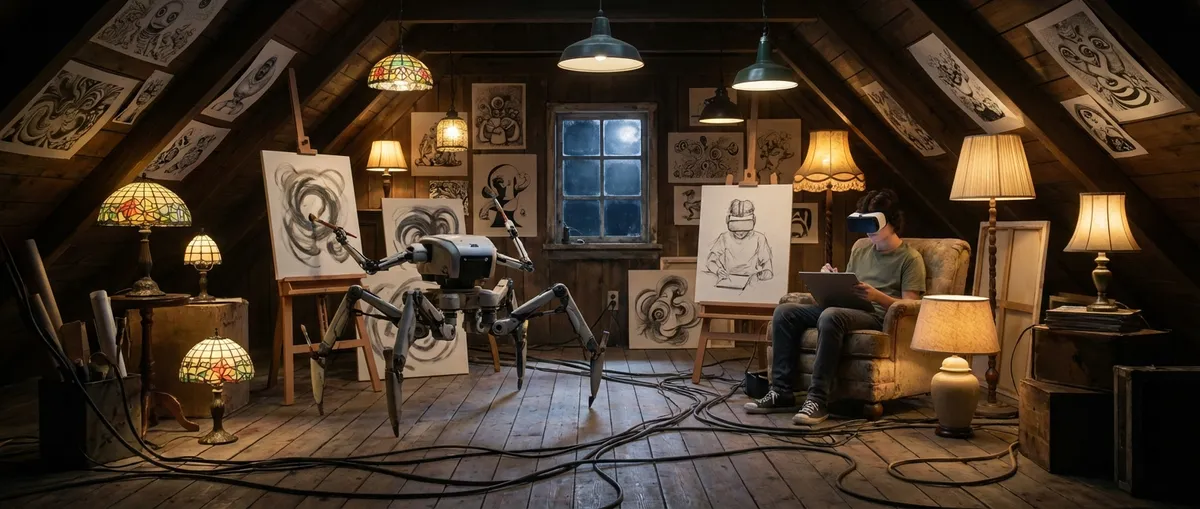
1. AI Isn’t Just Copying Art—It’s Remixing Style Like a DJ
Tools like DALL·E, Midjourney, and Stable Diffusion don’t just “steal” images; they learn patterns from billions of pictures and then generate something new based on your prompt.
Think of it less like tracing and more like a hyperactive DJ mashing up every visual style it’s ever seen: oil painting, anime, blueprint, vaporwave, all fused into a single prompt like “a cyberpunk pizza shop on Mars at sunrise.”
What’s wild is how fast this is evolving. Researchers are now building systems that can:
- Keep a consistent character across multiple images
- Blend multiple art styles on the fly (e.g., “Studio Ghibli x retro comic book”)
- Take a rough sketch you draw and turn it into a fully rendered scene
For tech enthusiasts, the interesting angle isn’t just “Pretty AI pictures.” It’s that visual experimentation is now practically free. Concept art, mood boards, UI mockups—things that once took hours now take minutes, and that changes how fast teams can iterate on ideas.
2. AI Music Is Getting Good Enough to Be Background Noise (in a Good Way)
AI can now generate full songs: melody, harmonies, lyrics, and even “vocals” that sound like specific singers (which is where a lot of legal and ethical drama comes in).
Under the hood, these systems are basically pattern-prediction machines for sound. But from the outside, they feel like a playlist generator that doesn’t need a music library—it just invents the tracks on demand.
What’s interesting isn’t just the novelty of “AI-made songs,” but the shift in how we might use music:
- Streamers and YouTubers can create custom, copyright-safe background tracks on the fly
- Game devs can generate adaptive soundtracks that change with the player’s actions
- Hobby musicians can prototype ideas by describing the vibe instead of knowing music theory
Is AI music going to replace your favorite artists? Unlikely. But it might quietly power a huge amount of “functional” audio—background music, ambient soundscapes, and generative soundtracks that respond to what you’re doing in real time.
3. AI Is Becoming the World’s Fastest Rookie Scientist
AI isn’t just writing essays or making art—it’s starting to help with actual science in ways that matter.
One of the biggest breakthroughs: protein folding. DeepMind’s AlphaFold predicted the 3D structure of almost every known protein, a job that would’ve taken human researchers decades (or just never happened at all). That data is now being used to:
- Speed up drug discovery
- Explore new treatments for diseases
- Understand how cells work at a much deeper level
And it doesn’t stop at biology. AI models are being used to:
- Design better batteries and new materials
- Simulate physics experiments that are too expensive or slow in real life
- Spot patterns in climate data that humans might miss
The key twist: AI isn’t “solving everything.” It’s more like the world’s fastest intern that can try a billion bad ideas overnight, then hand scientists a short list of the ones actually worth testing in the real world. It’s brute-force curiosity at machine speed.
4. AI Co-Pilots Are Quietly Changing How We Write and Code
If you’ve used tools like GitHub Copilot, ChatGPT, or any “smart compose” feature, you’ve already seen this: AI that sits beside you instead of in front of you.
For writing and coding, AI is becoming less of an “answer machine” and more of a suggestion engine:
- It finishes sentences, but also suggests entirely different phrasing or structure
- It writes boilerplate code, but also explains what a function is doing in plain language
- It can turn a rough brain dump into something that looks like a clean email, report, or script
The fascinating part for tech folks isn’t just productivity; it’s the change in workflow. Instead of:
Think → Type → Edit
It’s increasingly:
Think a little → Generate → Judge → Tweak
You become the editor, not the first drafter. That shift feels small, but it changes how quickly people are willing to experiment with ideas—because the cost of trying a new direction is basically one prompt and a few seconds.
5. AI Agents Are Starting to Use the Web Like Actual Users
The next wave isn’t just chatbots that answer questions—it’s AI “agents” that can actually do stuff on your behalf.
Instead of saying, “What are some flights to Tokyo?” and getting links, you might say:
“Find me a flight to Tokyo in late May, under $800, with a window seat, and book it using my usual airline if possible.”
Behind the scenes, an AI agent could:
- Open a browser or use APIs
- Compare multiple sites
- Fill in forms
- Double-check details
- Ask you only when it truly needs clarification
Early versions of this already exist in tools that let AI control browsers, operate desktop apps, or chain multiple actions together. They’re still clumsy and need tons of guardrails, but the direction is clear: AI that doesn’t just respond, but acts.
For tech enthusiasts, this raises fun questions:
- What happens when AI agents start talking to other AI agents online?
- How do we tell human traffic from automated-but-legit “assistant” traffic?
- Do we start designing websites and services with AI users in mind, the same way we optimize for mobile?
We’re basically at the “dumb but promising” Roomba stage for digital assistants: not fully reliable, but clearly going somewhere.
Conclusion
AI is no longer just “that thing in the cloud that makes recommendations slightly better.” It’s:
- Remixing art like a visual DJ
- Generating music that follows your vibe
- Helping scientists sift through impossible amounts of data
- Acting as a co-pilot for writing and coding
- Starting to navigate the web like a junior digital assistant
You don’t have to love every use case (or trust all of them), but ignoring this wave is like ignoring the early internet because you didn’t care about email. The interesting part isn’t any single tool—it’s how fast these capabilities are leaking into creative work, science, and everyday tasks.
If you’re into tech, this is a good moment to stop treating AI like a magic trick and start treating it like a weird new collaborator: not perfect, not human, but incredibly fast, relentlessly experimental, and surprisingly fun to push to its limits.
Sources
- DeepMind – AlphaFold Protein Structure Database - Official database showing how AI-predicted protein structures are shared with researchers worldwide
- OpenAI – DALL·E 3 Overview - Details on how text-to-image generation works and what the model is capable of
- GitHub – About GitHub Copilot - Overview of how AI is being used as a coding assistant for developers
- Google DeepMind – AlphaFold: A Solution to a 50-Year-Old Grand Challenge in Biology - Research paper explaining how AlphaFold predicts protein structures
- U.S. Copyright Office – Copyright Registration Guidance for Works Containing AI-Generated Material - Government guidance on how AI-generated content is treated under copyright law
Key Takeaway
The most important thing to remember from this article is that this information can change how you think about AI.