AI headlines usually sound like a movie trailer: “Robots will replace us!” “Machines are taking over!” Meanwhile, in real life, AI is quietly doing something way more interesting—it’s becoming a behind‑the‑scenes collaborator.
Instead of a sci‑fi villain or miracle cure‑all, modern AI is more like a super‑fast intern: great at patterns, not so great at judgment. And the most exciting stuff happens when humans and AI team up.
Let’s dig into five surprisingly cool ways that’s already happening—and why it matters if you care about where tech is actually going, not just the hype.
1. AI Is Getting Weirdly Good at “Second Opinions”
In medicine, law, cybersecurity, and even coding, AI is turning into the world’s most obsessive fact‑checker.
Doctors are using AI systems to scan X‑rays and CT scans for tiny signals our eyes might miss—like early signs of lung cancer or fractures on crowded images. The twist: AI isn’t replacing the radiologist; it’s sitting beside them like a supercharged reviewer. When both agree, confidence goes up. When they disagree, the human takes a closer look.
Same thing in security: AI engines analyze impossible amounts of network data, spotting patterns that might signal an attack. But humans still decide whether that “weird traffic spike” is a cyberattack or just your marketing team finally going viral.
AI is becoming less “answer machine” and more “Are you sure about that?” machine. Not very cinematic—but incredibly useful.
2. AI Is Becoming a Creative Sparring Partner, Not an Artist
We’ve all seen AI art, AI music, AI writing—but here’s the fun part: creators are increasingly using AI less as a generator and more as a brainstorming buddy.
Writers throw half‑formed plot ideas into an AI and ask for versions from different character angles. Designers sketch a rough idea, then use AI tools to explore color schemes, lighting, or variations they wouldn’t have thought of. Musicians feed in a melody line and ask an AI tool to experiment with rhythm or harmony.
The pattern: humans still set the direction, taste, and final call. AI just floods the room with options—good, bad, and absolutely cursed. That chaos can spark genuinely new ideas.
If old‑school creativity was “stare at a blank page,” AI‑assisted creativity is “curate from 200 weird drafts in 30 seconds.”
3. Your Devices Are Low‑Key Training on You (In Helpful Ways)
Everyone knows AI is trained on giant datasets, but the more interesting trend is hyper‑personalization—AI quietly adapting to you over time.
Your phone’s keyboard predicts your next word not just based on generic language, but how you personally write. Smart email clients guess which replies you’ll actually send. Recommendation systems are increasingly blending your history with real‑time behavior—what you pause on, what you skip immediately, what you replay twice.
On-device and privacy‑focused AI models are also getting better. That means more “training” stays on your hardware instead of being shipped off to a server somewhere, which is a pretty big deal for privacy and latency.
The tech twist: AI is shifting from “What do people like?” to “What does this specific human like right now?” Slightly creepy, very convenient, and absolutely the direction things are going.
4. AI Is Starting to Explain Itself (…Sort Of)
One of the biggest knocks on AI: it often acts like a black box. You feed in data, it spits out an answer, and you’re supposed to just trust it. That’s a problem in areas like healthcare, law, and finance, where “Because the algorithm said so” is not a valid explanation.
Enter “explainable AI” (XAI). The more an AI system affects real lives, the more pressure there is to show its work.
Modern systems are being designed to highlight why they made certain predictions. For example, a medical AI might flag specific regions in an image that led to its diagnosis. A credit-scoring model might identify which factors most influenced a loan decision.
Is it perfect transparency? No. But it’s a huge shift from blind trust toward “Here’s the reasoning, now you judge.” That keeps humans in control, which is kind of the whole point.
5. AI Is Being Treated Less Like Magic and More Like Infrastructure
At first, AI felt like a standalone “feature.” Now it’s sinking into the background, more like an extra layer baked into everything else.
You see this in productivity apps that auto-summarize meetings, email clients that suggest smarter replies, game engines that use AI for NPC behavior, design tools that suggest layouts, and customer support platforms that triage tickets before a human even sees them.
In other words, AI is slowly becoming the new “electricity” of software: you don’t buy “an AI product,” you buy a thing you need—and it just happens to have AI under the hood.
That’s big for developers and users. For devs, AI becomes just another building block. For everyone else, the question shifts from “Should I use AI?” to “Where is AI quietly doing work for me already—and do I trust it?”
Conclusion
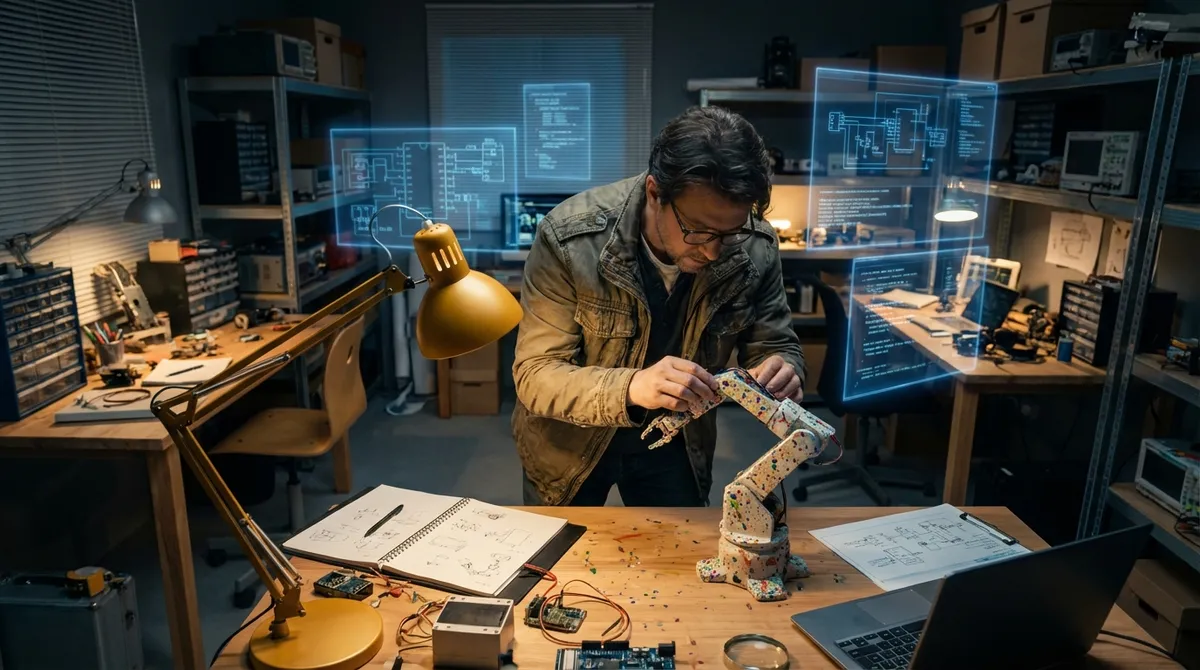
The most interesting AI stories aren’t about machines replacing humans. They’re about collaboration: humans handling nuance, values, and direction; AI handling volume, speed, and pattern‑spotting.
Right now, the real power move isn’t “Let AI do everything.” It’s “Let AI handle the grunt work so humans can focus on the parts that actually require being human.”
If you’re into tech, this is the moment to stop asking “Will AI take over?” and start asking “Where could AI be my co‑worker, co‑writer, or co‑pilot—and what do I still absolutely want a human mind on?”
Sources
- [World Health Organization – Ethics and Governance of Artificial Intelligence for Health](https://www.who.int/publications/i/item/9789240029200) – Covers how AI is being used in healthcare and why human oversight is essential
- [U.S. National Institute of Standards and Technology (NIST) – AI Risk Management Framework](https://www.nist.gov/itl/ai-risk-management-framework) – Explains how organizations are trying to make AI more trustworthy and explainable
- [Stanford HAI – AI Index Report](https://aiindex.stanford.edu/report/) – Annual deep dive into real-world AI adoption, trends, and impacts
- [MIT CSAIL – Human-AI Collaboration Research](https://www.csail.mit.edu/research/human-ai-collaboration) – Research projects focused on how humans and AI systems can effectively work together
- [Microsoft – Responsible AI Principles](https://www.microsoft.com/en-us/ai/responsible-ai) – Example of how a major tech company thinks about building AI that augments rather than replaces people
Key Takeaway
The most important thing to remember from this article is that this information can change how you think about AI.