Artificial intelligence isn’t just about chatbots and auto-complete anymore. Behind the buzzwords, AI is quietly learning a bunch of weirdly human skills—from drawing and coding to inventing games and helping scientists discover new materials. If you think “AI” just means “that thing that writes emails for me,” you’re missing the fun part.
Let’s walk through some of the most interesting ways AI is leveling up right now, in language that doesn’t require a PhD (or a headache).
1. AI Is Getting Weirdly Good at Inventing Stuff
We’re used to AI recognizing things: faces in photos, objects in a room, spam in your inbox. But now it’s getting good at inventing things that never existed before.
Modern “generative” models can:
- Propose new drug molecules that might stick to a disease-causing protein
- Suggest new alloys or battery materials that could be more efficient
- Design proteins that don’t exist in nature (and might help fight disease)
In drug discovery, this is a big deal. Normally, researchers might test thousands (or millions) of candidates in a long, expensive process. AI can narrow that down by predicting which molecules are most likely to work before anyone even mixes chemicals in a lab.
What’s wild: models like DeepMind’s AlphaFold changed protein science by predicting how proteins fold in 3D—basically a cheat code for biology that used to take months or years per protein. Now researchers can explore huge “what if” spaces that were completely impractical before.
AI still doesn’t magically understand biology like a human expert, but it’s becoming a brutally efficient idea generator—kind of like having a superhuman lab intern that never sleeps and tries millions of options in its head first.
2. AI Can Learn to Play Games Nobody Taught It
We’ve seen AI beat humans at chess, Go, and StarCraft. That’s already impressive. But the more interesting trend is what comes next: AI that learns to play games we never explicitly explained the rules for.
Some research uses open-ended environments—think digital playgrounds—where agents:
- Don’t get a rule book
- Just get rewards for survival or goals like “move faster” or “get to that point”
- Slowly stumble into strategies that look surprisingly creative
The result? You see behaviors that feel emergent, not programmed. Agents cooperate, compete, and sometimes exploit weird edge cases the designers didn’t even think about (speedrunning players will feel right at home with that energy).
This matters outside of gaming too. The same techniques can help:
- Robots learn how to move in unfamiliar spaces
- Self-driving systems learn safer driving strategies
- Logistics AI figure out better ways to route deliveries or manage power grids
We’re slowly moving from “AI that follows rules” toward “AI that figures out the rules by messing around and failing a lot,” which is basically how humans learn.
3. AI Is Becoming a Creative Partner, Not Just a Tool
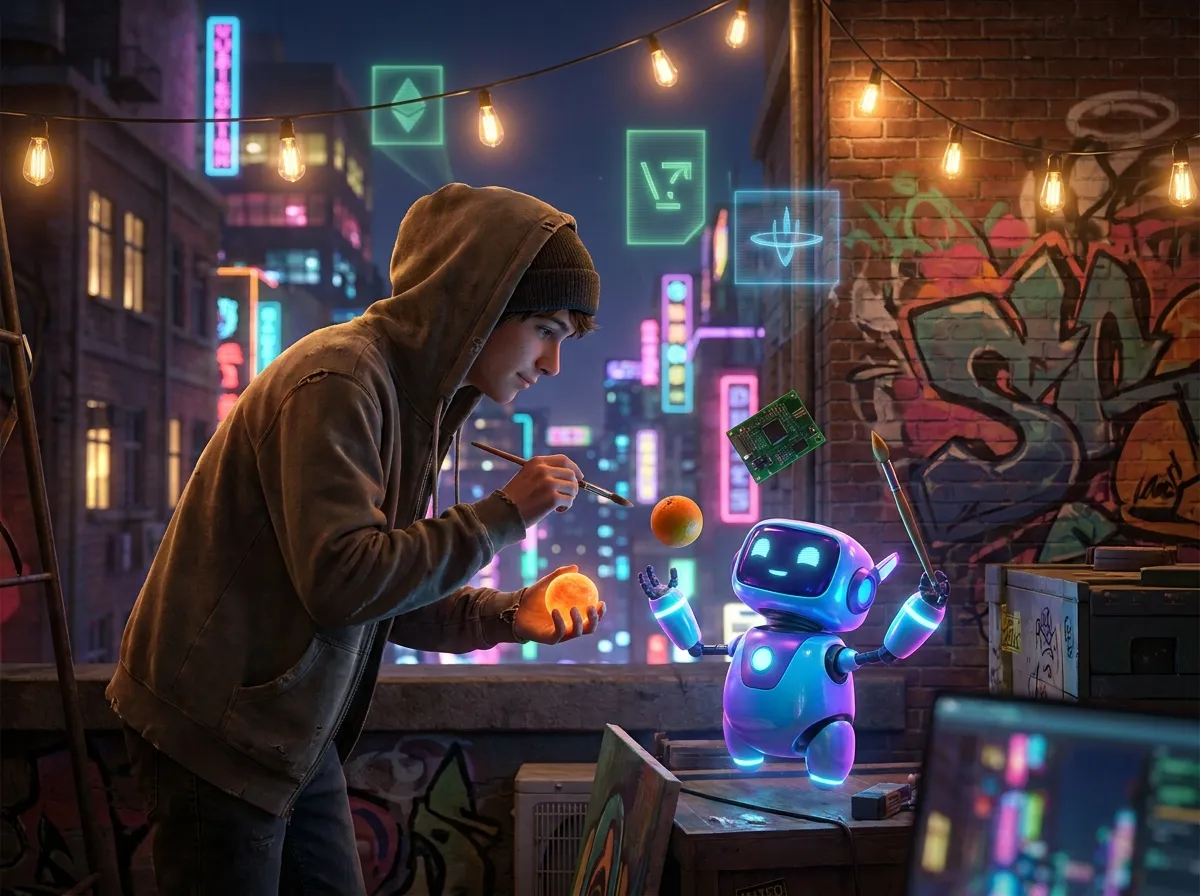
You’ve seen AI art and music by now, but the real shift is how creatives are starting to collaborate with these systems instead of just using them as a one-click generator.
People are using AI to:
- Brainstorm weird story premises or unexpected plot twists
- Create dozens of visual concepts quickly, then refine just the best ones
- Generate soundscapes, beats, or variations on a melody to explore new vibes
- Prototype comic panels, character designs, or motion graphics in hours instead of weeks
The interesting bit isn’t “AI can draw now.” It’s that creators can push the model, iterate on outputs, and steer a style. Prompting, tweaking, and mixing models becomes a new kind of artistry.
This flips the old narrative of “AI will replace artists.” In practice, what’s emerging is more like augmented creativity: humans set direction and taste, AI fills in grunt work and surprise options.
Is it perfect? Absolutely not—bias, copyright, and transparency are still huge issues. But as a creative playground, these tools are reshaping what a “solo” creator can pull off in a bedroom studio or on a laptop.
4. AI Is Learning to Explain (Sort of) What It’s Thinking
One of the biggest complaints about modern AI is that it’s a black box: it gives an answer, but not a reason. That’s a problem when the stakes are high—healthcare, hiring, loans, and more.
So there’s a big push toward “explainable AI,” where systems try to show:
- Which parts of an image led to a certain classification (like a tumor risk)
- Which words in a sentence triggered a prediction (like spam detection)
- How much different inputs affected the final score or answer
You’ll see tools that highlight text, heatmap images, or break down “this feature mattered 30%, this one 10%,” and so on. It’s not perfect mind-reading, but it’s better than a mysterious “because I said so” from a model.
For developers and researchers, this helps:
- Debug models when they latch onto the wrong signals (like background textures instead of actual objects)
- Reduce harmful bias by spotting patterns that discriminate unfairly
- Build trust with users who need to know why a decision was made
We’re still a long way from AI that can truly explain its “thought process” like a human, but the tools around interpretation are improving fast. It’s like adding a partial X-ray view to systems that used to be completely opaque.
5. Tiny AI Models Are Sneaking Onto Your Devices
Everyone talks about giant models with billions of parameters running in the cloud. But there’s another trend that matters just as much: tiny models that run directly on your phone, laptop, or even a microcontroller.
These smaller models:
- Handle things like wake word detection (“Hey Siri,” “OK Google”)
- Do on-device photo enhancement and noise reduction
- Translate speech offline
- Power smart features on earbuds, watches, and random “smart” devices
On-device AI has some huge perks:
- Privacy: your data doesn’t have to leave your device
- Speed: no round trip to a server = lower latency
- Reliability: it works even with flaky or no internet
- Efficiency: they’re optimized for low power and limited memory
Companies are now designing hardware just for this—neural engines in phones, AI accelerators in laptops, and specialized chips for wearables. At the same time, there’s a race to “shrink” models so they stay useful without needing a data center to run.
It’s not as flashy as giant cloud models that can write essays, but it’s the reason your gadgets are quietly getting smarter without melting your battery.
Conclusion
AI isn’t just one big monolithic “intelligence.” It’s a messy, fast-evolving toolkit that’s learning to invent, play, create, explain, and run on hardware that fits in your pocket.
If you’re a tech enthusiast, this is the fun moment: the systems are just good enough to be useful, but still weird enough to surprise you. Whether you’re into science, art, gaming, or hardware, AI is poking its head into your corner of tech—usually in more interesting ways than “write an email for me.”
The next few years won’t just be about bigger models. They’ll be about smarter uses: better collaboration with humans, more transparency, and more AI running where you actually are—on your desk, in your pocket, and eventually, in a lot of the objects around you.
Sources
- DeepMind – AlphaFold – Overview of how AlphaFold predicts protein structures and its impact on biology
- Nature: Generative Models for Drug Discovery – Research article on using generative AI to design new molecules for pharmaceuticals
- Stanford HAI – Explainable Artificial Intelligence – Introductory explanation of why explainability matters and current approaches
- NVIDIA: What Is Tiny Machine Learning (TinyML)? – Explains the trend of running small AI models on low-power devices
- Google AI Blog – On-Device Machine Learning – Discusses why and how Google runs ML models directly on phones and other devices
Key Takeaway
The most important thing to remember from this article is that this information can change how you think about AI.