AI isn’t just about chatbots, deepfakes, or robots stealing your job. Under the hood, it’s quietly learning a bunch of surprisingly creative, strange, and borderline sci‑fi skills that go way beyond “generate text” or “recognize cat.”
If you’re a tech enthusiast who thinks you’ve already seen all the AI hype, this is the fun stuff: the edge cases, the “wait, it can do that?” moments.
Let’s walk through five genuinely interesting AI abilities that show where things are really headed.
1. AI Can Read the “Vibes” of Your Surroundings
We’re used to AI recognizing objects in a photo: “That’s a dog. That’s a car. That’s a sandwich.” Cool, but basic. The next step is AI evaluating context and mood.
Newer systems can:
- Scan live video from cameras and guess how crowded a space is
- Estimate how stressed customers sound in support calls
- Read “sentiment” from images and posts (happy crowd vs. angry protest)
- Help stores analyze how people move through a space and where they get “stuck”
This kind of “vibe reading” is being used in smart cities, retail analytics, and customer service tools. It’s less about “what is this object?” and more about “what kind of situation is this?”—which is a huge leap in how software can react in real time.
It also raises the obvious big question: how comfortable are we with tech that can guess how we’re feeling just by watching and listening?
2. AI Is Getting Weirdly Good at Inventing Fake Worlds
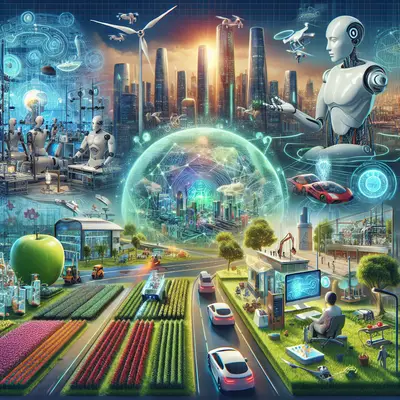
Game engines and film studios are starting to use AI not just to generate assets, but to invent entire environments on the fly.
Instead of designers hand‑crafting every detail, AI can:
- Generate unique city blocks, forests, or interiors from a simple prompt
- Fill in background characters and props with believable behavior
- Create multiple visual variations of the same world in seconds
This means a solo dev or tiny team can spin up rich, dynamic environments that used to require huge studios. Imagine a game where every new playthrough generates a fresh, coherent world that no one has seen before—terrain, buildings, background stories, all stitched together by models trained on massive datasets.
It’s not magic yet—human creators still need to guide, refine, and fix the rough edges—but AI is quickly becoming the world‑builder’s assistant that never sleeps.
3. AI Can “Hear” Images and “See” Audio (Cross‑Sense Skills)
One of the coolest shifts in AI lately is what’s called multimodal ability: models that can handle text, images, audio, and sometimes video in one brain.
That leads to some strange and powerful tricks:
- Give the AI an image and ask: “What sound would this scene make?” (busy street, quiet forest, noisy cafe)
- Feed it audio and ask: “Draw what you think is happening here.” (a crowd cheering, a dog barking, a train arriving)
- Show it a photo and ask for a mini story that matches the mood, not just what’s literally shown
For devs and creators, this opens doors to all sorts of tools: auto‑generated soundscapes for videos, accessibility features that narrate visual scenes more intelligently, and assistants that understand your content across formats instead of treating everything as disconnected files.
The long‑term direction is clear: we’re heading toward AI that interacts with the world more like humans do—through multiple senses at once.
4. AI Is Learning to Explain Why It Did Something (Sort Of)
Classic AI problem: the “black box.” It spits out an answer, and even the people who built it can’t easily explain why it made that decision.
That’s starting to change, at least in targeted ways. Newer systems are being trained (and sometimes forced) to show their work:
- Medical AI tools highlight the regions of an image that influenced a diagnosis
- Credit and lending models generate human‑readable reasons for approval or denial
- Safety‑focused AI can flag when it’s “not sure” instead of confidently hallucinating
This is less glamorous than AI art or generative video, but it’s crucial if we expect AI to make decisions about health, money, or safety. The goal isn’t perfect transparency (we’re not there yet), but useful transparency: enough explanation that humans can audit, override, or debug what the system did.
For tech folks, this is where “cool demo” AI turns into “I’d actually trust this in production” AI.
5. AI Is Becoming the “Glue” Between Your Devices
Most people think of AI as a feature inside a single app: the chatbot in your browser, the photo enhancer on your phone, the transcription tool in your meeting software.
The more interesting trend is AI acting as the glue that connects all of it:
- Assistants that can jump across apps and services: email, calendar, docs, chat, browser tabs
- Systems that watch your workflows and automatically chain actions together (receive file → summarize → file it → notify a teammate)
- Personal “orchestrators” that know what tools you use and can call them like APIs without you doing the wiring
Instead of every app trying to bolt on its own little AI, we’re heading toward AI layers that sit on top of everything you use and make them play nicely together. Less “smart app,” more “smart interface to all your stuff.”
For power users and tinkerers, that means way more flexibility—and way more incentive to think API‑first, automation‑friendly, and AI‑aware when building anything.
Conclusion
Underneath the headlines and hype cycles, AI is quietly picking up new skills that feel less like party tricks and more like the early pieces of a new computing layer.
It can read context, invent worlds, mix senses, explain (sometimes) what it’s doing, and glue together tools that were never designed to talk to each other. The individual tricks are fun, but the real shift is how these abilities stack: an AI that can see, hear, reason, explain, and orchestrate starts to look less like a single app and more like infrastructure.
If you’re into tech, this is the time to stop thinking of AI as just “that one tool” and start seeing it as a capability you can plug into almost anything you build.
Sources
- Stanford HAI – Multimodal AI Systems - Overview of multimodal AI and why combining text, image, and audio understanding is a big shift
- MIT Technology Review – AI’s Role in Smart Cities - Explains how AI analyzes environments and crowds in urban spaces
- NVIDIA – Generative AI for Virtual Worlds - Details how generative models are used to build 3D worlds and environments
- FDA – Artificial Intelligence and Machine Learning in Medical Devices - Discusses explainability, trust, and oversight for AI used in healthcare
- Microsoft – Copilot and AI Orchestration Across Apps - Shows how AI is being used as a layer across productivity tools and services
Key Takeaway
The most important thing to remember from this article is that this information can change how you think about AI.