AI used to feel like background tech—recommendation engines, spam filters, boring stuff under the hood. Now it’s showing up somewhere way more interesting: in the creative process. Music, film, code, design, writing—machines aren’t just crunching numbers; they’re helping people make things.
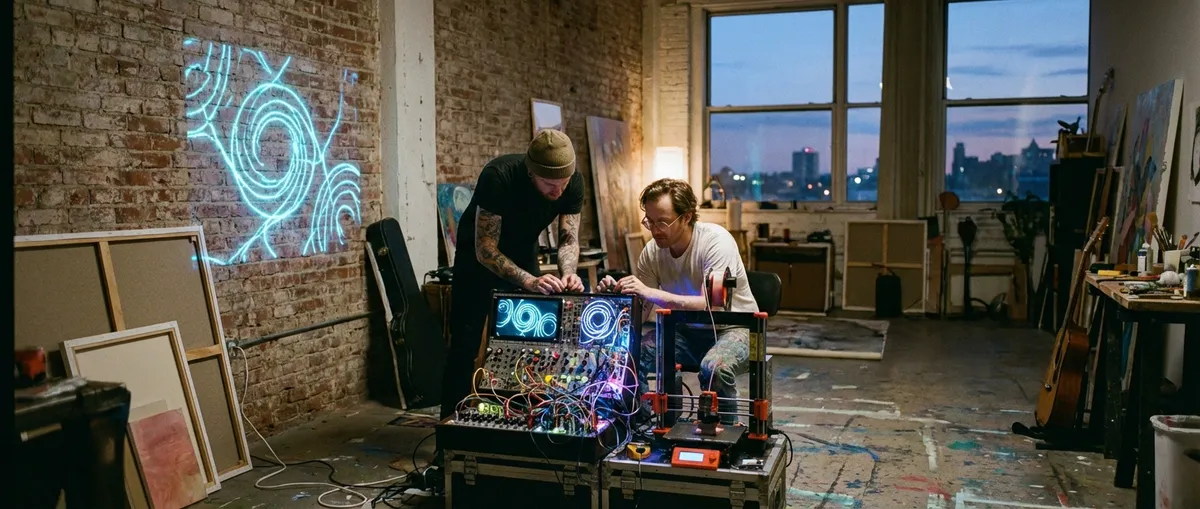
This isn’t “robots replacing artists.” It’s more like a strange new kind of collaboration: humans with taste + machines with endless patience. Let’s walk through some of the most interesting ways that’s actually playing out right now.
AI That Jams, Composes, and Remixes With You
Music is turning into a live lab for human–AI collaboration.
Today, tools like Google’s MusicLM experiments and Spotify’s AI DJ show how algorithms can listen, learn patterns, and then riff on them. AI can suggest chord progressions, generate backing tracks, or even remix stems in styles you’d never think to try.
What’s wild isn’t that AI can “make a song.” It’s that it can make hundreds of song ideas in minutes—then you, the human, decide what’s good. For producers, that means you can:
- Start a track from a rough text prompt or vibe (“moody, lo-fi, rainy night”)
- Generate variations on a melody you already wrote
- Quickly test different tempos, keys, and arrangements
This flips the old workflow. Instead of staring at a blank DAW session, you’re curating and shaping options. The creativity isn’t in typing a prompt—it’s in having the ear to say, “That’s the feel,” and then turning raw AI noise into something people want to put on repeat.
Scripts, Storyboards, and AI Co‑Writers
Hollywood and indie creators are both wrestling with the same thing: AI can “write,” but it can’t care. That’s exactly why it’s so interesting as a tool.
Modern language models can:
- Brainstorm plot twists and alternative endings
- Suggest character backstories or dialogue options
- Auto-generate loglines, synopses, and pitch material
- Rough out scenes that a human then rewrites
Some studios and solo creators are using AI to generate dozens of story directions, then cherry-picking the ones that feel fresh. It’s basically a never-tired writer’s room that throws out ideas without ego.
There’s also a visual side. AI storyboard tools can turn a script description into frames: camera angles, lighting moods, character positions. Directors can test scenes visually before a single shot is filmed.
The line everyone’s watching: “assist” vs “replace.” Current AI is great at patterns and style, but it still struggles with long-term consistency, emotional nuance, and cultural context. That’s where human storytellers stay firmly in charge.
AI as a Coding Sidekick (That Actually Reads the Docs)
If you write code, AI has probably already wandered into your workflow.
Tools like GitHub Copilot and similar assistants act like autocomplete on steroids. They don’t just finish variable names; they suggest entire functions, tests, or boilerplate code from a single comment. The magic trick is context: they read your existing file, sometimes your whole repo, and try to match your style and intent.
Tech enthusiasts are using this in surprisingly powerful ways:
- Turning simple English instructions into working code snippets
- Generating tests as they write features instead of after the fact
- Exploring unfamiliar frameworks or languages faster
- Refactoring old code while preserving logic
The interesting bit isn’t “AI writes code.” It’s “AI lets humans spend more time on architecture and problem-solving instead of syntax and glue code.” You still have to understand what’s going on—AI can hallucinate or overlook edge cases—but the ceiling on what a single developer can ship in a weekend just went way up.
Design on Fast‑Forward: From Idea to Mockup in Minutes
Design used to have a very linear flow: sketch, iterate, refine, then build. AI is smashing that timeline.
Modern generative tools can:
- Turn a rough text description into UI mockups or layout suggestions
- Transform a simple wireframe into polished design variants
- Instantly generate alternate color palettes, icon sets, or visual themes
- Auto-resize and reformat designs for different screens and platforms
For product teams, that means ideas don’t get stuck waiting for a perfect mockup. You can explore 10 directions in an afternoon, test them with users, and only polish the winners.
For solo makers and small startups, this is huge. You don’t need a full design team to get something that looks good enough to test. You still need taste—AI can’t tell you if your screen actually makes sense—but it can move you from “nothing” to “something real” a lot faster.
The Ethics Layer: Watermarks, Ownership, and “Who Made This?”
The most interesting part of AI right now might not be the tech—it’s the rules we’re rushing to build around it.
As AI-generated content floods the internet, several big questions are getting urgent:
- Attribution: If a model was trained on millions of images, who gets credit when it generates something new?
- Watermarking: Companies like OpenAI and Google are exploring ways to mark AI-generated images and audio so people can tell what’s synthetic.
- Regulation: The EU’s AI Act and U.S. policy discussions are trying to define “responsible AI” in law, not just marketing copy.
- Copyright: Courts are now seeing real cases about training data, fair use, and what counts as derivative work.
For creators, this is more than a legal sideshow. It affects how comfortable you feel using AI, whether your own work gets scraped into future models, and how audiences view authenticity.
The direction seems to be: AI is here to stay, but the ecosystem around consent, credit, and transparency is still under construction. If you’re a tech enthusiast, paying attention to this early is like being around for the first wave of internet copyright debates—except this time it’s about creativity itself.
Conclusion
AI in 2026 isn’t just living in research labs or buried inside recommendation engines. It’s in the studio, in the code editor, in the design tool, and in the writing app. Not as a replacement for humans, but as an amplification layer for people who already know what “good” feels like.
If you’re into tech, the real opportunity isn’t to let AI create for you—it’s to learn how to direct it. The best results still come from humans with taste, curiosity, and a clear point of view… backed up by a machine that never gets tired of trying new options.
Sources
- GitHub Copilot Documentation – Official overview of how AI-assisted coding works in real-world development tools
- Spotify AI DJ Announcement – Details on how Spotify is using AI to create personalized DJ-style experiences
- European Union AI Act Overview – EU policy framework shaping how AI is governed, including creative use cases
- Google Research: MusicLM – Google’s research project on generating music from text prompts and its limitations
- U.S. Copyright Office: Artificial Intelligence Initiative – Official guidance and ongoing policy work on copyright and AI-generated works
Key Takeaway
The most important thing to remember from this article is that this information can change how you think about AI.