AI isn’t just about chatbots that write emails or filters that fix your selfies anymore. Quietly, it’s turning into a kind of digital sidekick that learns your habits, predicts your moves, and sometimes understands you better than your friends do (which is… cool and a little creepy).
For tech enthusiasts, this isn’t just futuristic fluff. Under the hood, AI is changing how we design products, how we build tools, and how we even think about “using” technology at all. Here are five angles on AI’s evolution that are especially fun to nerd out about.
AI That Learns From You in Real Time
Old-school software did what it was told. Modern AI systems watch what you do and update themselves on the fly.
Your music app isn’t just following genres; it’s tracking when you skip songs, what you replay, and what you listen to at 2 a.m. versus during a workout. Recommendation engines now adapt in near real time, adjusting to subtle shifts in your behavior—like your sudden obsession with 90s Eurodance or dark ambient focus playlists.
Smartphone keyboards do something similar. They don’t just auto-correct; they personalize. They learn your slang, your inside jokes, your “lol” vs “haha” patterns, and even how likely you are to swear in a work email (hopefully: not very). Over time, they build a model of you as a writer.
The interesting part: this kind of personalization is starting to move on-device, meaning your data doesn’t always have to be sent to the cloud. That opens the door to AI that feels deeply personal without being a total privacy nightmare—if companies actually design it that way.
AI as a Creative Partner, Not a Replacement
We’ve moved past AI that just “finishes your sentence.” Now, it can throw wild ideas at you that you never would’ve considered.
Writers are using AI to brainstorm plot twists or alternate endings. Designers are generating visual concepts from a single sentence, then iterating on the weird ones. Musicians can feed AI a melody and get back variations in completely different styles—like “what if this lo-fi beat were a symphonic piece?”
What’s fun here is that AI is best when it’s wrong in interesting ways. It doesn’t have taste or context like a human, so it often mashes styles, references, and formats together. A human then steps in and says: “That’s terrible, that’s terrible… wait, that one’s actually brilliant.”
For tech enthusiasts, the shift is clear: the most powerful use of AI isn’t “push button, get content.” It’s “use AI as a chaos machine to explore more ideas than your brain alone could handle, then curate the good stuff.”
Your Devices Are Quietly Becoming a Shared Brain
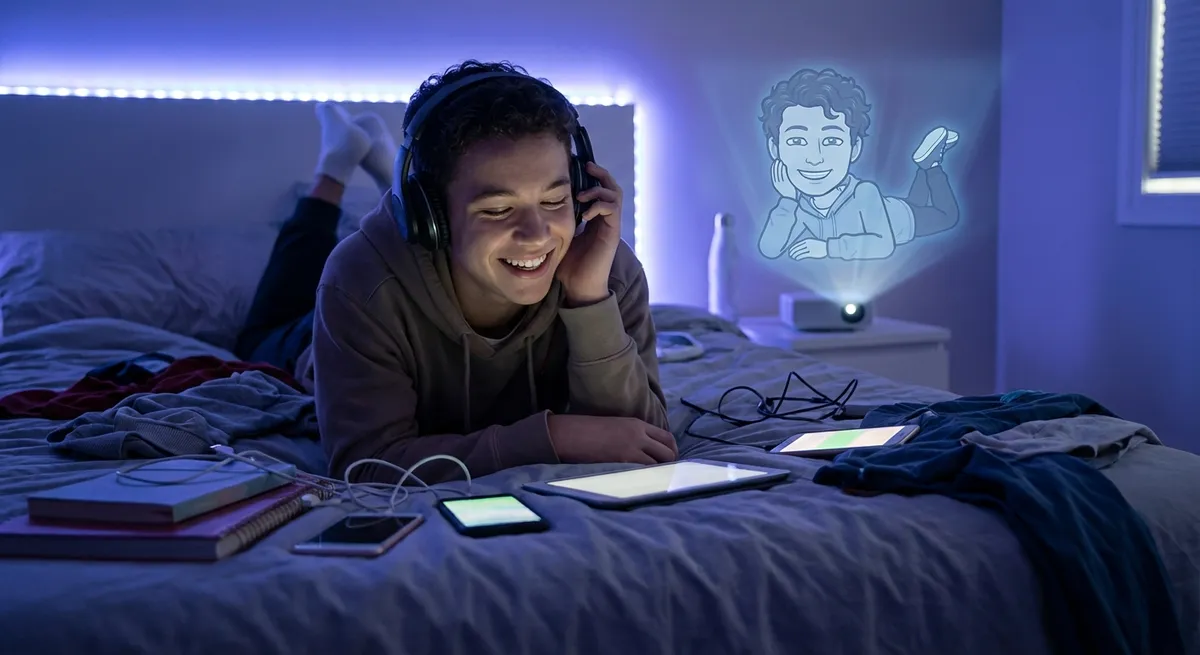
We already live in an ecosystem: phone, laptop, watch, headphones, TV, car. AI is starting to treat all of that as one continuous stream of you.
Think about it: your smartwatch knows your heart rate and sleep patterns. Your phone knows your location, your messaging habits, and your screen time. Your headphones know when you’re commuting or working out. AI systems can link these signals together to figure out context: you’re tired, it’s late, you’ve been doomscrolling, and your calendar says big meeting tomorrow.
Instead of each device acting alone, AI can coordinate across them. That could mean automatically toning down notifications, nudging you to sleep earlier, or switching your car’s navigation to a “no-tolls, less stressful” route when it senses you’re burned out.
Is this a little Black Mirror? Absolutely. But it also shows where consumer tech is headed: not more devices, but smarter coordination between them—powered by AI models trained on behavioral patterns instead of just raw data.
AI That Explains Why It Did Something
One of the coolest shifts happening now: AI is slowly learning to show its work.
A lot of AI systems used to feel like magic boxes. They spit out a recommendation—watch this movie, buy this thing, flag this transaction—but never explained why. That’s a problem if you care about trust, bias, or just understanding what’s going on.
Now, there’s heavy research going into “explainable AI.” That might mean:
- A loan system that shows which factors helped or hurt your application
- A medical AI that highlights which parts of an image look suspicious
- A recommendation engine that clearly says, “We suggested this because you liked X and Y”
For enthusiasts, the interesting bit is that this isn’t just a UI feature—it changes how the models are built. Systems have to be designed not only to get an answer, but to explain the path taken. That makes them easier to debug, easier to regulate, and a little less like mysterious oracles.
Local AI: Big Brains on Tiny Devices
The idea that serious AI needed massive servers is starting to crack. We’re now seeing impressive models running directly on phones, laptops, and even tiny edge devices.
Why this matters:
- Speed: No round trip to the cloud means instant responses.
- Privacy: Your data can stay on your device instead of being uploaded.
- Offline power: Translation, summarization, and image analysis can work with zero signal.
Chipmakers are building dedicated AI hardware into consumer devices. That’s why your phone can now magically clean up photos, remove background noise on calls, or transcribe speech in real time without melting.
For developers and tinkerers, local AI opens up a playground: imagine privacy-first apps that feel as smart as cloud-based ones, custom models tuned to your own data, or tiny home gadgets that don’t rely on a server to work. Instead of tech companies owning all the “smart,” more of that intelligence can literally live in your pocket—or your Raspberry Pi.
Conclusion
AI is drifting away from feeling like a feature and more like an extra layer of intelligence woven through everything we touch: our devices, our media, our creative tools, even our daily routines.
The most interesting part isn’t that AI can “do things for us.” It’s that it’s starting to adapt around us—learning our quirks, syncing across devices, explaining its choices, and living locally on hardware we actually own.
For tech enthusiasts, that’s the real story to watch: not just what AI can do in lab demos, but how it quietly reshapes the way we design, build, and live with technology day to day.
Sources
- [Google AI Blog – On-Device Machine Learning](https://ai.googleblog.com/2019/04/performing-on-device-ml-in-android.html) – Overview of how Google runs machine learning models directly on mobile devices
- [Microsoft – Responsible AI and Explainability](https://learn.microsoft.com/en-us/azure/machine-learning/concept-interpretability) – Explains concepts and tools behind explainable AI systems
- [MIT Technology Review – The Future of Creative AI](https://www.technologyreview.com/2023/01/26/1067436/creative-ai-artists-tools/) – Discusses how artists and creators are using AI as a collaborative tool
- [Stanford HAI – Personalized AI and Privacy](https://hai.stanford.edu/news) – News and research insights on human-centered, personalized artificial intelligence
- [OECD – AI in Society Report](https://www.oecd.org/publications/artificial-intelligence-in-society-eedfee77-en.htm) – High-level look at how AI systems are integrating into everyday life and devices
Key Takeaway
The most important thing to remember from this article is that this information can change how you think about AI.