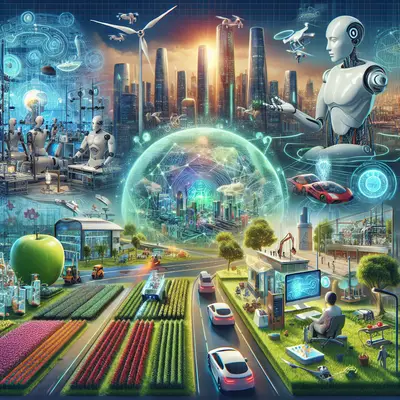
AI isn’t just living in research papers and sci‑fi movies anymore. It’s sneaking into your music, your map apps, your office tools, and even the background noise of the internet. A lot of this is happening quietly, which means you’re probably using AI a dozen times a day without realizing it.
Let’s dig into some of the more unexpected, actually-cool uses of AI that tech enthusiasts will appreciate—without getting lost in math or buzzwords.
1. AI Is Quietly Remixing Your World in Real Time
You’ve seen filters on Instagram or TikTok, but real-time AI is getting way more ambitious than puppy ears and fake freckles.
Today’s systems can:
- Change your background in video calls without a green screen
- Clean up your messy room virtually before you hit “Join Meeting”
- Translate your speech into another language while keeping your voice and lip sync
- Generate new frames in between video frames so gameplay and streaming feel smoother
This all happens fast enough that your brain just accepts it as normal. Under the hood, models are guessing what should be there, pixel by pixel, frame by frame. They’re not just detecting faces—they’re recreating new versions of reality on the fly.
For gamers and streamers, this means sharper visuals, smoother streams, and less bandwidth used. For everyone else, it means you can sit in pajamas in a disaster of a bedroom and still look like you have your life together on camera. AI is basically becoming a low-key special effects department running on your laptop or phone.
2. Your Voice Is Becoming a New Interface (Even When You Don’t Notice)
Voice assistants used to be a novelty—ask the weather, set a timer, maybe play a song. Now, AI-powered voice tools are getting weirdly good at handling messy, human speech.
Modern systems can:
- Pick your voice out of a noisy room
- Understand when you change your mind mid-sentence (“Play—no, actually call—wait, text Alex instead…”)
- Switch between languages in one conversation
- Imitate your tone to sound more “you” in generated messages
What makes this interesting isn’t just accuracy; it’s adaptation. Models are getting better at learning your habits: which playlist you mean when you say “play something chill,” which “Mom” you actually want to call, and which apps you usually mean when you say “open chat.”
The long-term shift: your voice becomes a primary way to drive your tech, even if you’re mostly a keyboard person. Devices can become more “ambient”—less tapping, more talking, more subtle listening. The UI starts to disappear, and what’s left is you just…asking for stuff.
3. AI Is Becoming a Creative Co-Worker, Not Just a Tool
You’ve probably seen AI-generated art or text, but the most interesting part isn’t that AI can make things—it’s how people are starting to work with it.
AI is now co-writing:
- Game levels and quests that adapt to your playstyle
- Background music that shifts based on mood or time of day
- Design drafts that explore dozens of variations from a single idea
- Code snippets that match your existing project’s style
The cool angle for tech enthusiasts: AI changes the shape of creative work. Instead of staring at a blank page or empty canvas, you can:
Throw rough ideas at an AI
Let it generate a flood of options
Curate, refine, and iterate
It’s less “AI replaces artists” and more “AI is the world’s most tireless, slightly chaotic intern.” It’s fast at exploring the space of what’s possible; humans are still better at deciding what’s actually good—or what feels right.
If you’re into hacking or tinkering, this opens up new workflows: prototype faster, test more variants, and push ugly drafts out of the way so you can focus on the fun parts.
4. AI Is Turning the Internet Into a Personalized Maze
Recommendation algorithms used to be simple: “People who liked X also liked Y.” Now, AI systems are building surprisingly detailed profiles of what keeps you scrolling.
They’re not just looking at:
- What you click
- What you like or share
They’re also quietly tracking things like:
- How long you hover over a post
- When you pause a video, replay, or skip
- What you mute or scroll past fast
All of that becomes input to a system that tweaks what you see next, second by second. Over time, your feed becomes less “the internet” and more “a custom tunnel built just for you.”
For tech enthusiasts, the interesting part is the feedback loop: your tiny actions shape the AI’s next move, which shapes your next actions, and so on. It’s a live experiment where you and the model are constantly training each other.
Upside: hyper-relevant content, better discovery, fewer totally random posts. Downside: echo chambers, weird rabbit holes, and the feeling that your time disappears somewhere between “just one more video” and “how is it 2 a.m. already?”
5. AI Is Learning to Explain Why It Did Something
Early AI systems were basically black boxes: throw in data, get an answer, hope for the best. That’s a problem when the stakes are high—like loans, hiring, medical decisions, or anything involving actual humans and consequences.
So a huge push right now is “explainable AI”—getting systems to justify their decisions in ways humans can understand. Modern models and tools can:
- Highlight the words or features that mattered most in a decision
- Show which examples in the training data were most influential
- Give human-readable reasons like “rejected due to insufficient income history”
For users, this matters because it’s a step toward accountability. If an AI denies you something important, you should be able to ask: “Why?” And if the answer is unfair or biased, that system can (in theory) be challenged or improved.
For tech enthusiasts, it’s interesting because it forces AI to grow up. It’s not enough to be accurate—you have to be legible. That’s pushing research into better models, better debugging tools, and more transparency around how AI systems are built and deployed.
Conclusion
AI isn’t just about “smart robots” or chatbots that write essays. It’s leaking into everything—voice, video, feeds, games, work tools—reshaping how we interact with tech in ways that feel increasingly natural and invisible.
The wild part isn’t that AI can do impressive tricks; it’s that it’s quietly changing the default settings of everyday life. How we discover content. How we create things. How we talk to devices. How decisions get made about us.
If you’re into tech, this is the moment to stop treating AI like a distant “field” and start treating it like part of your daily stack—something you can poke, bend, question, and build with.
Sources
- [Microsoft – What is Artificial Intelligence (AI)?](https://azure.microsoft.com/en-us/resources/cloud-computing-dictionary/what-is-artificial-intelligence) - Overview of how AI powers everyday applications, including speech and vision features
- [NVIDIA – What Is Generative AI?](https://www.nvidia.com/en-us/glossary/data-science/generative-ai) - Explains how generative models enable creative uses like image, video, and code generation
- [Stanford HAI – Explainable AI Resources](https://hai.stanford.edu/research/explainable-ai) - Research and discussion on making AI decisions more transparent and understandable
- [Pew Research Center – How Americans View AI](https://www.pewresearch.org/internet/2023/08/28/how-americans-view-artificial-intelligence/) - Data on how people perceive AI’s growing role in daily life and decision-making
- [MIT Technology Review – The Algorithm Issue (Recommender Systems)](https://www.technologyreview.com/2021/08/05/1030200/recommender-systems-explainer) - Deep dive into how recommendation algorithms shape what we see online
Key Takeaway
The most important thing to remember from this article is that this information can change how you think about AI.