AI used to sound like something you’d bump into on a spaceship. Now it’s hiding in your phone, your car, your fridge, your playlist… and somehow also in your Excel sheets at work.
This isn’t about killer robots or superintelligence. It’s about the weird, clever, and occasionally creepy ways AI is quietly reshaping normal life — even when you don’t notice it.
Below are five angles on modern AI that tech‑savvy people should absolutely have on their radar.
1. Your Data Doppelgänger: How AI Builds a “Shadow You”
Every time you scroll, tap, pause on a video, or abandon something in your cart, you’re training a model that doesn’t technically know your name but knows you scarily well.
This is often called a “user profile” or “inference model,” but the vibe is closer to a data doppelgänger — a statistical version of you that lives on servers and helps algorithms guess what you’ll do next.
Streaming apps use it to decide which show is “95% match.” Online stores use it to figure out what you’ll buy if they knock 10% off. Even news feeds use it to decide which headlines will keep you doomscrolling instead of sleeping like a responsible adult.
These systems don’t understand your feelings or beliefs the way humans do, but they’re very good at connecting dots:
- You liked three videos about mechanical keyboards → here’s a custom keyboard ad
- You paused on three travel clips and one airline sale → here’s a flight deal notification
- You binged late‑night horror movies → your recommendations suddenly got a lot darker
The wild part: often the model can guess things you never explicitly shared, like whether you’re likely to move soon, change jobs, or switch phones — just from patterns in your behavior.
It’s not psychic. It’s statistics, at scale. But when it’s done well, it feels like mind‑reading.
2. AI as Your Creative Co‑Pilot (Not Your Replacement)
For a while, the conversation around AI and creativity was all “robots will take your job” and not enough “robots might just be your nerdy assistant.” The reality right now is much more co‑pilot than overlord.
Writers use AI to outline articles, brainstorm headlines, or rephrase awkward sentences. Developers let AI autocomplete chunks of code or suggest bug fixes. Designers test color palettes or logo variations with AI tools before they open their “real” software.
This co‑pilot pattern has a few interesting side effects:
- Idea generation gets cheaper. You can explore ten bad ideas to get to one good one without burning a whole afternoon.
- Non‑experts get a boost. You don’t have to be a pro video editor to get something watchable when AI helps with cuts, captions, and audio cleanup.
- Experts move up a level. Less time on grunt work, more time on taste, direction, and actual judgment.
- AI helps sketch
- Humans still decide what’s actually good
There are legitimate concerns: copyright, deepfakes, and the ethics of training AI on massive creative datasets. But the day‑to‑day reality for a lot of people is:
Think of AI like a super fast but clueless intern. It will eagerly generate a hundred versions of something. You’re still the one who has to say, “No, that’s ugly, try again.”
3. When AI Hits the Real World, Physics Fights Back
AI looks magical on a website demo. Put it in the real world, and physics immediately starts punching it in the face.
Self‑driving cars, warehouse robots, delivery drones — they all rely on AI, but also have to deal with:
- Random weather
- Bad lighting
- Weird edge cases (like a human in a dinosaur costume on a scooter)
In simulation, a car sees a clear 2D lane and a predictable cyclist. In reality, there’s glare, rain on the camera, someone jaywalking with a dog, plus a construction zone nobody planned for. This is where robustness matters: can the AI not only recognize cats and dogs, but also “vaguely cat‑shaped blob in fog at night”?
What’s fascinating is how much progress has come from combining AI with old‑school rules:
- Classic “if this, then that” safety checks
- Redundancy across sensors (camera + radar + lidar)
- Hardcoded limits when the system isn’t confident
The takeaway: AI by itself isn’t enough to handle the chaos of reality. The most advanced systems look less like “pure AI” and more like a layered stack of smart guesses, strict rules, and fail‑safes.
The next time you see a robot doing something simple in a busy environment — like stacking boxes or weaving through people — remember how brittle these systems used to be. Just getting a robot to not fall on its face for ten minutes used to be a research milestone.
4. AI Is Getting Weirdly Good at Reading Stuff Humans Can’t See
AI doesn’t just recognize faces and cats anymore. It’s getting weirdly good at picking up signals we’re terrible at noticing — in health, security, and even boring business data.
Some examples that feel a little sci‑fi:
- Health monitoring: AI can analyze tiny variations in your voice or cough to flag risks for conditions like Parkinson’s or respiratory illness — long before you’d notice anything.
- Medical imaging: AI models can spot faint patterns in scans (X‑rays, MRIs) that radiologists might miss, especially in early‑stage disease.
- Fraud detection: In finance, AI can catch subtle transaction patterns that look harmless one by one but sketchy in aggregate.
None of this makes human experts obsolete. It does change their job from “find the needle” to “check if this AI‑highlighted spike is actually a needle or just noise.”
There’s a catch: if the AI is a black box, even experts may not fully understand why it flagged something. That’s why there’s a big push for “explainable AI” — systems that can show which features or patterns drove a decision.
The upside is huge: earlier interventions, fewer misses, better detection of rare events. The downside is that over‑trusting a model that’s wrong 1% of the time can still hurt real people. So the interesting frontier isn’t just better AI; it’s better partnership between humans and models.
5. The New Power Move: Owning the “Boring” AI
It’s fun to talk about flashy AI — image generators, chatbots, robot dogs. But some of the most powerful shifts are happening in places that look painfully boring from the outside: spreadsheets, logistics, back‑office tools, and internal dashboards.
Companies are quietly using AI to:
- Predict which part in a factory is likely to fail next
- Automatically sort thousands of support tickets by urgency and topic
- Optimize delivery routes in real time based on traffic and weather
- Scan contracts for weird clauses before anyone signs them
Most people never see these systems directly. They just notice that their package magically arrives faster, their support ticket gets answered quicker, or their refund appears without a fight.
For tech enthusiasts, this “boring AI” is where a lot of future jobs, startups, and innovation live: not inventing something visibly futuristic, but making existing processes way less dumb.
If you can:
- Understand a messy workflow
- Spot where AI could take over the repetitive, pattern‑based parts
- Keep humans in the loop for judgment calls
…you’re not just “using AI.” You’re designing how work itself changes. That’s a big deal, even if it doesn’t look cool on a TED Talk slide.
Conclusion
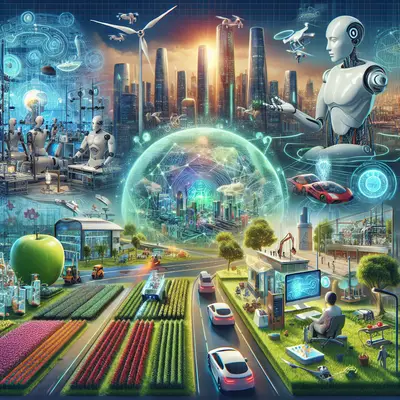
AI right now isn’t one monolithic brain taking over everything. It’s a toolkit sneaking into all the cracks of daily life: powering your recommendations, co‑writing your drafts, nudging your commute, optimizing deliveries, and quietly scanning your medical images.
For tech enthusiasts, the interesting questions aren’t just “How smart will AI get?” but:
- Where do we want AI to help, and where do we not want shortcuts?
- How do we stay in charge of systems that know our habits better than we do?
- What can we build when “getting a decent first draft” — of text, code, video, or an idea — is almost free?
We’re past the stage where AI is a futuristic buzzword. It’s here, woven into the infrastructure of everyday life. The fun (and responsibility) now is in deciding what we do with it.
Sources
- Stanford University – AI Index Report - Annual report tracking global AI trends, capabilities, and real‑world deployment
- MIT Technology Review – How AI is changing creativity - Overview of how generative AI tools are affecting creative work and workflows
- U.S. National Institute of Standards and Technology (NIST) – AI Risk Management Framework - Guidance on building and deploying AI systems responsibly in real‑world settings
- Nature – Artificial intelligence in medicine: applications, risks, and ethics - Research review on how AI is used in healthcare and what challenges it creates
- McKinsey Global Institute – The economic potential of generative AI - Analysis of how AI is transforming productivity and “boring” business processes
Key Takeaway
The most important thing to remember from this article is that this information can change how you think about AI.